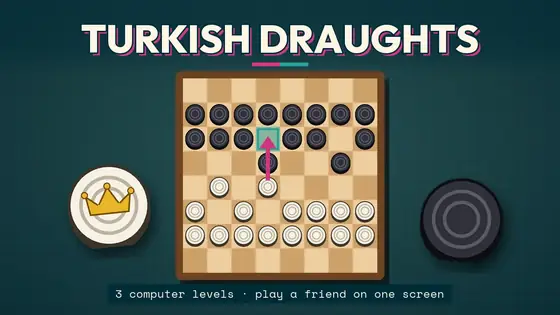
Turkish draughts is the checkers game played in Turkey under the name dama. It looks like checkers at first, but the pieces move straight rather than diagonally, all 64 squares are in use, and a king can fly across the board. On this page you can play Turkish draughts free, with no download and no sign-up, against the computer at three levels or against a friend on the same phone or computer.
Play Turkish draughts vs computer or a friend
Above the board is the Opponent setting:
- Computer: You play White and the computer plays Black. Choose Easy, Medium or Hard under Difficulty. Start with Easy while you learn the capture rules, then move up.
- Friend: Two players take turns on one screen. The board shows whose turn it is.
White always moves first. The game saves as you play, so if you close the page you continue from the same position at the same level.
Turkish draughts board and setup
The board is 8 x 8 and the colors of the squares don’t matter, because pieces stand on every square. Each player has 16 men, placed on the second and third rows from their side. The back row starts empty. Seen from White’s side:
| Row | At the start |
|---|---|
| 8 (Black’s back row) | empty |
| 7 | 8 black men |
| 6 | 8 black men |
| 5 | empty |
| 4 | empty |
| 3 | 8 white men |
| 2 | 8 white men |
| 1 (White’s back row) | empty |
The empty back row matters: an enemy man that reaches it becomes a king, so it is both your last line of defense and your opponent’s target.
Turkish draughts rules
How men move
A man moves one square forward, left or right. It never moves backward or diagonally. Tap one of your pieces and the squares it can reach appear; then tap the square you want.
Capturing
If an enemy piece stands directly in front of or beside your man and the square behind it is empty, you jump over it and remove it. Men capture forward and sideways, never backward.
The capture rules are strict:
- Capture is mandatory. If any capture is available, you cannot make a quiet move. The screen reminds you with Capture is mandatory.
- Take the maximum. If several capture sequences exist, you must play the one that takes the most pieces. A man and a king each count as one.
- A chain is one move. If you can capture again from the landing square, you keep going in the same move.
- Captured pieces leave at once. So later in a chain you may cross a square you already passed through.
If two capture routes end on the same square, tap the squares of the route you want in order to choose it.
Becoming a king
A man that ends its move on the opponent’s back row becomes a king and shows a crown. If a man touches the back row in the middle of a capture chain and keeps capturing, it finishes the move as a man; it has to stop on that row to be crowned.
How the king moves
The king flies: it moves any number of empty squares forward, backward or sideways. It can capture an enemy piece at a distance as long as the squares in between are empty, and land on any empty square beyond it. In a chain it may turn 90 degrees, but it cannot turn back the way it came.
How the game ends
| Situation | Result |
|---|---|
| You captured all your opponent’s pieces | You win |
| Your opponent has no legal move on their turn | You win |
| 40 moves on each side with no capture and no man moving | Draw |
| The same position appears for the third time, same player to move | Draw |
Being blocked usually happens with pieces still on the board: men hemmed in by their own and enemy pieces, with no king to help, leave a player with nothing to play. The 40-move rule mostly applies in endings where only kings are left wandering.
A forced capture example
Name the columns a to h from left to right and the rows 1 to 8 from bottom to top.
- Your white man is on d4. Black has men on d5 (with d6 empty), e4 (with f4 empty) and f5 (with f6 empty).
- Capturing forward, d4 takes d5 and lands on d6: one piece.
- Capturing sideways, d4 takes e4 and lands on f4, then takes f5 and lands on f6: two pieces.
You may not choose the first route. The two-piece route is compulsory, and the game shows only that move. This is why offering a piece can be a weapon: your opponent must take it, and you decide where their piece ends up.
Turkish draughts vs international checkers
Most draughts games, including English checkers and international draughts, use only the dark squares and diagonal moves. Turkish draughts moves orthogonally, uses every square and gives each side 16 pieces. Players coming from another variant are usually surprised by two things: the king’s long-range capture, and the rule that you must take the most pieces available.
The computer levels
The computer looks ahead by searching moves and replies. Easy looks two moves ahead (one for each side) and plays a random legal move about a third of the time. Medium looks up to four moves ahead and Hard up to six, always choosing the best result it finds, and every level keeps searching when a capture is still pending. All levels follow the same mandatory capture rules you do.
Hint shows a good move in the current position. Undo takes back your last move; against the computer its reply is taken back too. New game resets the board.
Turkish draughts strategy
- Count your opponent’s captures before you move. Since capturing is forced, a piece you give away can drag an enemy man onto the square you want and open a longer chain for you.
- Keep your men side by side. A man with a friendly piece next to it cannot be captured from that side, because there is no empty square behind it.
- Don’t run ahead alone. A lone man gets surrounded from both sides. Advance on a wide front.
- The first king often decides the game. A king crosses the board in one move, so stop enemy men approaching your back row early.
- Don’t leave your back row too soon. Push everything forward and an enemy man may slip behind you and crown.
For a game with dice on a board, try backgammon. For another thinking game with no luck at all, play mangala, the Turkish mancala; both also work for two players on one device. See all of them on the Turkish games page.
Frequently asked questions
What is Turkish draughts?
Turkish draughts, called dama in Turkey, is a checkers game on an 8x8 board where pieces move straight forward or sideways instead of diagonally. All 64 squares are used and each player has 16 pieces.
How is the board set up in Turkish draughts?
Each player places 16 men on the second and third rows nearest to them, eight on each row. The back row and the two middle rows start empty.
Is capturing mandatory in Turkish draughts?
Yes. If you can capture, you must, and you must take the sequence that captures the most pieces. A man and a king both count as one piece. A chain of captures is a single move.
How does a king move in Turkish draughts?
A king flies: it moves any number of empty squares forward, backward or sideways. It can capture a piece at a distance if the squares between are empty and land on any empty square beyond it. In a chain it may turn 90 degrees but not reverse direction.
Can a man capture backwards?
No. A man moves and captures only forward and sideways. Capturing backwards is something only a king can do.
How does a game of Turkish draughts end?
You win when your opponent has no pieces left or no legal move on their turn. The game is drawn if 40 moves pass on each side with no capture and no man moving, or if the same position appears for the third time with the same player to move.
Can I play Turkish draughts with a friend?
Yes, on the same device. Set Opponent to Friend and you take turns on one screen, one playing White and one Black. There is no online play with someone on another device.
 Okey
 101 Okey
 Batak
 Pishti
 King Card Game
 Sixty-Six (66)