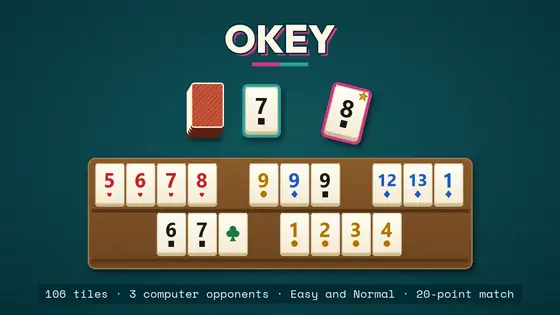
Okey is a Turkish rummy tile game for four players. You build runs and sets on a rack, and the first player to arrange 14 tiles into valid groups and discard the 15th wins the hand. Here you can play okey free in the browser against three computer players, with nothing to install. The rules below are the ones this version uses.
How to play okey
Four seats sit around the table: you are at the bottom, and the computer players sit to your right, across and to your left. Play moves counterclockwise, so the player on your right goes after you. A hand runs like this:
- The tiles are dealt and one tile is turned face up as the indicator. It tells you which tile is the okey (joker) for this hand.
- The dealer starts with 15 tiles, so the dealer opens by discarding one tile without drawing.
- On your turn you first take one tile: either draw from the face-down pile in the middle or pick up the tile the player on your left just threw.
- Then you throw one tile. Select it and press Discard, or drag it to the discard box in the bottom-right corner of the table. The player on your right may pick up what you throw.
- When your 14 tiles form runs and sets, throw the 15th with Finish to win the hand. If one of your tiles can finish, the game lights it up in green. A tile thrown with Discard never ends the hand; you have to press Finish.
Your rack has two rows: 10 slots per row on a phone, 13 on a wide screen. Drag tiles to rearrange them, or tap a tile and then another slot; tapping a filled slot swaps the two tiles. Sort runs groups finished runs and lines up the rest by color and number, while Sort pairs puts identical tiles next to each other. On a keyboard, the arrow keys move between slots, D draws, T takes the discard, A discards and F finishes.
The Difficulty menu sets how the computer players play. Easy players only pick up a discard when it lets them finish and sometimes throw away a useful tile. Normal players pick up discards they can use and avoid feeding the color the next player is collecting. The match is saved in your browser, so you can close the page and carry on later; New match resets everyone to 20 points.
Okey tiles: what is in the set
| Tiles | Count |
|---|---|
| Yellow 1-13, two of each | 26 |
| Blue 1-13, two of each | 26 |
| Black 1-13, two of each | 26 |
| Red 1-13, two of each | 26 |
| False jokers (no number) | 2 |
| Total | 106 |
Every tile exists exactly twice, and that matters. Once both copies of a tile have been thrown, nobody can get it any more except through a joker.
The deal: the dealer gets 15 tiles, the other three get 14 each (57 tiles in total), one tile becomes the indicator and 48 tiles stay face down. The dealer seat moves one place each hand. If the pile runs out and nobody has finished, the hand is a draw and nobody loses points.
The indicator and the okey joker
The okey is the tile one number higher than the indicator, in the same color. There is no 14, so if the indicator is a 13, the okey is the 1 of that color.
| Indicator | Okey for this hand |
|---|---|
| Red 5 | Red 6 |
| Blue 12 | Blue 13 |
| Black 13 | Black 1 |
| Yellow 1 | Yellow 2 |
Both copies of the okey are wild and can stand in for any tile; on your rack they carry a small gold star. The two false jokers are not wild. They stand for the okey tile itself: with a blue 12 indicator, the two blue 13s are wild and the false jokers play as plain blue 13s.
If you were dealt the twin of the indicator (same color, same number), you get a small bonus. On your first turn a Show indicator button appears. Press it before you draw (before your first discard if you are the dealer) and the other three players lose 1 point each. Only one player can do this per hand, and the chance is gone after your first turn.
Runs, sets and pairs
To finish, your 14 tiles must be split into groups of two kinds:
- Run: three or more consecutive numbers in one color, such as yellow 3-4-5 or red 9-10-11-12. 12-13-1 is allowed, 13-1-2 is not.
- Set: the same number in three or four different colors, such as blue 7, black 7, red 7. Two tiles of the same color can’t be in one set.
There is a second way out: seven pairs. Seven pairs of identical tiles (same color, same number) also finish the hand, and the okey can pair with anything.
Okey scoring
Everyone starts the match with 20 points. When a hand ends, points come off the three players who did not finish:
| How the hand was finished | Each of the other three players |
|---|---|
| Runs and sets | loses 2 points |
| Discarding the okey as the last tile | loses 4 points |
| Seven pairs | loses 4 points |
| Seven pairs with the okey as the last tile | loses 8 points |
| Indicator shown (first turn) | loses 1 point |
As soon as anyone’s score hits 0, the match ends and the player with the most points left wins. House scoring varies between tables; these are the numbers this game uses.
How long a game takes
We ran the game’s own rules code with four Normal computer players for 100 matches (931 hands, fixed random seed 2026). A match lasted 9.3 hands on average, and a hand took about 31 discards in total, so roughly 8 turns per player. The indicator’s twin was shown in 53% of hands, which fits the math: 57 of the 105 non-indicator tiles are dealt, so there is about a 54% chance its twin lands on someone’s rack. Only 1.6% of hands ended with an empty pile, and none with an okey discard, because the computer players never throw the okey. Hands with people at the table may run a little longer.
Okey strategy tips
Save the okey for the finish. It is your most flexible tile and also the one that doubles the penalty. Try to build a hand where the okey is the spare tile, then throw it last.
Throw loose tiles first. A lone black 11 with nothing near it is worth far less than a blue 5-6 that can become a run with a 4 or a 7.
Count the discards. Each tile has one twin. If both red 9s have been thrown, only a joker can fill the gap in red 8-10, so stop waiting for it.
Don’t feed the player on your right. They see your discard first. If they just picked up a yellow 10, a yellow 9 or 11 from you is a gift.
Decide early on pairs. With five or more pairs in your opening tiles, going for seven pairs makes sense and costs the others 4 points, but that opening is rare: fewer than 1 in 1,000 deals. With three or four pairs it usually wastes turns.
For more, with numbers from 20,000 hands between the computer players, read our okey tips and strategy guide.
If you like the tiles but want a longer game where melds go on the table, try 101 Okey. For a quicker tile game where you match ends instead of building sets, play dominoes against the computer. More classics are on the Turkish games page.
Frequently asked questions
How many tiles are in an okey set and how many does each player get?
106. The numbers 1 to 13 are printed twice in each of four colors (yellow, blue, black and red), which makes 104 tiles, plus two false jokers. The dealer gets 15 tiles, the other three players get 14 each, one tile is turned face up as the indicator and the remaining 48 stay face down in the middle.
What is the okey tile?
The okey is the tile one number above the indicator in the same color. If the indicator is black 7, both black 8s are okeys for that hand and work as wild jokers. If the indicator is a 13, the okey is the 1 of that color.
Can a run go 13-1-2 in okey?
No. A 1 may follow a 13, so 12-13-1 is a valid run, but nothing may follow the 1. 13-1-2 does not count.
How is okey scored?
In this version everyone starts the match with 20 points. When someone finishes a hand, each of the other three loses 2 points for a normal finish, 4 for finishing by discarding the okey or with seven pairs, and 8 for seven pairs with the okey as the last tile. The match ends when anyone reaches 0; the player with the most points left wins.
Can I play okey with friends or with 2 players here?
No. Okey is a four-player game, and here the table is always you plus three computer players. There is no two-player mode and no online play with friends.
Do the computer players see my tiles?
No. They only know the tiles that have been placed face up on the table: the indicator and the discards.
Do I need to download anything or pay?
No. Okey opens in the browser on phones and computers, with no sign-up. There is no money, no chips to buy and no prizes; points only count inside the match. Once the page has loaded, the game keeps running even if your connection drops.
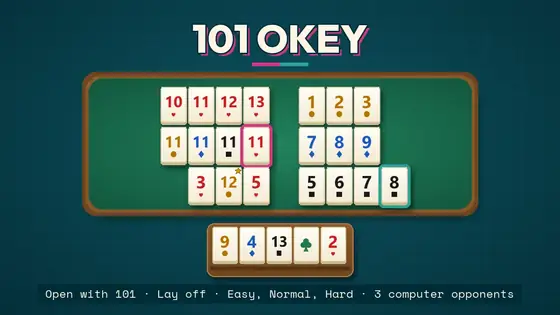 101 Okey
 Batak
 Pishti
 King Card Game
 Sixty-Six (66)
 Old Maid