Okey Tips and Strategy: How to Win More Hands
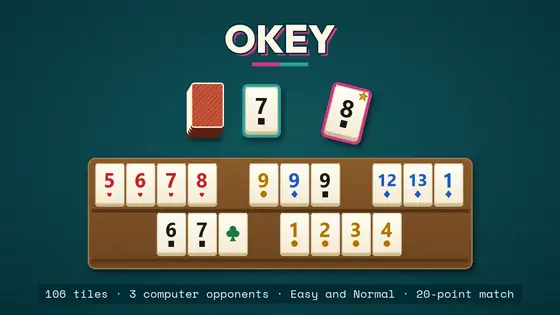
Okey is won by the first player who arranges 14 tiles into runs and sets and throws the 15th. With four players at the table, you should expect to win about one hand in four; good play is what moves you above that. This guide collects okey tips that we could check against the game itself. We played 20,000 hands between four computer players using the engine of our free okey game, dealt 100,000 opening hands, and counted how often each kind of start led to a win. The rules recap stays short: the game page explains the full okey rules, tiles and scoring.
A quick recap of the rules that matter
The set has 106 tiles: 1 to 13 twice in yellow, blue, black and red, plus two false jokers. The dealer gets 15 tiles, everyone else 14, one tile is turned up as the Indicator and 48 stay in the Pile. The tile one number above the indicator, in the same colour, is the okey (joker) for that hand.
On your turn you take one tile, either from the pile or the tile the player on your left just threw (Take), then throw one with Discard. When your 14 tiles form groups, you throw the last one with Finish. A run is three or more consecutive numbers in one colour (12-13-1 counts, 13-1-2 doesn’t). A set is one number in three or four different colours. Seven identical pairs also finish.
In our test a hand lasted 32.3 discards on average, about 8 turns per player, and only 2.0% of hands ran the pile dry. That is not many turns, so every tile you keep has to earn its place.
Tip 1: the okey is worth more than anything else you are dealt
A real okey can stand in for any tile, so it closes a gap that no other tile can. The numbers show how much that matters. With 105 tiles left after the indicator and exactly two okeys among them, a 14-tile hand holds:
- no okey 75.0% of the time,
- one okey 23.3% of the time,
- both okeys 1.7% of the time.
Those are exact counts. Then we checked how often each seat won.
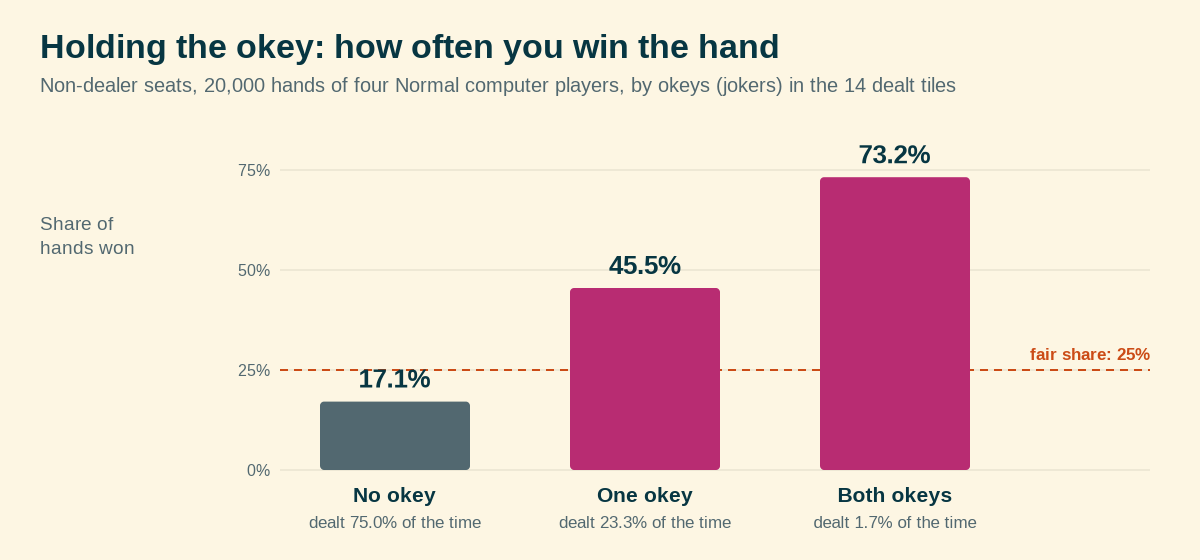
A seat holding one okey won 45.5% of hands, close to double the fair share. Without one, it won 17.1%. Two practical points follow:
- Never discard the okey mid-hand. It goes to the player on your right, who may take it.
- Don’t lock it in early. Keep it loose on the rack until you see which gap is hardest to fill. Our engine searches every arrangement and uses a real tile wherever one fits, keeping the okey free; that is the right habit for a person too.
The okey also doubles your reward if you keep it to the end. Finishing by discarding the okey costs every opponent 4 points instead of 2. To do that, your other 14 tiles must be complete on their own. If you are one tile away and already hold the okey, waiting a turn or two for a natural tile can pay, but don’t wait if the pile is getting short. Our computer players almost never manage it: the okey was the finishing tile in under 0.1% of the 20,000 hands, because they finish as soon as they can and rarely hold 14 complete tiles without the okey.
Tip 2: judge your opening tiles by melds, not pairs
Press Sort runs right after the deal and count the tiles that land in finished runs and sets. In 20,000 of our deals the average was 3.8, and one hand in five (20.2%) had none.
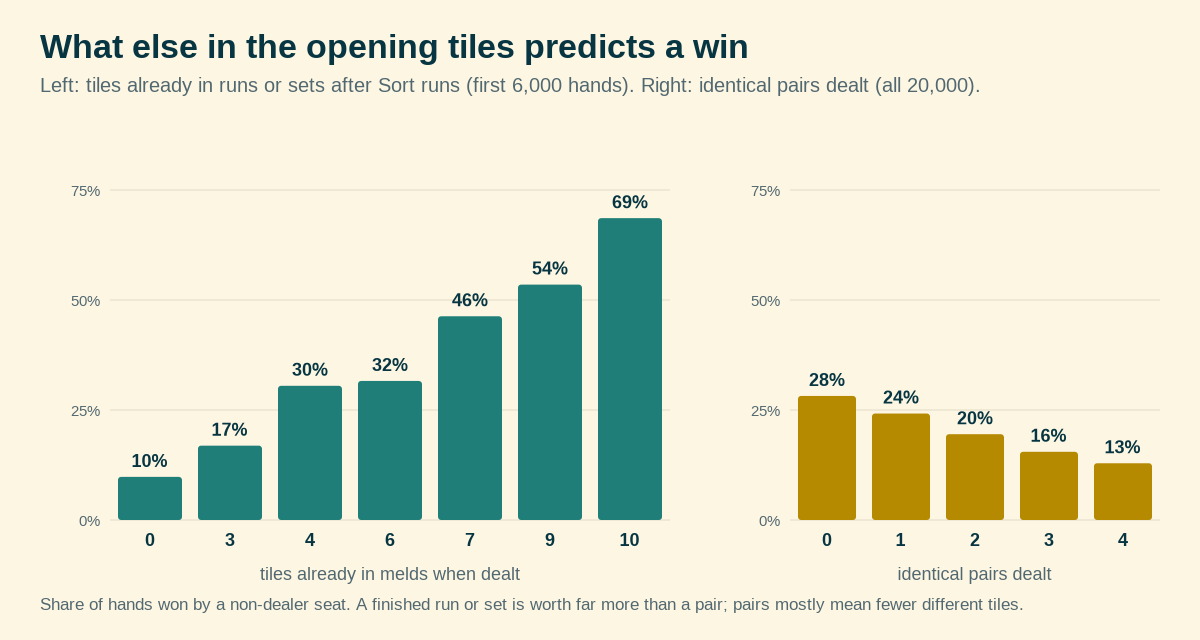
The left chart (from the first 6,000 test hands) shows the pattern: a hand with no finished meld won 9.8% of the time, one with six tiles already in melds 31.6%, one with ten 68.6%. The right chart surprises many players. Identical pairs at the deal went with fewer wins: 28.2% with no pair, 19.5% with two, 12.9% with four. A pair means two of your 14 tiles do the work of one in a run or set, so a hand full of pairs is a hand with less variety.
What to do with this: when your start is poor (few melds, no okey), play for flexibility and don’t expect to finish first. Throw tiles that sit far from everything else and keep the shapes described in the next tip.
Tip 3: keep shapes that more tiles can complete
Every tile exists twice. That makes counting easy: each number you could use is worth two tiles.
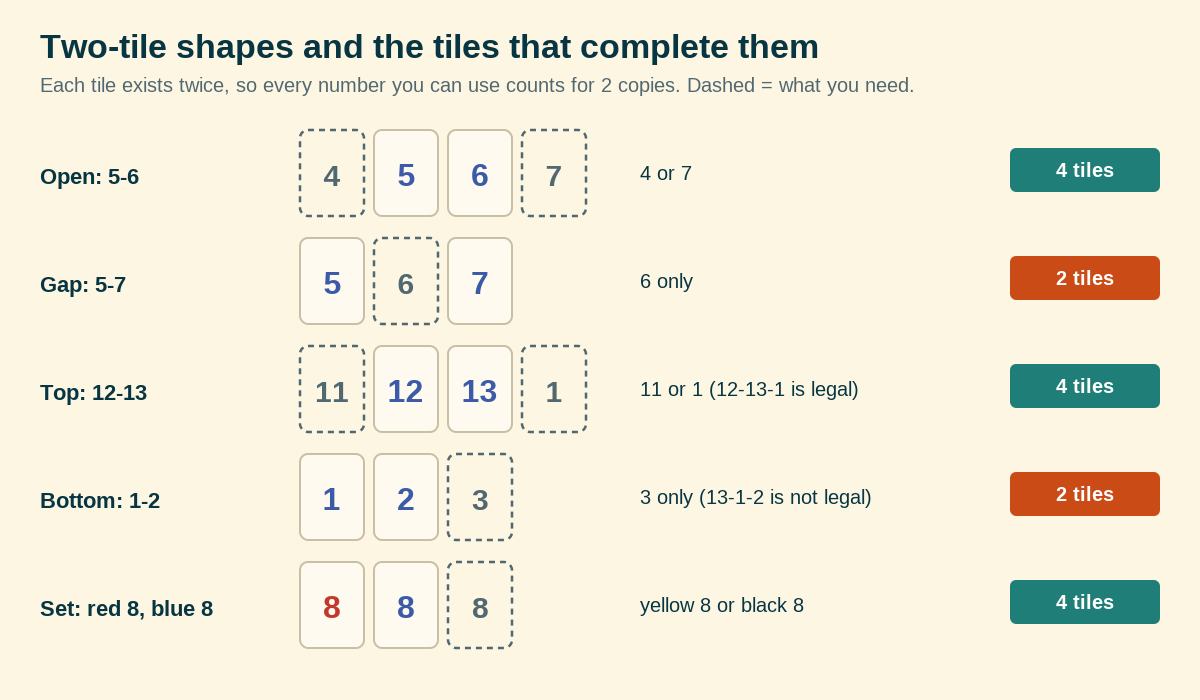
- 5-6 in one colour becomes a run with a 4 or a 7: four tiles.
- 5-7 needs the 6: two tiles.
- 12-13 takes an 11 or a 1, because 12-13-1 is a legal run: four tiles.
- 1-2 takes only a 3, because 13-1-2 is not legal: two tiles.
- Two colours of one number, such as red 8 and blue 8, take either missing colour: four tiles.
When you must break a shape, break the gapped or edge one first. Our computer players use the same order: in their hand evaluation a gapped pair like 5-7 scores lower than a connected one like 5-6.
The same thinking applies when you are one tile from finishing. In 300 test hands we stopped at each point where a player needed just one more tile and counted the tile types that would finish. The average was 4.6 types, but 9.1% of these positions could finish with only one type. If you can choose between two discards, pick the one that leaves more ways out.
Tip 4: count the discards
Since every tile has one twin, the discards tell you what is gone. After 20 discards, an average of 1.8 tile types in our test had both copies in plain view, thrown or picked up from the discards. If both red 9s are gone, red 8-10 can only be finished with the okey, so stop holding the 8 and 10 for that run.
It works in reverse, too. If one blue 4 is in the discards and you hold blue 3-5, only one blue 4 is left, and the player across may be holding it. Prefer the shape whose missing tiles are still unseen.
Tip 5: take the discard only when it builds something
Taking the tile on your left shows everyone what you collect. Drawing from the pile shows nothing. Our Normal computer players take the discard only when it finishes their hand, is an okey, or clearly improves their best arrangement. With that rule, they took it on 23.5% of their draws, and the players who went on to win took it slightly more often (27.4%), because a useful discard is a sure tile.
So take it when it completes or extends a meld right away. Don’t take a tile just because it is close to something on your rack.
Tip 6: don’t feed the player on your right
The player on your right sees your discard first. Every time they take one of your tiles, you learn what they are building. The Normal computer players remember the last four tiles the next player picked up and avoid throwing anything within two numbers in the same colour, or the same number in another colour. If the right-hand player just took a yellow 10, a yellow 8 to 12 or any other 10 would help them.
That habit is one of the differences between the two difficulty levels. Easy players draw from the pile unless the discard finishes their hand, ignore what the next player collects, and about a third of the time pick their discard at random from their four best candidates. Here is what it does over full matches, where everyone starts on 20 points (800 matches per line, our seat is the one at the bottom of the screen):
| Table | Matches we won | Hands we won |
|---|---|---|
| Four Normal players | 21.5% | 23.8% |
| We play Normal, three Easy opponents | 68.5% | 37.0% |
| We play Easy, three Normal opponents | 2.3% | 10.3% |
Matches won don’t add up to 25% because some end in a tie for the most points. The gap is large: careful discarding and taking only useful tiles turn a quarter of the matches into more than two thirds.
Tip 7: seven pairs is a rare exit
Sort pairs lines up identical tiles, and seven pairs ends the hand for 4 points against each opponent. It is tempting, but it rarely comes. Of 100,000 opening hands, 38.1% had no identical pair, 42.3% one, 16.5% two, 2.9% three and 0.2% four; fewer than 1 in 1,000 had five. Only 0.3% of our 20,000 test hands ended with seven pairs.
Among winners who started with three pairs, 10.9% finished with pairs. With four pairs it was 12 of 16, a small sample. Our rule of thumb: think about pairs only with four or more at the start, and count an okey as half a pair, since it can partner any tile.
Tip 8: show the indicator when you can
If you were dealt the twin of the indicator, a Show indicator button appears on your first turn. Pressing it costs the other three players 1 point each. 57 of the 105 non-indicator tiles are dealt, so the twin lands on some rack in about 54% of hands. It costs nothing, so always press it before you draw. After your first turn the chance is gone.
Play a hand with these tips
You can try every tip above for free in our okey game, against three computer players on Easy or Normal. Start on Normal if you want an honest test. Once runs and sets come easily, 101 Okey adds laying melds on the table and a point count, and the Turkish games page lists the other classics.
Frequently asked questions
What is the best strategy in okey?
Build runs and sets as early as possible, keep the okey for the gaps you can't fill otherwise, throw lone tiles first, and keep shapes that many tiles can complete. In 20,000 hands of our game's computer players, the strongest predictors of winning were holding an okey and having tiles already in melds at the deal.
Should I ever throw the okey?
Only as your very last tile. Finishing by discarding the okey costs each opponent 4 points instead of 2. Throwing it at any other time hands the most flexible tile in the game to the player on your right.
When should I go for seven pairs in okey?
Rarely. In 100,000 simulated deals, 38.1% of hands had no identical pair, 42.3% had one, and fewer than 1 in 1,000 had five. Winners who started with three pairs finished with seven pairs only 10.9% of the time. Go for pairs only when you already hold four or more, ideally with an okey.
Should I take the discarded tile or draw from the pile?
Take the discard when it completes or extends a meld; otherwise draw, because a face-down tile tells the other players nothing. The Normal computer players took the discard on 23.5% of their draws, and the eventual winners on 27.4%.
How do I avoid helping the next player?
Watch what the player on your right picks up from your discards. If they took a yellow 10, don't throw yellow 8 to 12 or another colour's 10. Our Normal computer players follow this exact rule, and it is one reason they beat the Easy players so clearly.
Does the dealer have an advantage in okey?
A small one. The dealer starts with 15 tiles and discards first. In our test the dealer won 26.0% of the hands that someone finished, against 25% for a perfectly even split. The seat rotates every hand, so it evens out over a match.