Jacks or Better Pay Table and Hand Rankings

Jacks or Better is five-card draw poker against a pay table: you are dealt five cards, hold the ones you want, draw once, and get paid if the final hand is a pair of jacks or better. It is the most common video poker game and also one of the cheapest casino games to play well. This guide covers the 9/6 pay table, the poker hand rankings it uses, how often each hand turns up, and the hold decisions that make the difference. Everything matches the code of our free video poker machine.
What is video poker?
There is no dealer to beat and no other player at the table. Each hand uses a freshly shuffled 52-card deck, so earlier hands have no effect on the next one. You bet 1 to 5 credits, press Deal, tap the cards you want to keep, and press Draw. Every card you didn’t hold is replaced once, and the final five cards are paid from the table below.
Your decision about which cards to hold is the whole game. The machine can’t change the deck, but a careless hold can cost you several percent of return.
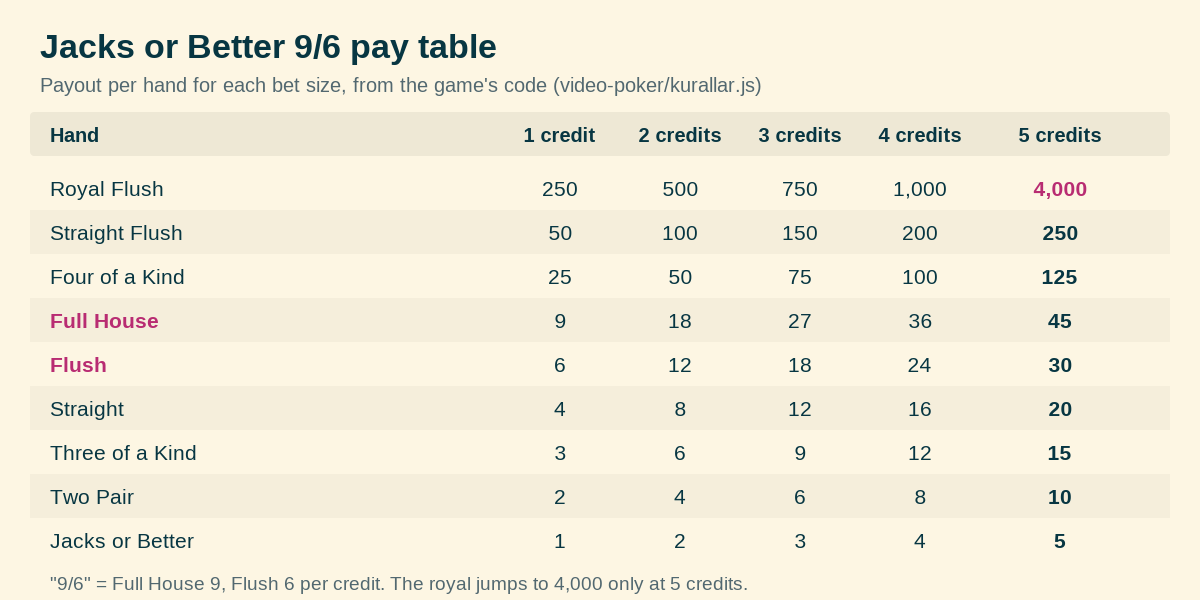
The 9/6 Jacks or Better pay table
| Hand | Pays per credit | At 5 credits |
|---|---|---|
| Royal Flush | 250 (800 at 5 credits) | 4,000 |
| Straight Flush | 50 | 250 |
| Four of a Kind | 25 | 125 |
| Full House | 9 | 45 |
| Flush | 6 | 30 |
| Straight | 4 | 20 |
| Three of a Kind | 3 | 15 |
| Two Pair | 2 | 10 |
| Jacks or Better | 1 | 5 |
The name “9/6” comes from the full house and flush lines. Those two are the lines a casino trims when it wants a lower-paying machine, so the pair of numbers became a quick way to identify the version. A machine paying 8 and 5 on those lines plays exactly the same way and returns less.
Notice that a winning pair of jacks pays 1 per credit: you get your bet back and nothing more. It counts as a win on screen, but it is really a push.
Poker hand rankings, from the top
- Royal flush: A-K-Q-J-10, all one suit.
- Straight flush: five cards in sequence, one suit, such as 9-8-7-6-5 of spades.
- Four of a kind: four cards of one rank.
- Full house: three of a kind plus a pair.
- Flush: five cards of one suit, in any order.
- Straight: five cards in sequence, mixed suits.
- Three of a kind: three cards of one rank.
- Two pair: two different pairs.
- Jacks or better: one pair of jacks, queens, kings or aces.
The ace can play high (10-J-Q-K-A) or low (A-2-3-4-5) in a straight, but a straight can’t wrap around: Q-K-A-2-3 is not a straight. Suits never rank against each other.
How often each hand is dealt
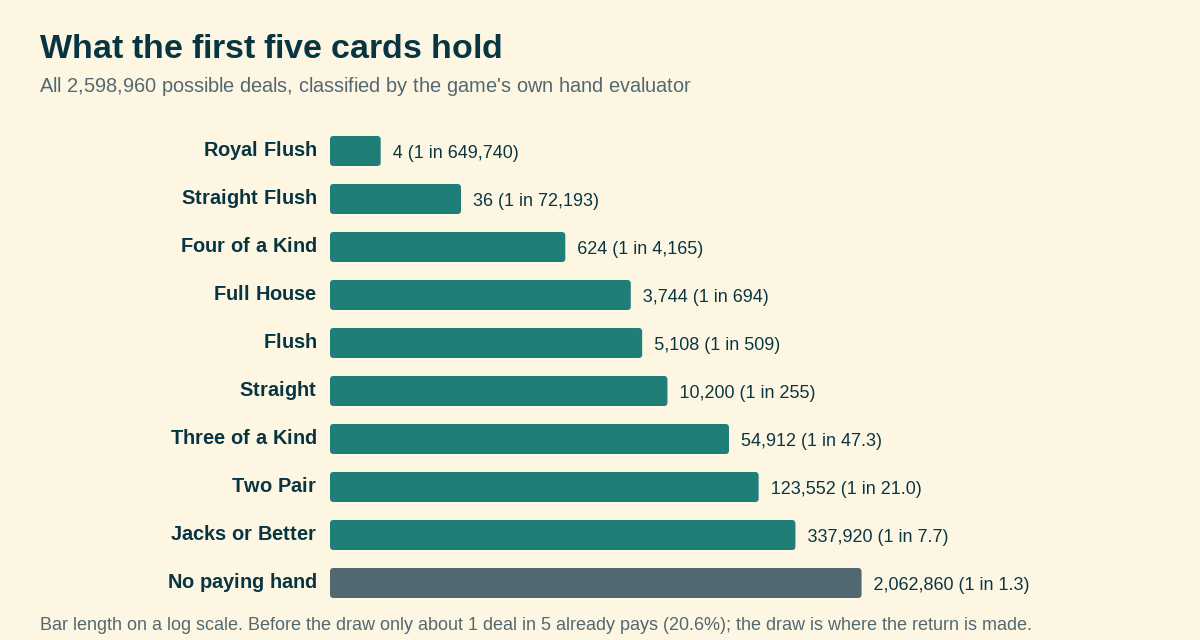
A 52-card deck can produce 2,598,960 different five-card hands. We ran every one of them through the machine’s hand evaluator:
| Hand on the deal | Number of deals | Roughly |
|---|---|---|
| Royal Flush | 4 | 1 in 649,740 |
| Straight Flush | 36 | 1 in 72,193 |
| Four of a Kind | 624 | 1 in 4,165 |
| Full House | 3,744 | 1 in 694 |
| Flush | 5,108 | 1 in 509 |
| Straight | 10,200 | 1 in 255 |
| Three of a Kind | 54,912 | 1 in 47 |
| Two Pair | 123,552 | 1 in 21 |
| Jacks or Better | 337,920 | 1 in 7.7 |
| Nothing that pays | 2,062,860 | 79.4% |
Only 20.6% of deals already pay. The draw is where the return comes from, which is why the hold matters more than anything else in the game.
Which cards to hold
We calculated the exact average payout of different holds for some typical hands, counting every possible draw from the 47 unseen cards with the machine’s own evaluator. Values are credits returned per credit bet at the 5-credit pay table.
| Your five cards | Hold A | Hold B | Better hold |
|---|---|---|---|
| A♥ K♥ Q♥ J♥ 4♥ (a made flush) | Flush: 6.00 | A-K-Q-J of hearts: 18.43 | Break the flush |
| J♥ J♠ 2♥ 9♥ 5♥ | Pair of jacks: 1.54 | Four hearts: 1.19 | Keep the jacks |
| 6♥ 6♠ 2♥ 9♥ K♥ | Pair of 6s: 0.82 | Four hearts: 1.21 | Go for the flush |
| A♥ K♥ Q♥ A♠ 7♣ | Pair of aces: 1.54 | A-K-Q of hearts: 1.39 | Keep the aces |
| 5♣ 6♦ 7♥ 8♠ K♣ | 5-6-7-8: 0.68 | King only: 0.47 | Hold the open straight draw |
| 5♣ 6♦ 8♥ 9♠ K♣ | 5-6-8-9: 0.34 | King only: 0.47 | Keep the king, skip the inside draw |
| 2♣ 5♦ 8♥ 9♠ 3♣ | Draw five new cards: 0.36 | - | Throw all five away |
From these and similar cases come the rules most players learn first:
- Keep any paying hand of two pair or better, unless you hold four cards to a royal flush. Four to a royal is worth about three times a made flush.
- A high pair beats a four-card flush draw, and it beats three to a royal too.
- A four-card flush beats a low pair. Nine of the 47 unseen cards complete the flush, and a flush pays 6.
- A low pair beats unsuited high cards. It pays nothing yet, but it can grow into two pair, trips, a full house or quads.
- Open-ended straight draws are worth holding; inside ones usually aren’t. 5-6-7-8 can be filled by any 4 or 9 (eight cards). 5-6-8-9 needs a 7 (four cards).
- With nothing at all, throw everything away. Holding a single low card only removes chances.
Video poker RTP: what perfect play returns
We worked out the best possible hold for each of the 2,598,960 starting hands, using the machine’s evaluator and counting every draw. Played that way every time:
| Bet | Royal flush pays | Return with best holds |
|---|---|---|
| 5 credits | 800 per credit | 99.54% |
| 1 to 4 credits | 250 per credit | 98.37% |
That makes 9/6 Jacks or Better at max bet one of the cheapest games you can play: the machine keeps 0.46 credits per 100 bet if you never make a mistake. Most players do make mistakes, and simplified hold rules like the ones above give up a little. It is still a game with a house edge. With the best holds, 45.5% of final hands pay something, but almost half of those (21.5% of all hands) are a pair of jacks or better that only returns the bet. The royal flush, which supplies part of the return, comes up about once in 40,391 hands even with perfect play.
For comparison, our slot RTP guide shows slots at 94.8% to 95.3%, where no decision of yours changes anything. Blackjack is the other game here where skill moves the number; the basic strategy chart takes it to about half a percent as well.
Practice for free
Our Jacks or Better machine runs the 9/6 table above with 1,000 virtual credits and free refills. Credits can’t be bought, cashed out or exchanged for prizes. The game is for adults (18+); playing video poker for money is gambling, the machine keeps a share even with perfect play, and it may be illegal where you live.
Frequently asked questions
What is video poker?
A one-player poker machine. You get five cards, choose which to keep, replace the rest once, and the final hand is paid from a fixed pay table. There are no opponents and no bluffing; the only skill is choosing which cards to hold.
What does 9/6 mean in Jacks or Better?
It refers to the two pay table lines casinos change most often: a full house pays 9 and a flush pays 6 for each credit bet. Versions that pay 8/5 or 7/5 return less. Our machine runs the full 9/6 table.
What is the best hand in Jacks or Better?
A royal flush: ace, king, queen, jack and 10 of the same suit. It pays 250 per credit at 1 to 4 credits and 800 per credit at 5 credits, which is 4,000 credits on a max bet. Only 4 of the 2,598,960 possible deals are a royal flush.
Should you hold a low pair or high cards in video poker?
Hold the low pair. A pair of 2s to 10s pays nothing by itself, but it can become two pair, three of a kind, a full house or four of a kind. On average it is worth more than holding one or two unsuited high cards.
Is it better to bet max credits in video poker?
The pay table is the same per credit for every hand except the royal flush, which jumps from 250 to 800 per credit at 5 credits. That jump is worth about 1.2 points of return: 99.54% at 5 credits versus 98.37% at 1 to 4 with perfect holds.