Mancala Strategy: How to Win at Turkish Mangala
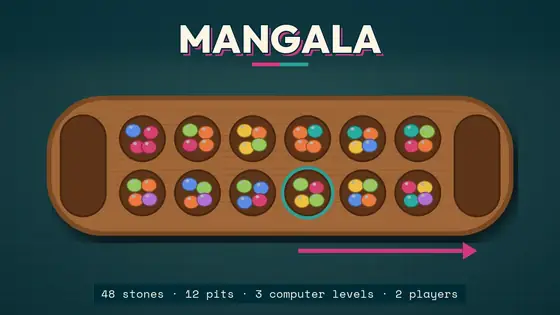
To win at mancala, you chain moves that end in your store, capture whenever your last stone can make an opponent’s pit even or land in an empty pit of your own, and plan the endgame by counting the stones left on each side. This guide applies those ideas to Turkish mangala, the rule set of our free mangala game, and every number in it was measured with that game’s code: its rules file and its computer players.
Read the next section before using any mancala tips you found elsewhere. The rules differ, and so does the arithmetic.
Which mancala rules this guide uses
Most mancala apps and English rule sheets describe Kalah. Mangala looks the same, with 6 pits a side, 4 stones per pit and a store at each end, but it plays differently:
| Rule | Mangala (this guide) | Kalah (most apps) |
|---|---|---|
| First stone of a move | Goes back into the pit you emptied | Goes into the next pit |
| A pit with one stone | The stone moves to the next pit | Same |
| Last stone in your store | Extra turn | Extra turn |
| Capture on the opponent’s side | Last stone makes their pit even: you take the pit | None |
| Capture on your side | Last stone in your own empty pit, opposite pit has stones | Last stone in your own empty pit (some rule sets require stones opposite) |
| End of the game | Whoever empties their side first takes all stones left on the other side | Each player keeps the stones on their own side (usual rules) |
| Store-ending count | Pit number + stones = 8 | Pit number + stones = 7 |
The first-stone rule is the one that trips people up. A Kalah habit such as “open from pit 3” sends your last stone one pit short in mangala.
The counting rule that drives everything
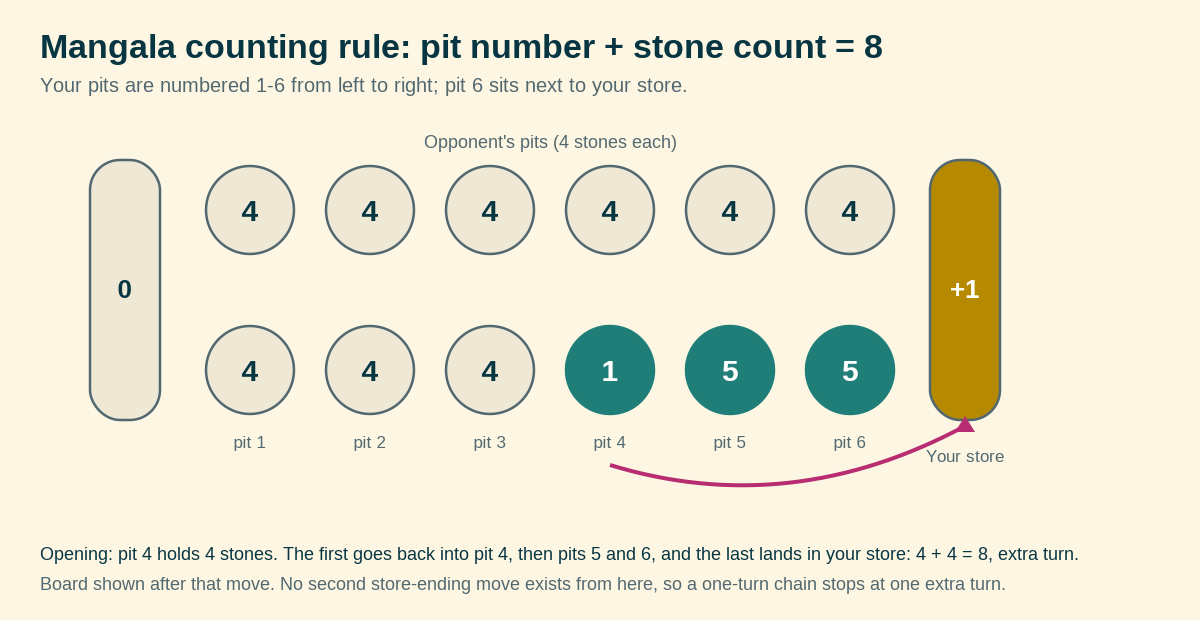
Number your pits 1 to 6 from left to right, so that pit 6 sits next to your store. Because the first stone stays at home, a pit holding n stones reaches n - 1 pits ahead. That gives a rule you can use on every move:
- Pit number + stones = 8: the last stone drops into your store and you move again.
- Below 8: the last stone stays on your side. If it lands in an empty pit, check the pit opposite for a capture.
- Above 8: the stone spills over. A total of 9 lands in the first opponent pit, 10 in the second, and so on. That’s where even captures come from.
- A single stone just moves one pit. A lone stone in pit 6 goes into your store and also earns an extra turn.
The count works up to a total of 14, which reaches the opponent’s sixth pit. A bigger total carries the stones around and back to your own side.
The best first move in mangala
Every pit starts with 4 stones, so only pit 4 ends in the store. It is tempting to play it every game. We checked all six openings three ways with the game’s own code:
- Look-ahead search. The same search the computer uses, run 14 moves deep from the starting position.
- Medium vs Medium. After each forced first move, the Medium level played both sides, 2,000 games per opening.
- Hard vs Hard. The same with the Hard level, which looks 9 moves ahead, 400 games per opening.
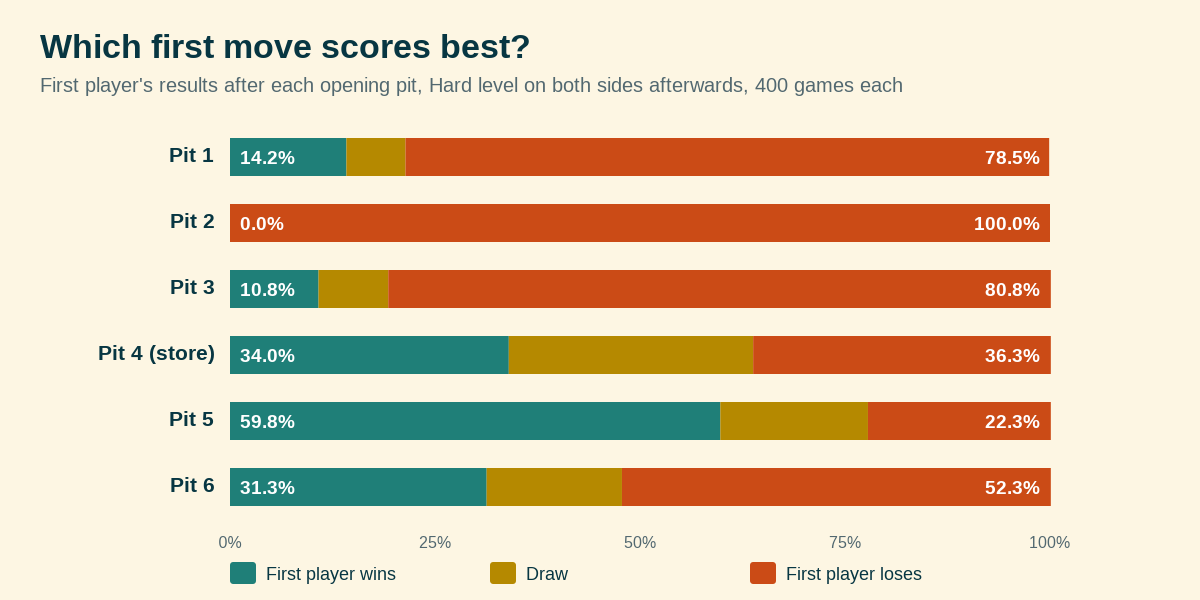
| First move | Search, 14 moves deep (store difference) | Medium vs Medium: first player wins | Hard vs Hard: first player wins |
|---|---|---|---|
| Pit 1 | -7 | 23.9% | 14.2% |
| Pit 2 | -10 | 0.0% | 0.0% |
| Pit 3 | -7 | 18.8% | 10.8% |
| Pit 4 (store) | 0 | 23.4% | 34.0% |
| Pit 5 | +1 | 75.5% | 59.8% |
| Pit 6 | +1 | 45.3% | 31.3% |
All three tests point the same way:
- Pit 5 is the strongest opening we found. It drops a stone in your store and one in the opponent’s first pit without giving them a strong reply.
- Pit 4 is safe but not best. The extra turn feels like a gain, but your second move then has to break up the position, and none of the follow-ups is better than pit 5.
- Pit 6 is a mixed case. The search rates it level with pit 5, but between Hard bots it lost more games than it won.
- Avoid pits 1 to 3, and pit 2 above all. After those openings the opponent’s best reply (their own pit 4, the store move, every time) was worth 6 to 10 stones to them in a 10-move search.
The bots are strong but not perfect, so read this as a well-tested recommendation, not a solved result.
Going first or second
Moving first is not a big advantage in mangala:
| Players | Games | First player wins | Second player wins | Draws |
|---|---|---|---|---|
| Medium vs Medium | 2,000 | 47.5% | 43.9% | 8.6% |
| Hard vs Hard | 200 | 43.0% | 47.0% | 10.0% |
| Random vs random | 10,000 | 48.6% | 45.6% | 5.8% |
When you go second, look at what the first player opened with. If they played pit 1, 2 or 3, your own pit 4 still has 4 stones and still ends in your store: take it, it was the best reply in our search each time. If they played pit 5 or 6, your pit 4 still reaches the store, but it scored worse than other replies. After pit 5 the search preferred your pit 5; after pit 6, your pit 1, which now holds 5 stones. Recount with the rule of 8 before you move.
In our game you always move first against the computer, so you can try the pit 5 opening straight away.
Extra turns: chain them in the right order
In games between our Medium bots, 42.4% of all moves ended in the store, about 18 extra turns per game for the two players together. Between Hard bots it was 40.2%. Random play reached only 18.5%. That gap is most of the difference between a beginner and a decent player.
Two habits help:
- Play the pit nearest your store first. If pits 5 and 6 both end in your store, play pit 6 first. Its stones don’t pass pit 5, so pit 5 still adds up to 8 afterwards. Play pit 5 first and its sowing adds a stone to pit 6, which breaks the second move.
- Look one extra turn ahead. After a store move, recount: the stones you just sowed may have set up a new pit that adds up to 8.
Captures: even pits and empty pits
Mangala has two captures, and they happen at different rates. In the 200 Hard vs Hard games:
| Capture | Per game | Average stones taken |
|---|---|---|
| Empty pit on your side (with stones opposite) | 4.01 | 2.7 |
| Making an opponent’s pit even | 2.60 | 4.2 |
Empty-pit captures are more frequent, but even captures are bigger. To find them:
- Look for odd pits on the other side. A pit with 3, 5 or 7 stones becomes even when your last stone lands on it. Use the rule of 8 to see which of your pits reaches it: a total of 9 reaches the opponent’s first pit, 10 the second, and so on.
- Guard your own odd pits. The computer runs the same arithmetic. A big odd pile in reach of the opponent’s counts is a target.
- Keep an empty pit facing a full one. An empty pit on your side opposite a full opponent pit is a capture waiting for the right count.
Plan the endgame
The game ends the moment one side’s six pits are empty, and the player whose side is empty takes everything left in the other side’s pits. In our bot games the player whose side ran empty won 70.0% (Hard) to 73.5% (Medium) of the time. The final sweep itself was small, 2.4 to 3.0 stones on average, because strong players rarely leave much behind.
So in the last phase, count both sides. If your pits are nearly empty and your opponent still holds many stones, finishing quickly can win you the game. If you are the one with the full side, avoid moves that let your opponent run out first.
Practice against the computer
Our mangala game has three levels. Easy plays a random pit half the time and barely looks ahead, Medium looks four moves ahead and Hard looks nine. Hint marks a strong pit using a six-move search.
A simple plan already goes a long way. A player who took any store-ending move first (nearest the store), otherwise the biggest capture, beat our Easy level in 93.5% of 2,000 games when moving first and 79.5% when moving second. Against Medium and Hard that plan isn’t enough; you will need the opening and endgame ideas above.
For a dice game with its own strategy, read our backgammon strategy guide for beginners. More board games from Turkey are on the Turkish games page.
Frequently asked questions
What is the best strategy to win mancala?
Chain moves that end in your store, capture by making your opponent's odd pits even or by landing in your own empty pits, and keep track of how many stones are left on each side for the endgame. In our tests a player who simply took store-ending moves first and otherwise the biggest capture beat our Easy computer in 93.5% of games when moving first.
What is the best first move in mancala?
Under Turkish mangala rules, our computer analysis and bot games favour pit 5 (the second pit from your store). Pit 4, which ends in your store, is a sound choice, but it scored worse than pit 5. Under Kalah rules the opening analysis is different, because the counts are different.
Is it better to go first or second in mancala?
In mangala the difference is small. In 2,000 games between our Medium bots the first player won 47.5% and the second 43.9%; between Hard bots the second player even came out slightly ahead. Your moves matter far more than who starts.
Can you win mancala in one turn?
Not in mangala. At the start only one pit (pit 4) ends in your store, and after that move no other pit does, so the first turn gives at most one extra move. A game also needs 25 of the 48 stones to be won outright, far more than any single turn collects at the start.
How do you capture in mangala?
Two ways. If your last stone makes an opponent's pit even, you take that whole pit. If your last stone lands in an empty pit on your side and the pit opposite has stones, you take both. In our Hard bot games there were about 4 empty-pit captures and 2.6 even captures per game.
Is mangala the same as the mancala game on my phone?
Probably not. Most English-language mancala apps use Kalah rules: the first stone goes into the next pit, there is no capture on the opponent's side, and each player keeps their own remaining stones at the end. Mangala changes all three, so tips written for Kalah often give wrong counts here.