Backgammon Strategy for Beginners: How to Win
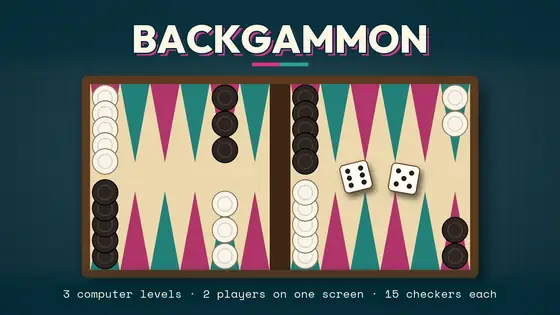
Backgammon strategy for beginners comes down to a few habits: make points with your opening rolls, leave as few blots as you can within six pips of the enemy, hold a strong home board, and know when the fighting is over and the race begins. Dice decide single games, but these habits decide who wins over a hundred of them. Every number in this guide comes from our free backgammon game: the hit chances are counted with its rules engine, and the win rates come from 4,000 games the computer played against itself at the Normal level.
The rules and setup are explained on the game page. Here we only look at how to play them well.
The best opening moves in backgammon
In our game the first move uses the two dice from the opening roll, so the first roll is never a double. That leaves 15 possible opening rolls. Four of them are a gift, because they make a new point in or next to your home board at once:
- 3-1: 8/5 6/5, making your 5-point.
- 4-2: 8/4 6/4, making your 4-point.
- 5-3: 8/3 6/3, making your 3-point.
- 6-1: 13/7 8/7, making your bar point (the 7-point).
The notation reads “from point / to point” in your own count, where your home board is points 1 to 6. Both the Normal and Hard computer levels play these four rolls exactly this way. 6-5 is the other easy one: run one back checker from the 24-point all the way to safety on the 13-point.
The other rolls can’t make a point, so you choose between safety and building. This table compares a common choice among experienced players with what our two stronger computer levels play:
| Roll | Common play | Hard level | Normal level |
|---|---|---|---|
| 2-1 | 13/11 6/5 or 24/23 13/11 | 13/10 | 13/10 |
| 3-2 | 24/21 13/11 or 13/10 13/11 | 13/8 | 13/8 |
| 4-1 | 24/23 13/9 | 13/8 | 13/8 |
| 4-3 | 24/20 13/10 or 13/9 13/10 | 13/6 | 13/6 |
| 5-1 | 13/8 24/23 | 13/8 24/23 | 8/2 |
| 5-2 | 13/8 13/11 | 13/6 | 13/6 |
| 5-4 | 24/20 13/8 or 13/8 13/9 | 13/8 13/9 | 13/8 13/9 |
| 6-2 | 24/18 13/11 | 24/16 | 8/2 13/11 |
| 6-3 | 24/18 13/10 or 24/15 | 24/15 | 13/4 |
| 6-4 | 24/18 13/9, 8/2 6/2 or 24/14 | 8/2 6/2 | 8/2 6/2 |
The gap is easy to explain. Our engine scores a position partly by counting exactly how many rolls could hit each of its blots, so on quiet rolls it likes to slide one checker all the way to safety. Experienced players accept a blot early on, because a checker brought down to the 9, 10 or 11-point is a builder: next turn it can help make a new point. If you want to play the long game, copy the “common play” column. If you’re just starting, the computer’s safer choice won’t lose you many games.
How often does a blot get hit?
A blot is a single checker on a point. If your opponent lands on it, it goes to the bar and has to start again from the far end. Knowing which blots are dangerous is the most useful number in backgammon.
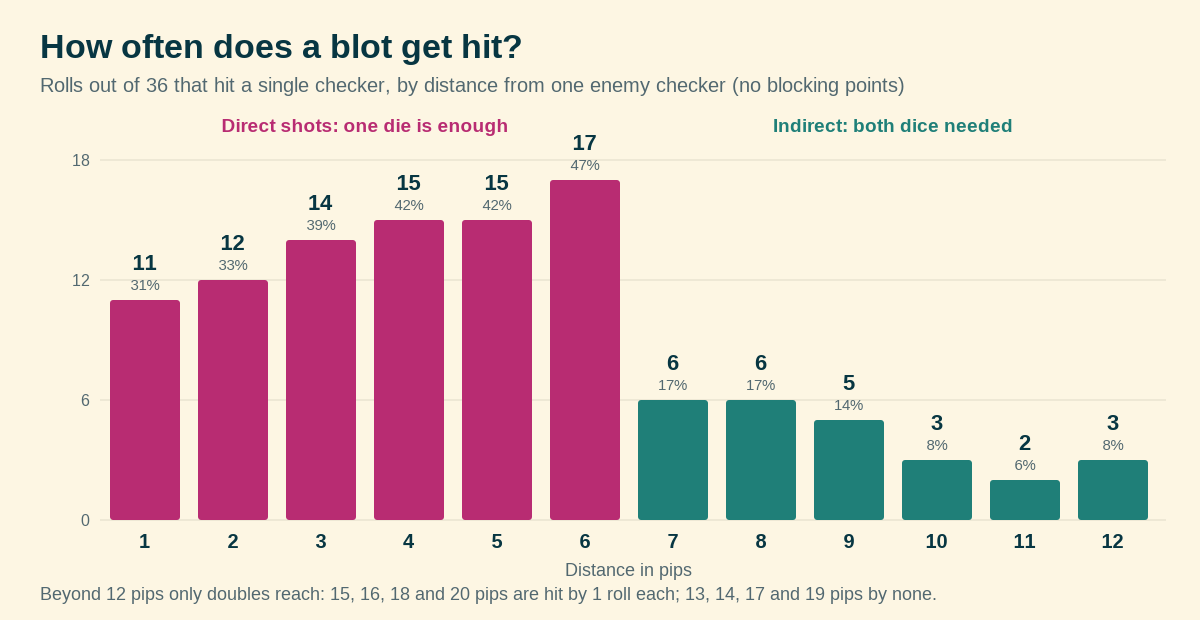
Two things stand out:
- Inside six pips, the danger is high. A blot 6 pips away is hit by 17 rolls in 36, almost half. Even at 1 pip it is 11 rolls, because any roll containing a 1 hits it.
- From 7 pips, it falls off a cliff. Now only a combination of both dice can reach, so the count drops to 6 rolls (7 and 8 pips), 5 rolls (9 pips) and 3 or fewer beyond that. At 13, 14, 17 and 19 pips no roll hits it at all.
So if you must leave a blot, leave it 7 or more pips away from the nearest enemy checker. Points in between help too: each closed point on the way blocks some of the combination shots.
Where the blot sits matters as much as the odds. A blot hit in your opponent’s home board loses only a few pips. A blot hit in your own home board, close to bearing off, loses 19 to 24 pips.
Build points, then a prime
Two or more of your checkers on a point make it closed: your opponent can’t land there. Closed points do three jobs at once. They keep your checkers safe, they block the opponent’s back checkers, and they make it hard to come in from the bar.
The best points to own early are your 5-point and your bar point (7), then the 4-point. Six closed points in a row form a prime, and nothing can jump it. A five-point block is already very hard to get past.
Your home board also decides how painful it is to be hit. A checker on the bar enters on the opponent’s home board, and it needs a die number that matches an open point there:
| Points closed in the home board | Rolls that enter (of 36) | Chance to enter |
|---|---|---|
| 0 | 36 | 100% |
| 1 | 35 | 97.2% |
| 2 | 32 | 88.9% |
| 3 | 27 | 75.0% |
| 4 | 20 | 55.6% |
| 5 | 11 | 30.6% |
| 6 | 0 | 0% |
With four points closed, your opponent misses almost half the time, and while a checker waits on the bar, nothing else can move. That is why hitting is worth so much more once your home board is strong.
Hit or play safe?
Hitting sets your opponent back and costs them a tempo, since the next roll has to bring the checker in. In the 4,000 games our Normal level played against itself, the side that hit first went on to win 60.1% of the games (2,273 of 3,783 games with a hit).
Hitting is usually right when:
- the hit checker loses a lot of ground (it was far advanced),
- you can hit and still make a point, or hit two checkers at once,
- your home board has several closed points, so the hit checker may stay out.
Think twice when hitting leaves your own blot in front of several enemy checkers, especially in your home board, where a return hit would cost you almost the whole board.
When the game turns into a race
Once every checker has passed the other side’s checkers, nothing can be hit anymore. From then on it’s a pure race, and the pip count decides most of it. Both sides start at 167 pips, and the average roll is worth 8.17 pips, because doubles count four times.
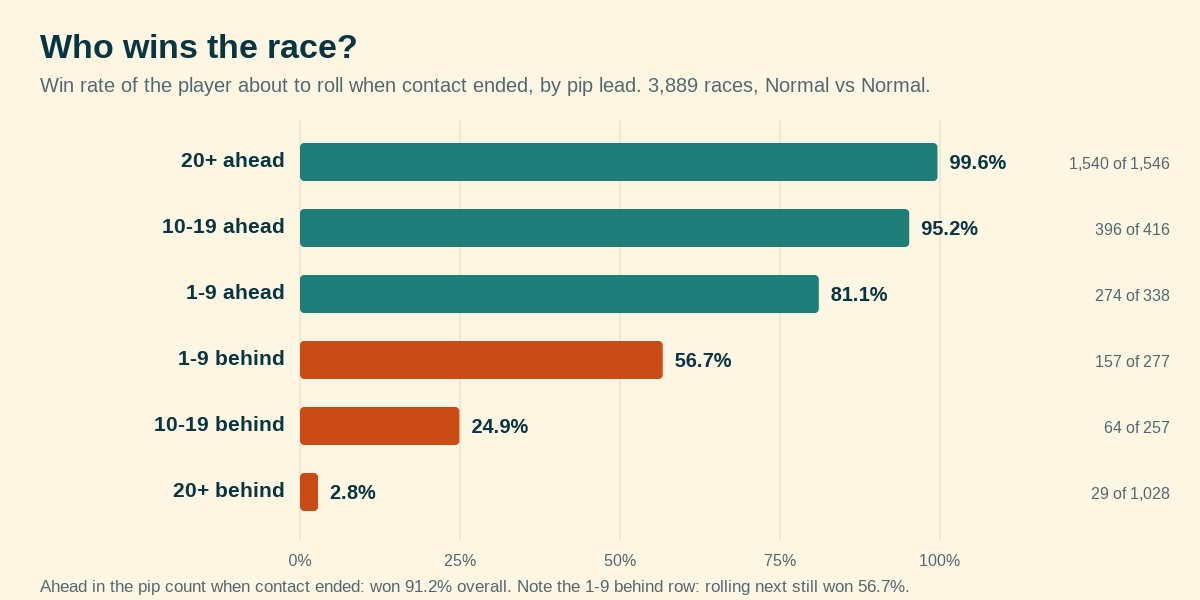
Of the 4,000 games, 3,889 reached a pure race before someone won, and the player ahead in the pip count at that moment won 91.2% of them. The chart shows one more lesson: being on roll is worth something. A player 1 to 9 pips behind who rolls next still won 56.7% of the time.
This gives you a simple plan:
- Ahead in the race: break contact and run. Avoid fights you don’t need.
- Behind by a lot: keep contact. Hold a point in your opponent’s home board (an anchor) and wait for a shot. A pure race 20 pips down is close to lost.
The game shows both totals on the Pip count line, so you never have to add them up yourself.
Gammons and backgammons
A win is worth 2 points (a gammon) if the loser hasn’t borne off a single checker, and 3 (a backgammon) if the loser also still has a checker on the bar or in the winner’s home board. In our 4,000 games, 17.9% ended in a gammon and 3.1% in a backgammon, so about one game in five was worth double or more.
When you are clearly losing, get one checker off as soon as you can. That single checker turns a 2-point loss into a 1-point loss. In a 5 or 7-point match that is often the difference.
Practice against the computer
Our backgammon game has three levels. Easy plays a random legal move about four turns in ten, Normal weighs blot risk, made points and pip count, and Hard tests its four best candidate moves against all 21 rolls you could throw next. Over 300 games Hard beat Normal 57% of the time, so the gap is real but dice still matter.
Press Hint when a position puzzles you. The hint uses the Normal level’s evaluation, so treat it as a second opinion rather than a perfect answer, especially on the quiet opening rolls above.
If you like counting moves without dice, the mancala strategy guide works through Turkish mangala the same way. More board games from Turkey are on the Turkish games page.
Frequently asked questions
What is the best opening move in backgammon?
It depends on the roll, since you never choose your opening numbers. The four best rolls make a point straight away: 3-1 makes your 5-point (8/5 6/5), 4-2 makes the 4-point, 5-3 makes the 3-point and 6-1 makes the bar point (13/7 8/7). 6-5 runs a back checker to safety (24/13).
How do you win at backgammon as a beginner?
Make points instead of leaving single checkers, keep blots more than six pips away from enemy checkers when you can, build a wall of points in front of your opponent's back checkers, and count pips so you know whether to race or keep fighting. These habits beat random play by a wide margin.
Can you win backgammon every time?
No. Dice decide a lot, and even the strongest player loses a fair share of games against a weaker one. Good strategy raises your win rate over many games. In our tests the Hard computer level beat the Normal level in 57% of games, a clear edge that still leaves plenty of losses.
What are the odds of getting hit in backgammon?
With nothing blocking the way, a single checker 1 to 6 pips from an opposing checker is hit by 11, 12, 14, 15, 15 and 17 of the 36 rolls. At 7 and 8 pips it is 6 rolls, at 9 pips 5, and beyond 12 pips only a few doubles reach it.
What does pip count mean in backgammon?
The pip count is the total number of points all your checkers still have to travel to bear off. Both players start at 167. The average roll moves 8.17 pips, so a lead of about 8 pips is worth roughly one roll. The game shows both counts on the Pip count line.
Is there a doubling cube in this backgammon game?
No. Our backgammon plays without the doubling cube, so a game is worth 1 point, 2 for a gammon and 3 for a backgammon. Cube strategy is therefore not covered in this guide.