Blackjack Basic Strategy Chart Explained
Basic strategy is a chart that tells you the best move for every blackjack hand: your total down the side, the dealer’s face-up card across the top. Follow it and you give the house the smallest edge the rules allow. This guide prints the full chart for the rules of our free blackjack table, explains the reasoning behind the main moves, and shows what the chart is worth when you play it through the game’s own code.
The rules this chart is built for
A strategy chart is tied to the rules of the table. These are the rules our game runs, taken from its rules file:
| Rule | Our table |
|---|---|
| Decks | 6 (312 cards), reshuffled when fewer than 78 remain |
| Dealer | Draws on 16 or less, stands on all 17s including soft 17 |
| Blackjack | Pays 3:2 |
| Double down | On any first two cards, also after a split |
| Split | Once per hand; split aces get one card each |
| 21 on a split ace | Counts as 21, not blackjack (paid 1:1) |
| Dealer blackjack | Checked before you play when the upcard is an ace or 10-value |
| Insurance | Offered against an ace; costs half the bet, pays 2:1 |
| Surrender | Not offered |
Two details matter here. Because the dealer checks for blackjack first, you never lose extra money on a double or split against a dealer blackjack. And because there is no surrender, the chart never says “surrender”; hands like 16 against a 10 are played out.
Basic strategy for hard totals
A hard hand has no ace, or has an ace that must count as 1. Most hands you play are hard.
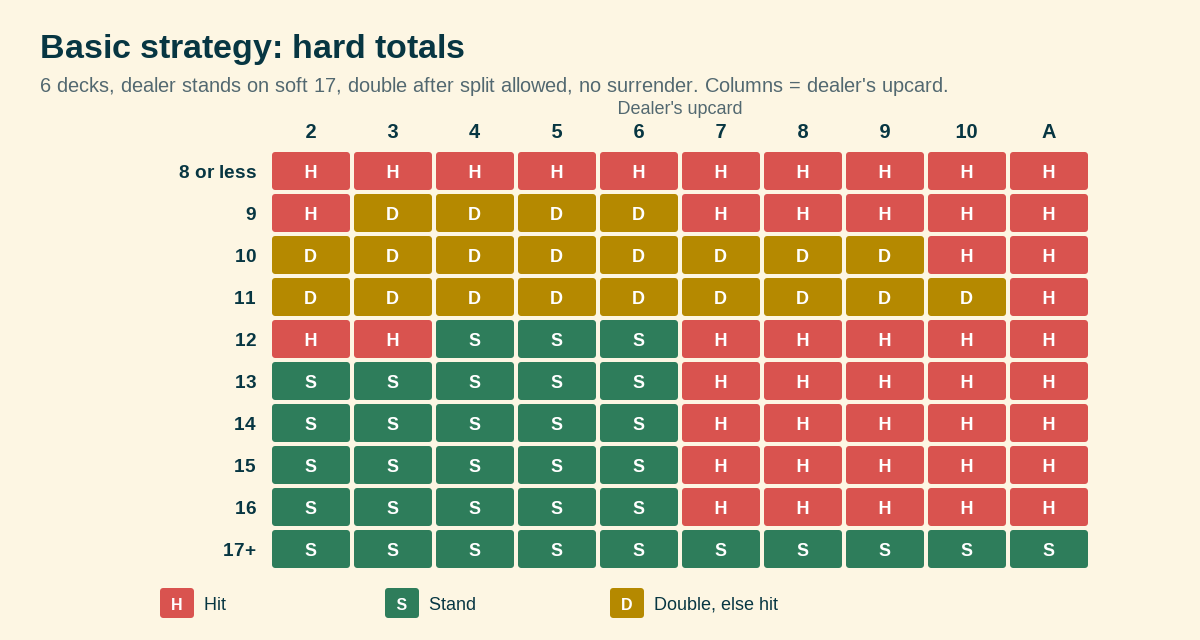
The chart has a clear shape once you see the reasoning:
- 17 and up: stand. Any card of 5 or more busts 17, and most of the shoe is 5 or more.
- 13 to 16: stand against 2-6, hit against 7-ace. A dealer showing 2 to 6 has to draw on a weak total and busts often. Let the dealer take that risk. Against 7 or higher, the dealer will usually reach 17 or more, so your 13-16 loses if you stand; hitting loses too, but less often.
- 12: stand only against 4, 5 and 6. Against 2 and 3 the dealer busts a bit less often, and only a 10-value card can bust your 12, so hitting is slightly better.
- 11: double against everything except an ace. About a third of the shoe is worth 10.
- 10: double against 2-9. Against a 10 or an ace, just hit.
- 9: double against 3-6.
- 8 or less: hit. You can’t bust.
Hard 16 against a 10 is the hand players hate most, and they’re right to: it loses whatever you do. The chart says hit because standing loses a little more often.
Soft hands and pairs
A soft hand has an ace counted as 11, like ace-6 (soft 17). A soft hand can’t bust on one card, because the ace drops back to 1 if needed. That makes soft hands good candidates for an extra card, and sometimes for a double.
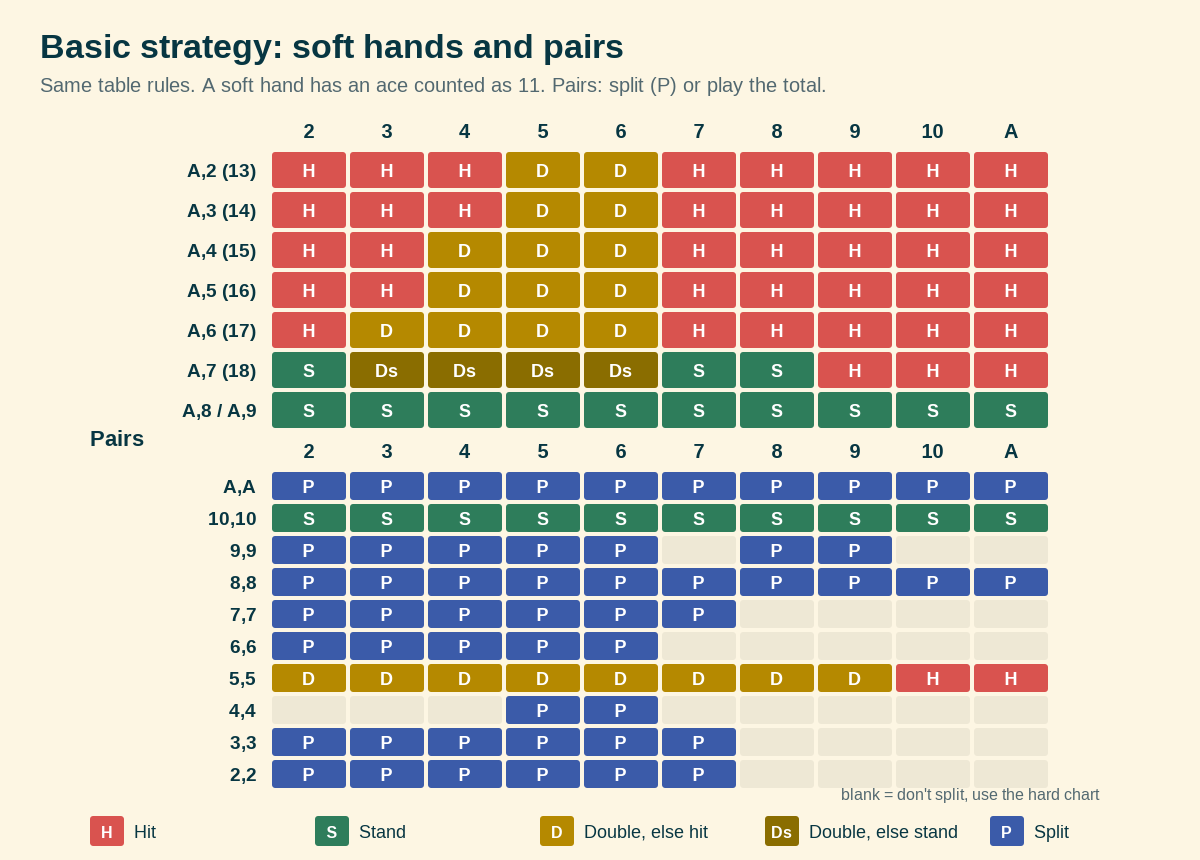
Soft hands in short:
- Soft 19 and 20 (A-8, A-9): stand.
- Soft 18 (A-7): double against 3-6, stand against 2, 7 and 8, hit against 9, 10 and ace. Soft 18 looks strong, but against a dealer 9 or 10 it loses more often than it wins.
- Soft 17 (A-6): double against 3-6, otherwise hit. Never stand on soft 17.
- Soft 13 to 16: double against the dealer’s weakest cards (5-6 for A-2 and A-3, 4-6 for A-4 and A-5), otherwise hit.
Pairs follow a few firm rules:
- Always split aces and 8s. Two aces as one hand are only a soft 12. Two 8s are 16, the worst total in the game.
- Never split 10s or 5s. Twenty is a winning hand already. Two 5s are a hard 10, so double it instead.
- Split 2s, 3s and 7s against 2-7, 6s against 2-6, 4s only against 5 and 6. These splits lean on the double-after-split rule: when a split 4 draws a 7, you can double the new 11.
- Split 9s against 2-6, 8 and 9; stand against 7, 10 and ace. Against a 7, your 18 already beats the dealer’s most likely 17.
Our table allows one split, so if a split hand gets another pair, play it from the hard chart.
What the chart is worth: 16 million hands
We played this exact chart through the blackjack game’s rules file, the same code that runs the table, for 16 million hands in four separate runs. Insurance was always declined.
| Result | Share of hands |
|---|---|
| Hands won | 43.3% |
| Hands lost | 47.9% |
| Pushes | 8.8% |
| House edge | about 0.49% (runs ranged from 0.44% to 0.54%) |
You lose more hands than you win, mainly because you act first: if you bust, your bet is gone even when the dealer busts afterwards. The 3:2 blackjack payout, doubles and splits win back most of that gap. What’s left is roughly half a credit per 100 bet. Each run of 4 million hands carries a statistical margin of about ±0.06 points, which is why the four runs don’t match exactly.
Half a percent is low by casino standards, but it is still a loss. Over a short session the swings are far larger than the edge, so a winning night proves nothing about the chart, and a losing night doesn’t disprove it.
Mistakes the chart fixes
Taking insurance. Insurance is a side bet that the dealer’s hole card is a 10. It pays 2:1, so it needs more than one card in three to be a 10. A full 6-deck shoe has 96 ten-value cards out of 312, under 31%. With the dealer’s ace and your own two cards out of the shoe, insurance loses roughly 7 to 9 cents per credit insured, depending on whether you hold tens yourself. The chart never takes it, not even when you are holding a blackjack yourself.
Copying the dealer. Hitting until 17 and never doubling or splitting sounds safe. It throws away the only advantages you have over the dealer: the 3:2 blackjack, doubles and splits.
Never hitting a stiff hand. Standing on 12-16 against a dealer 7 or higher feels careful, but the dealer will usually make 17 or better. You are better off taking the bust risk.
Changing moves after a streak. The cards don’t remember the last hand. The chart’s advice for 12 against a 3 is the same after five wins as after five losses.
Practice without risk
Our free blackjack table is a good place to drill the chart: it runs the same rules as above, you start with 1,000 virtual credits, and you can refill them for free. Credits can’t be bought or cashed out. Blackjack is a game for adults (18+), and with real money, basic strategy only makes a losing game lose more slowly.
If you like decisions that change the return, Jacks or Better video poker works the same way: hold the right cards and the machine keeps only about half a percent. For a card game with no decisions at all, the baccarat rules guide explains how the drawing rules are fixed in advance.
Frequently asked questions
What is basic strategy in blackjack?
It is a table that lists the best move (hit, stand, double or split) for each of your hands against each dealer upcard. It comes from calculating the expected result of every option, so following it gives the lowest house edge possible without counting cards.
Does the dealer hit on soft 17 in this game?
No. The dealer stands on every 17, soft 17 included, and draws on 16 or less. This rule is slightly better for the player than hitting soft 17, and the chart in this guide is built for it.
Should you always split 8s in blackjack?
Yes. Two 8s make 16, the weakest total you can hold. Split, each 8 becomes the start of a new hand, and two mediocre hands lose less on average than one bad 16, even against a dealer 10 or ace.
Why should you never take insurance?
Insurance pays 2:1 when the dealer has a 10-value hole card. It would need more than a third of the remaining cards to be 10s to break even. A 6-deck shoe has 96 tens in 312 cards, under 31%, so the bet loses roughly 7 to 9% of what you put on it.
How much does basic strategy lower the house edge?
On our table it brings the edge down to about half a percent: 0.49% in our 16-million-hand test. Playing by feel, or copying the dealer's hit-to-17 rule, typically costs several times more.