Baccarat Rules: Third-Card Chart Explained
Baccarat looks formal, but the rules leave you exactly one decision: where to put your chips. You bet on the Player hand, the Banker hand or a Tie; both hands are dealt by fixed rules; the total closer to 9 wins. The only part that takes some learning is the third-card rule, which decides when each hand draws one more card. This guide explains the card values, the drawing rules step by step, and the exact odds of each bet, all matched to the rules code of our free baccarat table.
Baccarat card values and totals
| Card | Value |
|---|---|
| Ace | 1 |
| 2 to 9 | Face value |
| 10, jack, queen, king | 0 |
Add up the cards and keep only the last digit. A 7 and an 8 make 15, which counts as 5. Two 9s make 18, which counts as 8. A king and a 4 count as 4. No hand can go bust; every total is between 0 and 9, and 9 is the best.
“Player” and “Banker” are just names for the two hands on the table. You don’t hold either one, and the house doesn’t play the Banker hand against you. You can bet on whichever you like.
How a hand is dealt
Cards come out in the order Player, Banker, Player, Banker, from an 8-deck shoe of 416 cards. Our table reshuffles when fewer than 104 cards (a quarter of the shoe) are left. Then the rules run in this order:
- Naturals. If either hand has 8 or 9 on its first two cards, that is a natural. The coup ends and no one draws.
- Player’s rule. With a total of 0 to 5, Player draws one card. With 6 or 7, Player stands.
- Banker’s rule when Player stood. Banker uses the same rule: draw on 0-5, stand on 6-7.
- Banker’s rule when Player drew. Banker’s decision now depends on two things: Banker’s own total and the value of Player’s third card. That is the third-card chart below.
Neither hand ever gets more than three cards.
The third-card chart
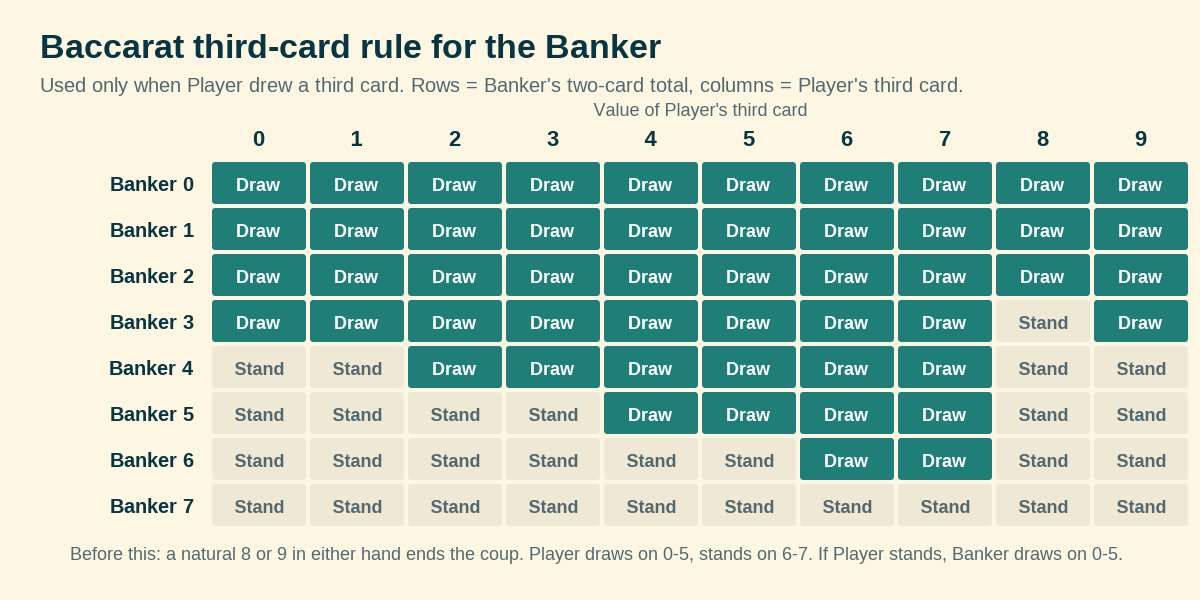
The same chart as a list:
| Banker’s total | Banker draws when Player’s third card is | Banker stands when it is |
|---|---|---|
| 0, 1, 2 | Any card | Never |
| 3 | Anything except 8 | 8 |
| 4 | 2 to 7 | 0, 1, 8, 9 |
| 5 | 4 to 7 | 0 to 3, 8, 9 |
| 6 | 6 or 7 | 0 to 5, 8, 9 |
| 7 | Never | Always |
Remember that a 10 or a picture card has value 0, so “Player’s third card is 0” means Player drew a ten, jack, queen or king.
You don’t need to memorize this to play; the dealer, or in our case the game’s code, applies it for you. It’s still worth knowing, because the chart is the reason the Banker bet wins more often.
Two example hands
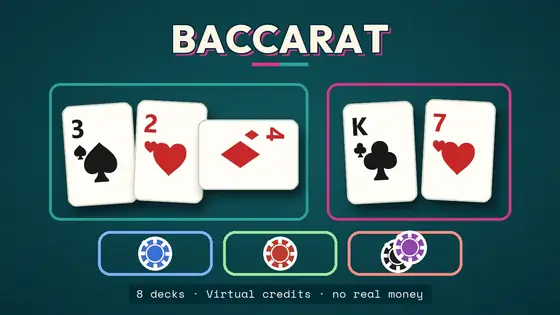
Example 1. Player gets 2 and 3 (total 5). Banker gets a king and 4 (total 4). Nobody has a natural. Player has 5, so Player draws: a 7. Player’s total is 2+3+7 = 12, which counts as 2. Banker has 4, and Player’s third card is a 7, so the chart says draw. Banker draws a 9: 0+4+9 = 13, which counts as 3. Banker wins, 3 to 2.
Example 2. Player gets 9 and queen (total 9). That is a natural. Banker’s 6 and 2 make 8, also a natural, but 9 beats 8. Player wins, and no third cards are dealt.
Payouts and the 5% commission
| Bet | Wins when | Pays | A winning 10-credit bet returns |
|---|---|---|---|
| Player | Player’s total is higher | 1:1 | 20 |
| Banker | Banker’s total is higher | 0.95:1 (5% commission) | 19.50 |
| Tie | Totals are equal | 8:1 | 90 |
When the hand is a tie, Player and Banker bets are returned, not lost. Our table has no side bets.
The commission exists because Banker wins more often. Banker acts last, and its chart reacts to Player’s third card, so it gets a small information edge every time Player draws. Pay the Banker bet at even money and the bettor would come out about 1.24% ahead in the long run. Taking 5% from each Banker win flips that to a small house edge.
Baccarat odds: what each bet costs
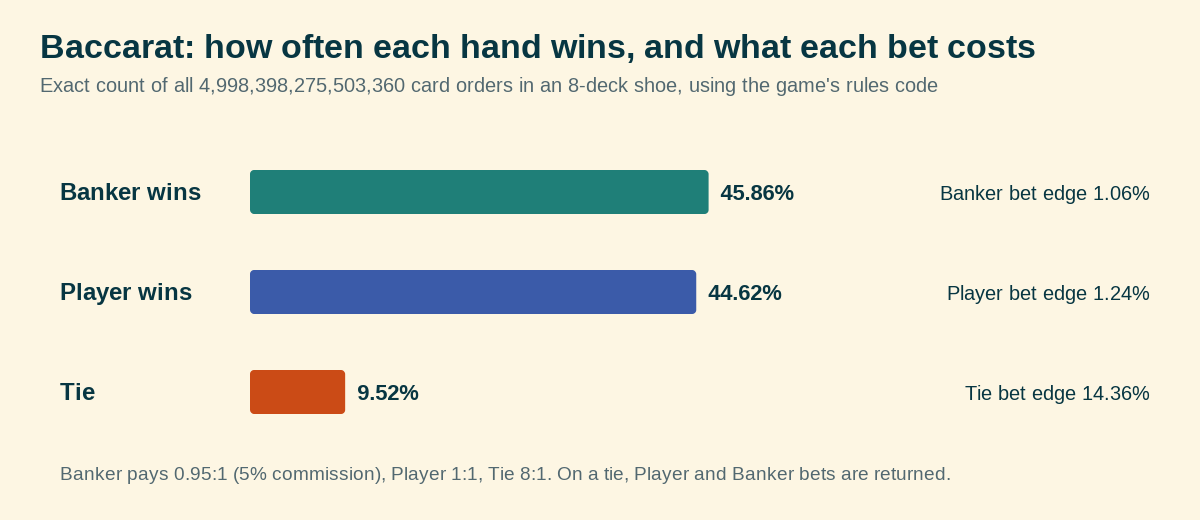
These numbers are not from a simulation. The game’s rules file includes a function that walks through every possible order of the six cards that can be dealt from an 8-deck shoe, 4,998,398,275,503,360 of them, and counts who wins. The result:
| Outcome | Probability | House edge on the bet |
|---|---|---|
| Banker wins | 45.86% | Banker: 1.06% |
| Player wins | 44.62% | Player: 1.24% |
| Tie | 9.52% | Tie: 14.36% |
To more decimals the edges are 1.0579%, 1.2351% and 14.3596%. A few other results from the same count:
- 34.30% of hands end with a natural.
- Player draws a third card in 50.34% of hands, Banker in 43.54%.
- A tie comes up about once in 10.5 hands. A fair payout would be about 9.5 to 1; the table pays 8 to 1, which is where the Tie bet’s large edge comes from.
Is there a baccarat strategy?
Since you only choose the bet, strategy comes down to price. Banker is the cheapest bet, Player is close behind, and the gap between them (0.18 points) is too small to notice over an evening. The Tie bet costs more than thirteen times as much as Banker and is the one real mistake on the table.
Tracking patterns on the scoreboard doesn’t help. The cards don’t know what the last hand was, and the shoe composition changes too little from hand to hand to matter for Player or Banker bets. Systems that raise the stake after a loss run into the same wall as roulette systems, which our European roulette guide works through with the numbers.
If you want a card game where your own choices move the odds, blackjack basic strategy is the next step: the edge there depends on how you play.
Play baccarat free
Our free baccarat table deals by exactly these rules, with 1,000 virtual credits to start and free refills. Credits can’t be bought, cashed out or exchanged for prizes. The game is meant for adults (18+). Real-money baccarat is gambling with a house edge on every bet, and it may be illegal where you live.
Frequently asked questions
How do you play baccarat for beginners?
Put your chips on Player, Banker or Tie and the cards are dealt by fixed rules. Each hand gets two cards, sometimes a third, and the hand whose total is closer to 9 wins. You make no decisions after placing the bet.
Why does the Banker bet pay a commission?
Because Banker draws after Player and uses a chart that reacts to Player's third card, it wins slightly more often (45.86% against 44.62%). Paid at even money, the Banker bet would favor the bettor by about 1.24%. A 5% commission on Banker wins turns that into a 1.06% house edge.
What is a natural in baccarat?
A two-card total of 8 or 9 in either hand. When a natural appears, the coup ends at once and neither hand draws. In an 8-deck shoe about 34.3% of hands end with a natural.
Is the Tie bet worth it in baccarat?
No. A tie comes up 9.52% of the time, about once every 10.5 hands, but pays only 8:1. A fair price would be about 9.5:1, and the gap gives the Tie bet a 14.36% house edge, more than thirteen times the Banker bet's.
Who decides whether a third card is drawn?
The rules, not the players. Player draws on 0-5 and stands on 6-7. Banker draws on 0-5 if Player stood; if Player drew, Banker's move depends on its own total and the value of Player's third card, as shown in the chart.