Slot RTP and Volatility Explained
Every slot has two numbers that decide what playing it feels like. RTP (return to player) is how much of all the money bet comes back over a very long run. Volatility is how unevenly it comes back. The first tells you the price of playing. The second tells you whether you’ll pay it in small steady amounts or in long dry spells broken by the odd big hit. This guide explains both with real figures from the slots on this site, starting with the simplest one, our 3-reel Jackpot Slot.
What RTP really means
RTP is an average over every outcome the game can produce, weighted by how likely each one is. If a slot’s RTP is 95%, then across millions of spins it pays back 95 credits for every 100 staked. The missing 5 is the house edge.
On a simple slot you can count it exactly. Our Jackpot Slot has three reels, and each reel stops on one of 32 positions, so there are 32 × 32 × 32 = 32,768 possible results. Add up what each result pays on all five lines, divide by the total bet, and you have the RTP. We did exactly that with the game’s own code: 95.32%, without the progressive jackpot pool.
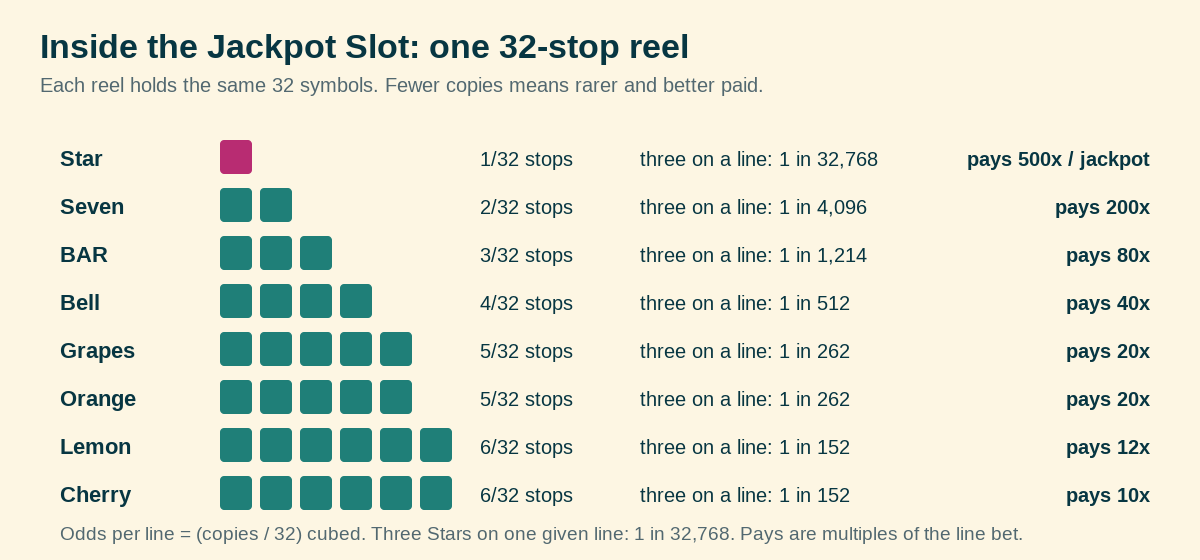
The reel strip shows where the number comes from. There is a single Star among the 32 stops, so three Stars on a given line come up once in 32,768 spins, and with five lines that is once in about 6,554 spins. Cherries fill 6 stops, so a cherry on the first reel is common, and it pays only 2 times the line bet. Every payout is matched to how often it happens, and the sum lands just under 100%.
The progressive pool sits on top. It starts at 5,000 credits and grows by 2% of every bet; at the max bet three Stars win the whole pool instead of the fixed 500× pay. Since the extra 2% of each bet is eventually paid back through the pool, the return at the max bet is about 97.3%. At the smaller bets the pool can’t be won and the return stays at 95.32%.
What RTP doesn’t tell you
RTP is not what you’ll get back today. It is a long-run average, and a session of a few hundred spins can land far above or below it. That spread is volatility.
Volatility: how the return is paid out
Two slots can both return 95% and still feel nothing alike. One pays a small amount on most spins; the other pays nothing for a long time and then a lot. The first is low volatility, the second high volatility. Statistically, volatility is the standard deviation of the result of one spin.
Here is what it looks like on the Jackpot Slot, from the same full count of 32,768 results:
| Measure | Jackpot Slot |
|---|---|
| Spins that pay something | 56.23% |
| Spins that return less than the bet (including no win) | 76.68% |
| Share of the 95.32% paid back through wins smaller than the bet | 20.69 points |
| Share paid back through wins of 20× the bet or more | 11.27 points |
| Standard deviation of one spin | about 3.0 × the total bet |
The first two lines are the interesting pair. More than half the spins “win”, yet more than three spins in four leave you with less than you bet, because many wins are a single cherry paying 2× the line bet, which is under half your total stake. A slot that lights up often is not necessarily paying you.
The same RTP, different slots
Our three Turkish-themed slots and Gem Mine return within half a point of each other, yet behave very differently:
| Slot | RTP | Paid spins with any win | Biggest round seen |
|---|---|---|---|
| Cappadocia Balloons | 95.33% (calculated) | - | - |
| Anatolian Treasure | 94.97% (40M spins) | 41.76% | 564.4× the bet |
| Turkish Delight Palace | 94.78% (40M spins) | 21.30% | 701.2× the bet |
| Gem Mine | 94.76% (calculated) | - | - |
Turkish Delight Palace pays on about one paid spin in five; Anatolian Treasure on about two in five. Over 40 million spins, the biggest single round on Turkish Delight Palace was larger too. That is the trade every volatile slot makes: fewer wins, more of the return packed into rare big ones. The figures come from each game’s rules file, where the exact calculation or the 40-million-spin measurement is stored next to the code. A dash means we didn’t measure that figure for the game.
What a session actually looks like
Averages are easier to trust once you see the spread. We played 20,000 sessions of 1,000 spins each on the Jackpot Slot, at a total bet of 5 credits (5,000 credits staked per session), using the game’s spin code.
| Result after 1,000 spins | Credits |
|---|---|
| Average | -233 |
| Median (middle session) | -278 |
| Worst 10% lost more than | 792 |
| Best 10% were up more than | 389 |
| Sessions that finished ahead | 28.1% |
The average loss, 233 credits, is almost exactly 4.68% of 5,000, just as the RTP predicts. Yet more than a quarter of the sessions ended in profit, and some swung a long way in either direction. That is why a good night on a slot doesn’t mean the slot is “loose”, and a bad night doesn’t mean it is “tight”. Over 1,000 spins the volatility is still bigger than the edge. Over a million spins it isn’t.
Demo slots vs real money
On this site the credits are virtual and the RTP printed on each game page is the one the game actually runs. Every slot here is our own code, so the demo and the math are the same thing.
Elsewhere, be careful with that assumption. Commercial slot makers often build the same game with several RTP settings, and the operator chooses which one goes live. A demo can show you how a game plays, but it may not tell you which setting a real-money version uses. Whatever the setting, it stays under 100%.
RTP across the games on this site
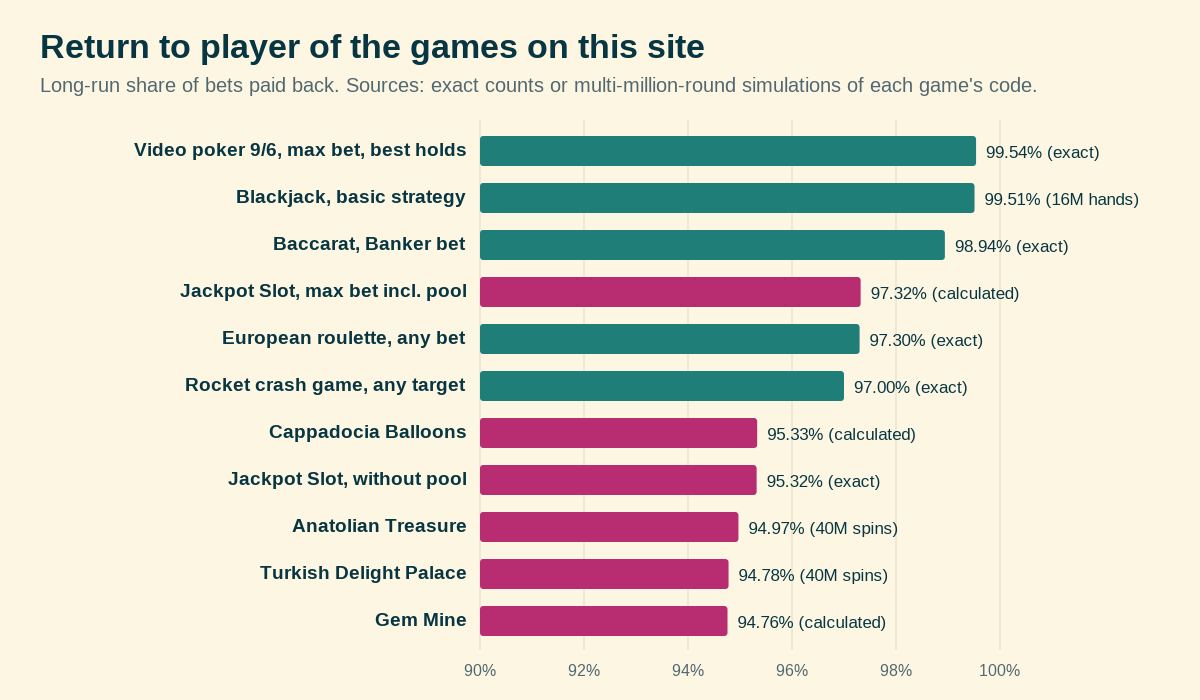
Slots have the lowest returns of the games we run, and they are also the only games where you make no decision that affects the result. If you want a machine where the choices matter, Jacks or Better video poker returns 99.54% with the best holds. If you like a fast, pure-chance game with a fixed price you can see, read how crash games set their 97% return. Roulette’s single-zero math is the cleanest example of a fixed edge of all.
Play the slots without the risk
You can spin the Jackpot Slot and the other slots here with 1,000 virtual credits and free refills. Credits can’t be bought, cashed out or turned into prizes. These games are for adults (18+). Real-money slots are gambling, every one of them returns less than it takes, and they may be illegal where you live.
Frequently asked questions
What does RTP mean on a slot?
Return to player: the percentage of all money wagered that the game pays back over a very long run. A 95% RTP slot pays back 95 of every 100 credits bet on average across millions of spins, and keeps the other 5. It is a long-run average, not a promise for any single session.
What is slot volatility?
Volatility (or variance) describes how the return is spread out. A low-volatility slot pays small wins often; a high-volatility slot pays rarely but sometimes pays a lot. Two slots with the same RTP can feel completely different because of it.
Is a high RTP slot better?
It costs less over a long run: at 97% you lose 3 per 100 bet on average, at 94% you lose 6. In a short session the difference is hidden by luck. RTP never goes above 100% on a real slot, so a higher RTP only means losing more slowly.
Is the RTP of a demo slot the same as the real money version?
Only if both run the same configuration. Our slots are our own games, and the RTP on each page is the one the demo runs. Commercial slots are often built with several RTP settings and the operator picks one, so a free demo somewhere else may not tell you the setting used for real money.
Do slots pay more after a long losing streak?
No. Every spin is independent. Our slots pick each reel stop at random on every spin, and nothing in the code looks at earlier results or at how long it has been since a big win.