Crash Games Explained: Odds and Strategy
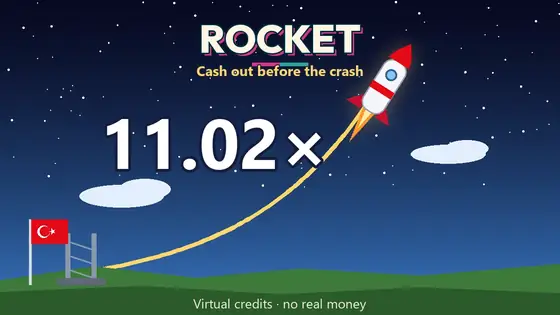
A crash game shows a multiplier that starts at 1.00x and keeps rising until it suddenly crashes. You win if you cash out before the crash; your bet is multiplied by the value at that moment. It looks like a game of nerve, but the outcome is fixed the instant the round begins. This guide shows how the crash point is picked, what the odds of every multiplier really are, and why cash-out strategies don’t beat the house. The numbers come from the rules file of our own crash game, Rocket, which you can play free with virtual credits.
What is a crash game?
You place a bet and the round starts. A rocket, a plane or a line on a chart climbs, and a multiplier beside it grows: 1.10x, 1.50x, 2.00x. At any moment you can press Cash out and collect your bet times the current multiplier. At some point the round crashes, and anyone still in loses their bet.
On our Rocket game the multiplier grows with time as e^(0.06 × seconds), so it reaches 2x after about 11.6 seconds and 10x after about 38 seconds. You can cash out from 1.01x, by hand or with an auto cash-out target anywhere from 1.01x to 1000x. Bets go from 10 to 500 credits in steps of 10.
How the crash point is picked
The key fact is that the crash point is drawn before the rocket moves. When you press Launch, the game draws one random number and turns it into a crash point. The climbing animation just plays toward that value. Watching the rocket, hesitating, or pressing Cash out at a “feeling” has no effect on where it stops.
The rule our game uses fits in one line:
Chance that the crash point is at least m = 0.97 / m
The value is rounded down to two decimals and capped at 1000x. Two consequences follow:
- 3% of rounds crash at once, on the launch pad, before reaching 1.01x. Add the rounds that crash between 1.00x and 1.01x and about 3.96% of rounds show 1.00x in the history bar.
- Half the rounds end below about 1.94x. That is the median crash point.
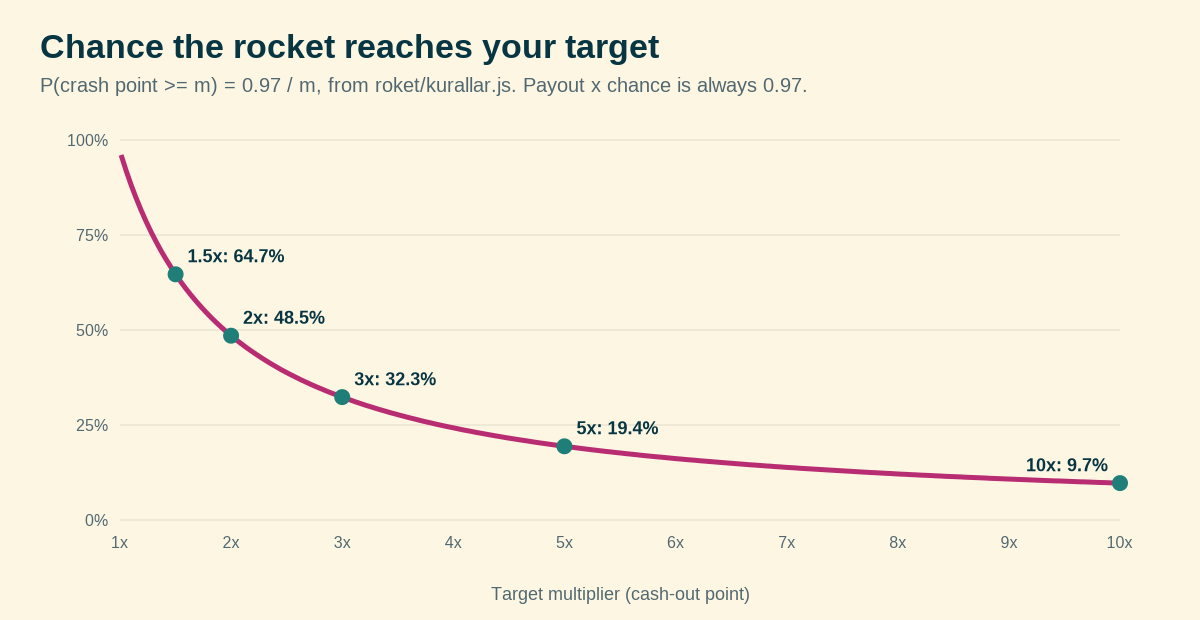
Crash game odds for each target
| Cash-out target | Chance the rocket gets there | Long-run return |
|---|---|---|
| 1.01x | 96.04% | 97% |
| 1.5x | 64.67% | 97% |
| 2x | 48.50% | 97% |
| 3x | 32.33% | 97% |
| 5x | 19.40% | 97% |
| 10x | 9.70% | 97% |
| 100x | 0.97% | 97% |
| 1000x | 0.097% | 97% |
Look at the last column. Aim for 2x and you win 48.5% of rounds, collecting 2 each time: 0.485 × 2 = 0.97. Aim for 10x and you win 9.7% of rounds, collecting 10: 0.097 × 10 = 0.97. Whatever target you pick, the chance of reaching it is 0.97 divided by the target, so the target cancels out and 97% is left every time. The house keeps 3 credits of every 100 bet, and there is no target where it keeps less.
That is the whole design of a crash game. The house edge doesn’t depend on your skill or your timing. It sits inside the rule that picks the crash point.
Why crash game strategies don’t work
Search for “crash game strategy” and you’ll find the same few ideas. None of them gets past the table above.
“Always cash out low.” Cashing out at 1.2x wins 80.8% of rounds, which feels great. Each win pays only 0.2 of the bet, though, and each loss costs the full bet. The return is 0.808 × 1.2 = 0.97, the same as any other target.
“Wait for a big one after a run of low rounds.” The history bar on our game shows the last 20 crash points, and five low rounds in a row look like a sign. They aren’t. Each round is drawn fresh; after any run of results, the chance of reaching 10x on the next round is still 9.7%. Expecting a big multiplier because it is “due” is the gambler’s fallacy.
“Double after every loss.” This is the martingale, and on a 2x target it seems to make sense: a win at 2x pays back everything lost plus the first bet. The trouble is how fast the stake grows.
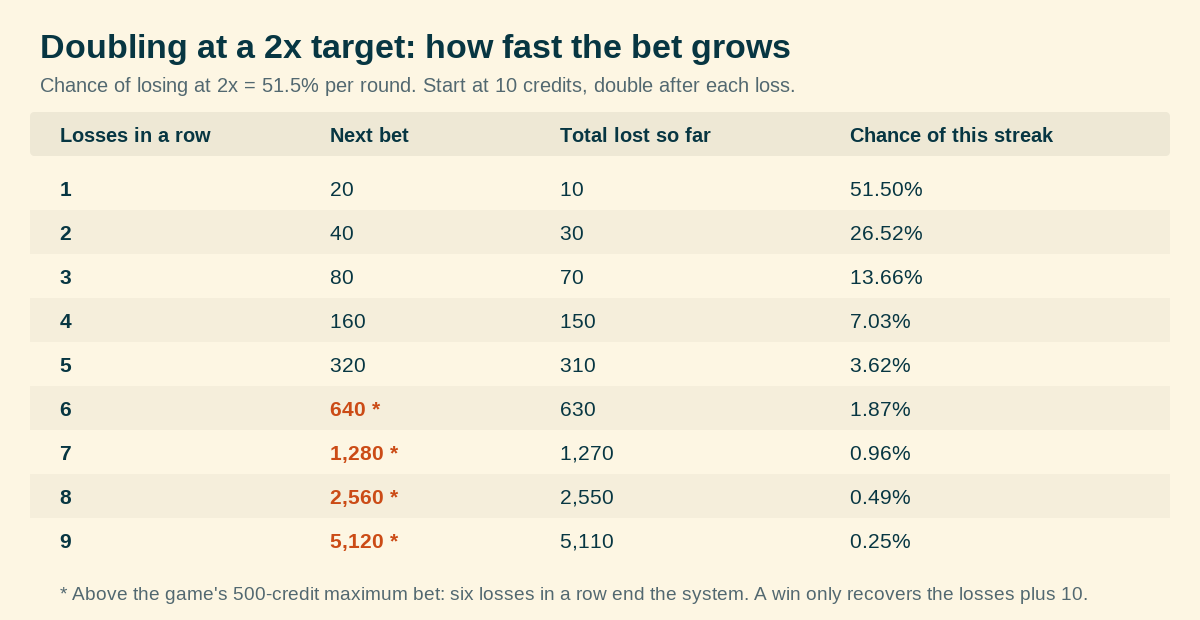
Starting at 10 credits, six straight losses cost 630 and call for a 640 bet, above our 500 limit. At a 2x target each round loses with a chance of 51.5%, so six losses in a row happen about 1.87% of the time on any given try. That looks small until you count rounds: over 50 rounds the chance of hitting at least one such run is about 36%, and over 100 rounds about 60%. The system turns many small wins into an occasional large loss, and the average stays at 97%.
“Raise the bet when you’re winning.” Changing the size of your bets changes how much you can win or lose in a session. It doesn’t touch the 97% that each round returns, and the total of rounds that each return 97% is still 97%.
Predictors, bots and signals
Crash games attract apps, bots and paid groups that promise to predict the next crash point. On our game, prediction is impossible by design: the crash point is drawn from the browser’s random number generator when the round starts, and nothing about earlier rounds feeds into it. The same holds for any crash game that draws its rounds fairly. If someone really could see the next crash point, they would have no reason to sell it to you.
How crash games compare
A crash game is closest to a slot: chance decides everything, and your only real choice is how to spread the risk. Our slot RTP and volatility guide shows the same idea from the other side, with slots returning about 95% against Rocket’s 97%. On a European roulette table every bet returns 97.30%, and the bets differ only in how often they win, which is exactly what crash targets do.
Try it with virtual credits
Rocket runs on the rules described here, with 1,000 virtual credits and free refills. Credits can’t be bought, cashed out or turned into prizes. It is meant for adults (18+). Real-money crash games are fast, a round takes seconds, they may be illegal where you live, and with a return under 100% they take money from players over time.
Frequently asked questions
What is a crash game?
A gambling-style game where a multiplier rises from 1.00x and stops at a random crash point. You decide when to cash out. If you cash out before the crash, your bet is multiplied by the value at that moment; if the crash comes first, the bet is lost.
How is the crash point decided?
In our Rocket game it is drawn once, when the round starts, using the browser's random number generator. The rule is that the chance of reaching at least multiplier m is 0.97 divided by m, with the value rounded down to two decimals and capped at 1000x.
What is the best crash game strategy?
There isn't one that wins. Every target returns 97% over time on our game: cashing out at 2x wins 48.5% of rounds and pays 2, while 10x wins 9.7% and pays 10, and both multiply out to 0.97. Picking a target only changes how bumpy your results are.
Can you predict the crash point?
No. Each round's crash point is drawn independently, so past rounds, the time of day and your bet size tell you nothing about the next one. Apps or groups that claim to predict it are wrong, or are selling something.
Why do so many crash rounds end below 2x?
Because of the 0.97 / m rule. Only 48.5% of rounds reach 2x, so more than half crash before it. The median crash point on our game is about 1.94x. Very high multipliers exist, but they are rare: 1000x has a 0.097% chance.