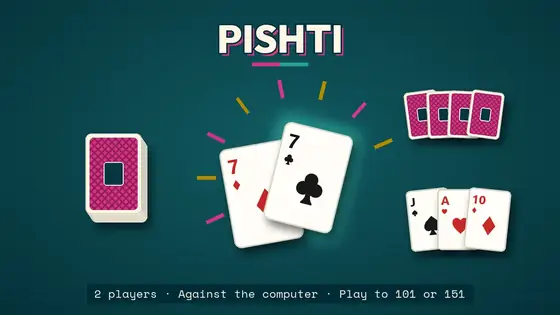
Pishti (written pişti in Turkish, sometimes pisti) is a fast two-player fishing card game. You capture the pile by matching the top card’s rank or by playing a jack, and you score for certain cards, for taking most of the deck and above all for pishtis. Here you play pishti against the computer in your browser, with nothing to install. The first to 101 points wins, or 151 if you prefer a longer match.
How to play pishti
The deal
A standard 52-card deck is used. At the start of a hand four cards go to the table: three face down and the top one face up. You and the computer get four cards each. When both hands are empty, four more cards each are dealt from the deck. In a two-player game that happens six times, so each player plays 24 cards per hand. The deal alternates every hand, and the player who didn’t deal plays first.
Your turn
Tap a card in your hand and it goes onto the pile in the middle. One of three things happens:
- Same rank: if your card matches the rank of the top card (7 on 7, queen on queen), you take the whole pile.
- Jack: a jack takes the pile whatever the top card is.
- No match: your card stays on the pile and it’s the computer’s turn.
Suits don’t matter, only rank: the 7 of diamonds takes the 7 of clubs.
What is a pishti?
Capturing a pile of exactly one card with the same rank is a pishti, worth 10 points. Taking a single jack with another jack is worth 20 points. The game calls it out on screen: Pishti! or Jack pishti! Two things look similar but are not pishtis:
- Taking a single non-jack card with a jack captures it, but scores no pishti.
- Taking the four-card starting pile is never a pishti, even though only one card shows.
Pishtis usually come right after a capture. The table is empty, the next player has to put down a single card, and if the opponent holds the same rank, that’s a pishti.
Cards left at the end
When the deck is used up and the last cards are played, some may still be on the table. They go to the player who made the last capture in that hand, which makes the final round worth planning for.
Pishti scoring
At the end of each hand your captured cards are counted. The score sheet in the game lists cards taken, card points, the most-cards bonus and pishtis line by line.
| Card or event | Points |
|---|---|
| Each ace (4) | 1 |
| Each jack (4) | 1 |
| 2 of clubs | 2 |
| 10 of diamonds | 3 |
| Most cards (27 or more) | 3 |
| Each pishti | 10 |
| Jack-on-jack pishti | 20 |
All other cards score nothing on their own, but they count toward the most-cards bonus.
Without pishtis, every hand hands out 16 points: 4 for aces, 4 for jacks, 2 for the 2 of clubs, 3 for the 10 of diamonds and 3 for most cards. A 26-26 split gives the bonus to nobody. Pishtis come on top, and they swing hands more than anything: one jack-on-jack pishti is worth more than all the card points together.
A scoring example
| You | Computer | |
|---|---|---|
| Cards taken | 30 | 22 |
| Aces | 3 → 3 | 1 → 1 |
| Jacks | 2 → 2 | 2 → 2 |
| 2 of clubs | no | yes → 2 |
| 10 of diamonds | yes → 3 | no |
| Most cards | 3 | no |
| Pishtis | 1 → 10 | 2 → 20 |
| Hand total | 21 | 25 |
The non-pishti part is 11 + 5 = 16. You took more cards and the 10 of diamonds, yet the computer’s two pishtis won the hand.
When the match ends
Scores carry from hand to hand. The first to 101 wins; the Target setting raises it to 151 from the next match. If you both pass the target in the same hand, the higher score wins, and a tie means one more hand.
Playing pishti against the computer
The computer only uses cards it has seen. It doesn’t see your hand or the face-down starting cards. If you take the starting pile, its three hidden cards are shown to you briefly; if the computer takes it, they stay hidden. Difficulty sets the computer’s memory:
| Difficulty | What the computer remembers | Win rate against Hard over 1,000 matches |
|---|---|---|
| Easy | Nothing; takes a match when it has one, throws a jack on a big pile | 14.9% |
| Normal | The last 8 cards shown | 33.5% |
| Hard | Every card shown since the start of the hand | 48.6% (Hard vs Hard) |
Normal beat Easy in 73.5% of 1,000 matches. We measured this by running the game’s own rules code with two computer players, 1,000 matches to 101 for each pairing, alternating who played first. Those matches averaged 1.1 to 1.2 pishtis per hand, about a third of hands had none, 26-26 splits happened in 3-4% of hands and a match lasted 6.3 to 6.8 hands. Jack-on-jack pishtis showed up only 0.4 to 1.3 times per 100 hands.
Pishti strategy
Count the ranks. There are four of each. If three 9s are gone, the last 9 is safe to put on an empty table: nobody can make a pishti on it.
Be careful on an empty table. Right after a capture, the player who must lay a single card takes the biggest risk. Prefer ranks you’ve already seen two or three of.
Save jacks for good piles. A jack takes anything, so its value depends on the pile. Use it on a pile holding the 10 of diamonds, the 2 of clubs, an ace or lots of cards, not on two plain cards.
Mind what the pile is worth. If the 10 of diamonds is on the table, don’t add a card the computer can match.
Keep something for the last round. The leftovers go to the last capture, so a jack or a likely match in your final four cards pays off.
For another two-player Turkish card game, try Sixty-Six. For a simple game to play with children, try Old Maid. If you would rather get rid of your cards than capture them, pis yedili is the Turkish take on crazy eights. More are on the Turkish games page.
Frequently asked questions
What is a pishti?
A pishti is capturing a pile of exactly one card with a card of the same rank. It is worth 10 points. Capturing a single jack with another jack is worth 20. Taking a single card with a jack of a different rank is not a pishti, and neither is taking the four-card pile from the start of the hand.
How are cards scored in pishti?
Each ace and each jack is 1 point, the 2 of clubs is 2 and the 10 of diamonds is 3. Whoever takes the most cards (27 or more) gets 3 more. Each pishti adds 10, a jack-on-jack pishti 20.
How many points are there in one hand of pishti?
16, not counting pishtis: 13 from the scoring cards and 3 for most cards. If the cards split 26-26, nobody gets those 3. Pishtis come on top.
Who gets the cards left on the table at the end?
The player who made the last capture in that hand. The three face-down cards from the start belong to the first pile, so whoever captures that pile gets them too.
How many players can play pishti here?
This pishti is for two: you and the computer. There is no three- or four-player table on this page and no online play with friends.
Does the computer cheat or see my cards?
No. It only knows cards that have been shown on the table, and it doesn't know the face-down starting cards either. How much it remembers depends on Difficulty: Easy doesn't count at all, Normal remembers the last 8 cards shown, Hard remembers every card shown since the start of the hand.
Do I need to download pishti?
No. It opens in the browser on phone and computer, with no account. There is no money or betting; points only count inside the match.
 Okey
 101 Okey
 Batak
 King Card Game
 Sixty-Six (66)
 Old Maid