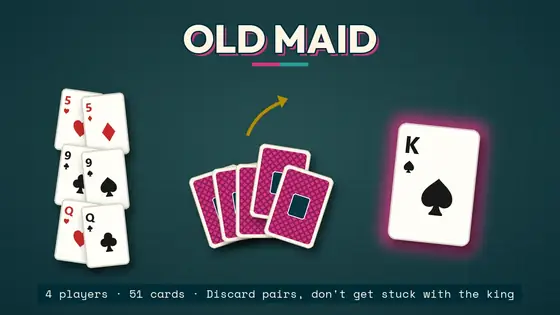
Old Maid is a simple matching card game: you pair off your cards and try not to be the one left holding the odd card. In the Turkish version, papaz kaçtı, the odd card is a king (papaz) rather than a queen. Here you play Old Maid online against three computer players, right in your browser with nothing to download. A hand takes a few minutes and one hand is enough to learn it.
Why a king instead of a queen?
In the classic English game a queen is taken out of the deck. The Turkish game takes out a king instead. In this version the removed card is always the king of clubs, so the kings of diamonds, hearts and spades stay in. Two of them eventually pair up, and the third never can. It wanders from hand to hand, and whoever ends up with it loses. In Turkish you then “become the king”. When you lose, the screen says You’re stuck with the King!; when you get away, it says You’re out!
Old Maid rules
Deck and players
Take a 52-card deck and remove the king of clubs, leaving 51 cards. Four seats: you at the bottom, computer players to your left, across and to your right. Cards are dealt one at a time, so three players start with 13 cards and one with 12.
The first clear-out
Before anyone draws, every hand is cleared of pairs. Two cards of the same rank, such as two 8s or two jacks, go straight to that player’s discard pile. You don’t do this yourself: the game clears every hand and shows how many pairs each player threw out next to their seat.
Drawing cards
You always go first. On your turn, the hand of the player to your left opens face down in the middle of the table and a message asks you to draw a card from the Left player. Tap any card:
- If it matches a card in your hand, both go out and the pair is shown to everyone.
- If it doesn’t, the card joins your hand and the turn passes.
Then Left draws from Across, Across draws from Right, and Right draws from you. When a card is taken from you, the message line says which card it was and whether the player who took it made a pair.
Getting out and losing
When your hand is empty, you’re safe; your seat is marked as out and you can watch the rest. Players with no cards are skipped, so if Left is out, you draw from the next player who still has cards. The game ends when only one player has cards left. That player holds one card, the odd king, and loses; the other three win. Play again deals a new hand. The game is saved while you play, so if you close the page, the hand continues where you left it.
How a hand plays out
- Open the page. Cards are dealt and pairs are cleared automatically.
- Your hand sits face up at the bottom, sorted by rank and suit.
- When the Left player’s face-down cards appear in the middle, tap one.
- A pair goes to the table; otherwise the card joins your hand.
- The computer players draw in turn; watch the message line for the card taken from you.
- Keep going until your hand is empty or you’re the only one left.
Why hands shrink so fast
A full deck has four cards of each rank. Any two of a rank dealt to the same player leave in the first clear-out, and four of a rank leave as two pairs. After the clear-out each hand holds at most one card of each rank. So a 13-card hand usually drops to five to seven cards before play starts. Across all four hands the average is 6.2 cards, and 13 pairs leave the table in the first clear-out.
After that, about one draw in three makes a pair. A draw that doesn’t pair makes your hand one card bigger and the giver’s hand one smaller; a pair removes two cards at once. A hand ends after about 36 draws on average.
The kings behave differently. Two of the three eventually meet and pair, but the odd one never matches. Whoever draws it gets one card bigger instead of smaller, which is why the last turns often see two players with one or two cards passing the king back and forth.
Which seat loses most often?
Picking a card can’t change your chances, but your seat does. We ran the game’s own rules code for 10,000 hands, with every seat drawing at random:
| Seat | Left holding the king |
|---|---|
| You (draw first) | 31.1% |
| Left | 12.6% |
| Across | 23.9% |
| Right | 32.5% |
With an even spread each seat would be at 25%. Left loses least: it’s the player you draw from every turn. Right starts with 12 cards and draws from you, and loses most. You always sit at the bottom here, so roughly one hand in three the king will stay with you. We repeated the test with a separately written program over 20,000 hands and got the same table (you 31.0%, Left 12.4%, Across 24.3%, Right 32.3%).
Tracking the king
There’s no skill in choosing a card, but you can usually tell where the king is.
- If you have it, you know. If you drew a king and couldn’t pair it, the odd one is with you for now. When Right takes it, the message line names the card.
- Watch the discarded pairs. Until a pair of kings shows up, two kings may still be loose. Once it does, the remaining king is the losing card.
- Watch card counts. If everyone’s hand shrinks and one player’s doesn’t, that player probably has the king.
For a card game where your choices matter more, try Pishti or Sixty-Six. All the classics are on the Turkish games page.
Frequently asked questions
How do you play Old Maid?
Deal the deck, and everyone throws out their pairs. On your turn you draw a face-down card from the next player's hand; if it makes a pair, you throw the pair out. Players who run out of cards are safe, and whoever is left holding the odd card loses.
Which card is removed in this version?
The king of clubs. That leaves three kings: two of them pair up, and the third can never find a match. Whoever holds it at the end loses. In Turkish the game is called papaz kaçtı, roughly 'the king ran off'.
How many players are there?
Four. You sit at the bottom, and computer players sit in the Left, Across and Right seats. There is no online play with friends.
Does it matter which face-down card I pick?
No. After every draw, both the hand that gave the card and the hand that took it are shuffled, so the position of a card tells you nothing. The computer players pick at random too.
Can a player be out right after the deal?
Rarely. When we dealt the game's code 10,000 times, it happened in only 6 hands. A player whose cards all pair up in the first clear-out is safe immediately and skipped.
Is Old Maid a good card game for kids?
Yes. The rules take a minute to explain and there are no wrong moves, so it's a good first card game: children practice spotting pairs, waiting their turn and losing gracefully. It's free in the browser, with no sign-up and nothing to buy.
 Okey
 101 Okey
 Batak
 Pishti
 King Card Game
 Sixty-Six (66)