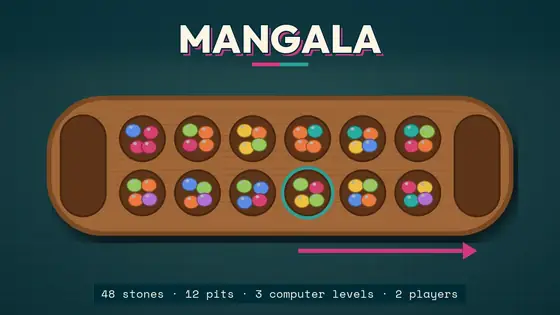
Mangala is the Turkish version of mancala, the family of games where you sow stones around a board of pits and try to collect the most in your store. In Turkey it is played everywhere from village tea houses to school tournaments. If you came here looking for mancala rules, note that mangala has a few rules of its own, explained below and matching the code of this game. You can play mangala free in your browser, with no download and no sign-up, against the computer at three levels or against a friend on the same device.
Mangala board and stones
The board has two rows of six pits, and at each end there is a long store.
| Item | Count |
|---|---|
| Stones | 48 |
| Small pits | 12 (6 per player) |
| Stones per pit at the start | 4 |
| Stores | 2 (one per player, empty at the start) |
Your side is the bottom row of six pits and your store is on the right. When you hold a phone upright, the board turns and your store appears at the top. Against the computer, you move first.
Play mangala vs computer or a friend
Pick your opponent above the board:
- Computer: Easy, Medium or Hard. Easy plays a random pit half the time and barely looks ahead. Medium looks four moves ahead. Hard looks nine moves ahead and plays the best line it finds.
- Friend: Two people share one phone or computer and take turns on the same board.
Hint marks a strong pit. Undo takes back your last move; against the computer, its reply comes back too. The game saves as you play, together with the level you picked.
Mangala rules
Sowing the stones
Tap one of your pits that has stones in it. All the stones are picked up and sown counterclockwise, one per pit:
- The first stone goes back into the pit you just emptied. The rest drop one by one into the following pits.
- Passing your own store, you drop a stone in it.
- Your opponent’s store is skipped. No stone goes there.
- A pit with a single stone is the exception: that stone moves on to the next pit.
The pits light up one after another as the stones drop, so you can follow where a move goes.
Where did the last stone land?
| Last stone lands… | Result |
|---|---|
| In your own store | You get an extra turn |
| In an opponent’s pit, making the count even (2, 4, 6…) | All stones in that pit go to your store |
| In an empty pit on your side, with stones in the opposite pit | That stone and all the stones opposite go to your store |
| Anywhere else | Your opponent moves |
End of the game
The game stops the moment all six pits on one side are empty. The player whose side is empty takes every stone still sitting in the other side’s pits and adds them to their store. The player with the most stones in their store wins. With 48 stones in play, a 24-24 finish is a draw.
Mangala vs Kalah: what’s different
Most English mancala rules describe Kalah. Both games use 4 stones per pit, skip the opponent’s store, give an extra turn for ending in your store, and capture from an empty pit on your side. The differences:
| Rule | Mangala (this game) | Kalah |
|---|---|---|
| First stone | Goes back into the emptied pit | Goes into the next pit |
| Capture on the opponent’s side | Last stone makes an even number: take the pit | None |
| Empty-pit capture | Only if the opposite pit has stones | Varies between rule sets |
| Game end | The player whose side is empty takes the stones left on the other side | Each player keeps the stones left on their own side, in the usual rules |
If you play mangala with Kalah habits, the first-stone rule is the one that catches you: every count is one pit shorter.
Your first move
Because the first stone goes back into its own pit, the last stone of a pit holding n stones lands n - 1 pits ahead. At the start every pit holds 4 stones, so the last one lands three pits away.
That means the third pit counting back from your store (the fourth from the left) ends exactly in your store and earns you an extra turn. After that move it holds 1 stone and the two pits to its right hold 5 each. Recount before the second move; the new numbers sometimes open another chain.
Quick counting rule
Number your pits 1 to 6 from left to right; pit 6 is next to your store. As long as a pit has too few stones to go all the way around:
- Pit number + stones = 8 means the last stone falls in your store. For example, 6 stones in pit 2, 4 in pit 4, or 2 in pit 6.
- A single stone doesn’t follow this rule, because it moves only one pit. A lone stone in pit 6 goes straight into your store and also gives you an extra turn.
- Below 8, the last stone stays on your side; above 8, it spills into your opponent’s pits.
The same count tells you where you reach on the other side: a total of 9 lands in the first opponent pit after your store, 10 in the second, and so on.
Capture examples
Making it even. Your pit 5 holds 4 stones. The first goes back into pit 5, then one each into pit 6, your store and the first opponent pit after your store. If that pit had 3 stones it now has 4, an even number, so all four go to your store. If it had 4, it now has 5 and you take nothing.
Empty pit. Your pit 1 holds 3 stones and pit 3 is empty. The stones drop into pits 1, 2 and 3. The last one landed in an empty pit, so it goes to your store together with every stone in the opponent pit opposite pit 3. If that opposite pit is empty, nothing is captured and the turn passes.
Mangala strategy
- Play store-ending moves first. If two pits both end in your store, start with the one closer to the store; the other pit’s count doesn’t change, so you keep the second extra turn.
- Target your opponent’s odd pits. Drop your last stone on a pit with 3, 5 or 7 stones and it becomes even and yours.
- Guard your own odd pits. The computer does the same math. Think about spreading a big odd pile before it sits within reach.
- Watch empty pits. An empty pit on your side facing a full one is a capture chance. An empty pit on the other side facing your full pit is a threat.
- Plan the finish. The first to clear their side takes the stones left opposite. If your pits are thin while your opponent’s side is full, emptying fast can win the game.
We measured how much the first two habits matter. A player who simply took any move ending in the store first, otherwise the move capturing the most stones, beat a player choosing pits at random in 1,764 of 2,000 games (88.2%), and 61 games ended 24-24. The two players took turns moving first, and the random player used a fixed seed so the test can be repeated. Our mancala strategy guide goes further: the best first move, going first or second, and the endgame under these rules.
For another luck-free thinking game for two, try Turkish draughts. For dice, there is backgammon. More classics are on the Turkish games page.
Frequently asked questions
Is mangala the same as mancala?
Mangala is the Turkish member of the mancala family, the large group of pit-and-stone sowing games. It is close to the Kalah version many people know, but it has its own rules: the first stone goes back into the pit you emptied, you capture by making an even number in an opponent's pit, and the player who clears their side first takes the stones left on the other side.
How many stones are used in mangala?
48. At the start each of the 12 small pits holds 4 stones, and the two stores at the ends are empty.
Why does the first stone go back into the same pit?
That is the Turkish rule. Because of it, a pit with 4 stones reaches 3 pits ahead, not 4. Only a pit with a single stone moves that stone to the next pit.
How do you capture stones in mangala?
If your last stone lands in an opponent's pit and makes the count there even, you take all the stones in that pit. If your last stone lands in an empty pit on your side and the opposite pit has stones, you take that stone and everything in the opposite pit.
How does a game of mangala end?
As soon as all six pits on one side are empty. The player whose side is empty also takes the stones left in the other side's pits. The player with more stones in their store wins; 24-24 is a draw.
Can I play mangala with two players?
Yes. Choose Friend and two people take turns on the same device. Choose Computer to play against Easy, Medium or Hard. There is no online play with someone on another device.
Is there a trick to always win at mangala?
No. There is no luck in mangala, but no move wins every game either. Simple habits help a lot: in our test, a player who always took a move ending in the store first, otherwise the biggest capture, beat a random player in 88.2% of 2,000 games.
 Okey
 101 Okey
 Batak
 Pishti
 King Card Game
 Sixty-Six (66)