European Roulette Rules, Bets and Odds
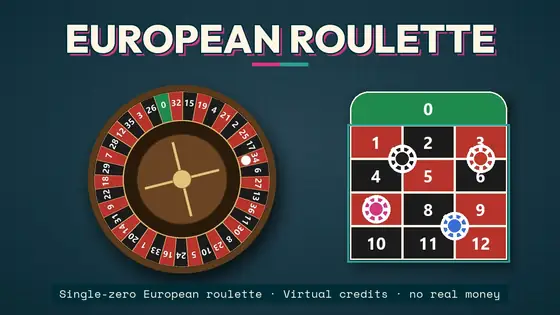
European roulette is the single-zero version of the game: 37 pockets, numbers 1 to 36 plus a green 0. Every bet on the table pays as if there were only 36 pockets, and that one missing pocket is the whole house edge: 1/37, or 2.70%. This guide walks through the table, each bet and its payout, and the math behind the odds. All of it matches the rules file of our free European Roulette table, where you can test any bet with virtual credits.
What is European roulette?
A wheel with 37 numbered pockets spins one way, a ball rolls the other way, and the pocket the ball settles in is the winning number. Eighteen numbers are red, eighteen are black and the zero is green. The colors alternate around the wheel, and the numbers are not in order: on our wheel 32 sits next to the zero on one side and 26 on the other.
Before the spin you place chips on the felt layout. After the spin, every bet that includes the winning number is paid and every other bet is collected. That is all there is to the game. You make no choices once the ball is rolling, which is why the only useful skill is knowing what each bet costs.
The table layout and the bets
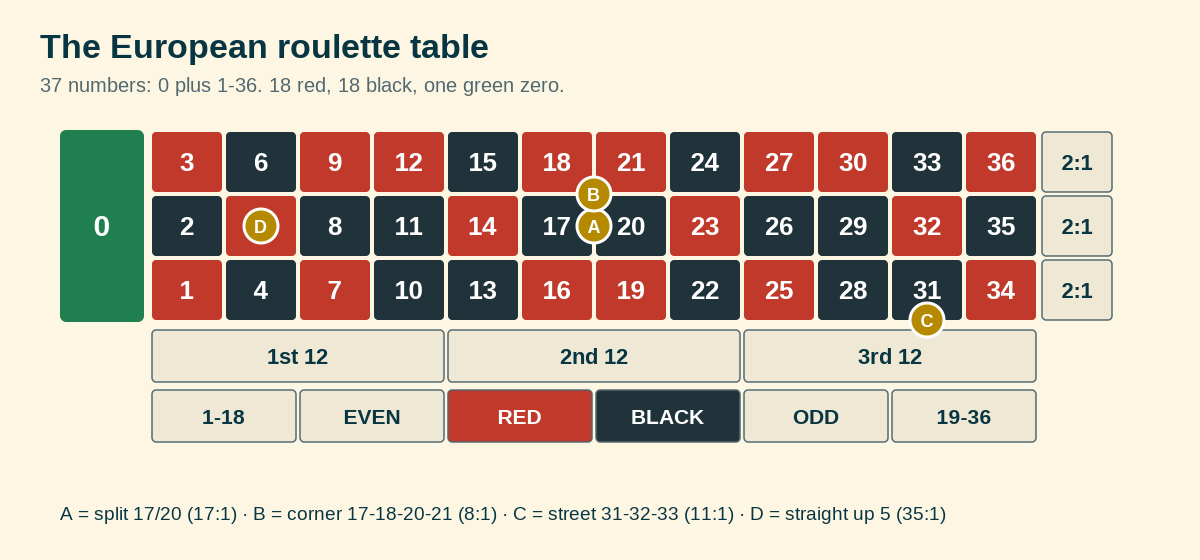
The numbers sit in a grid of 12 rows of three (1-2-3, 4-5-6 and so on up to 34-35-36), with the zero at the head. Bets placed on the numbers themselves, or on the lines between them, are inside bets. Bets in the boxes around the grid are outside bets.
Inside bets:
- Straight up: one number, including 0.
- Split: two neighboring numbers, chip on the line between them.
- Street: a row of three, chip on the outer edge of the row.
- Corner: four numbers that meet at one point.
- Six line: two rows next to each other.
Outside bets:
- Dozens: 1-12, 13-24 or 25-36.
- Columns: one of the three long columns, marked 2:1 at the end.
- Even-money bets: red or black, odd or even, 1-18 or 19-36.
Our table also takes the bets that include the zero: the 0-1, 0-2 and 0-3 splits, the 0-1-2 and 0-2-3 streets and the 0-1-2-3 corner. Counted one by one, that is 145 different inside bets and 12 outside bets, 157 in all.
Roulette payout chart
| Bet | Numbers covered | Pays | A winning 10-credit chip returns |
|---|---|---|---|
| Straight up | 1 | 35:1 | 360 |
| Split | 2 | 17:1 | 180 |
| Street | 3 | 11:1 | 120 |
| Corner | 4 | 8:1 | 90 |
| Six line | 6 | 5:1 | 60 |
| Dozen or column | 12 | 2:1 | 30 |
| Red/black, odd/even, 1-18/19-36 | 18 | 1:1 | 20 |
“35:1” means you win 35 for every 1 staked and keep your stake, so a 10-credit chip comes back as 360. The last column always includes the chip you put down.
There is a pattern in the payouts. Multiply the numbers covered by the payout plus one, and you get 36 every time: 1 × 36, 2 × 18, 3 × 12, 4 × 9, 6 × 6, 12 × 3, 18 × 2. That is the key to the odds.
Why every bet has a 2.70% house edge
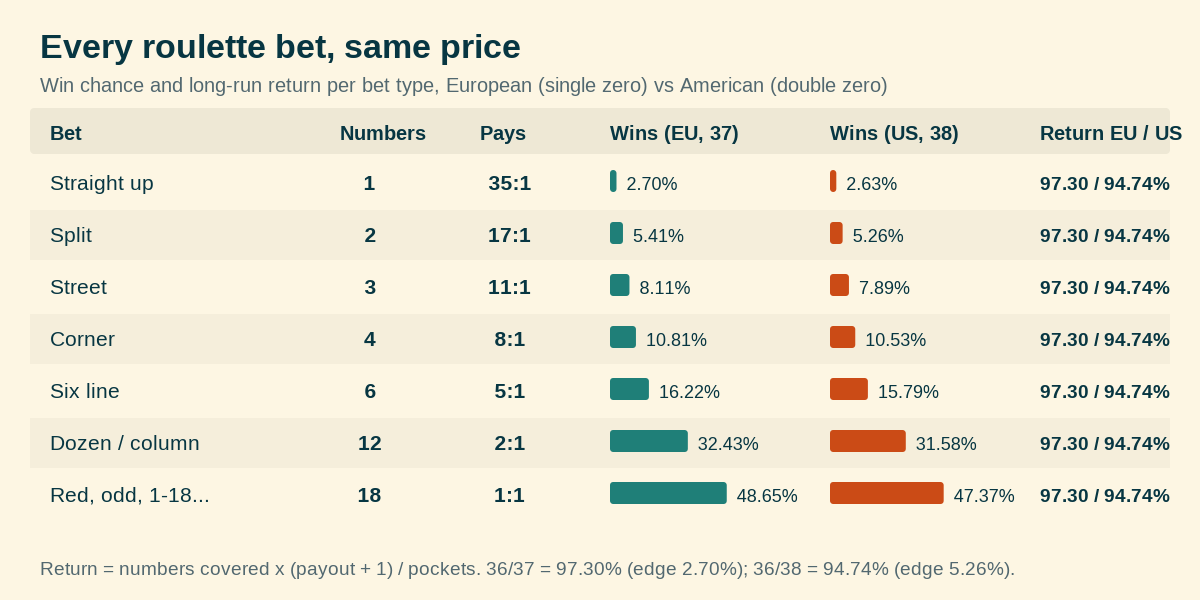
Take a straight up bet of 1 credit and imagine the wheel landing once in each of its 37 pockets. You win once and get back 36. You lose the other 36 times. Over those 37 spins you staked 37 and got back 36. The return is 36/37 = 97.30%, and the 1 credit you are short is the house edge: 1/37 = 2.70%.
Now try red. Red wins in 18 of the 37 pockets and returns 2 each time: 18 × 2 = 36. Same 36 out of 37. A dozen wins 12 times and returns 3: again 36. Because every payout in the chart above multiplies out to 36, every bet loses the same 1/37 on average. We checked this against the game’s code for all 157 bets on our table, each one across all 37 results, and every single one came out at exactly 36/37.
What changes between bets is how the result is spread out:
| Bet | Chance of winning one spin | Typical experience |
|---|---|---|
| Straight up | 1 in 37 (2.70%) | Long losing runs, rare big wins |
| Corner | 4 in 37 (10.81%) | Fewer misses, smaller wins |
| Dozen | 12 in 37 (32.43%) | Win about one spin in three |
| Red or black | 18 in 37 (48.65%) | Close to a coin flip, slightly worse |
A red bet feels safer because it wins almost half the time. It is not cheaper, though. It just loses its 2.70% in small, steady amounts instead of in long droughts.
European vs American roulette
The American wheel has a second green pocket, the double zero, for 38 pockets in total. The payout chart stays exactly the same. A straight up bet still pays 35:1, but now it returns 36 credits once every 38 spins. The return drops to 36/38 = 94.74% and the house edge rises to 2/38 = 5.26%, almost twice the European figure. (One American bet is even worse: the five-number bet on 0, 00, 1, 2 and 3 pays 6:1 and carries a 7.89% edge.)
If you are comparing roulette tables anywhere, the number of zeros on the wheel matters more than any choice you make on the felt.
Do roulette systems work?
Systems ask a fair question: if red has not come up for a while, isn’t it due? It isn’t. The wheel has no memory. After five blacks in a row, red still wins 18 times in 37 on the next spin.
The best-known system is the martingale: bet 10 on red, and double after every loss so the first win recovers everything plus 10. It works until it doesn’t. Starting from 10, six losses in a row cost 10 + 20 + 40 + 80 + 160 + 320 = 630 credits, and the seventh bet would have to be 640. With 1,000 credits you can’t place it. Six non-red results in a row happen with a chance of (19/37)^6, about 1.83% per attempt, which sounds rare. Over 100 spins, though, the chance of running into at least one such streak is about 60%.
The result is a familiar pattern: many small wins, then one loss that wipes them out. Spread a system over enough spins and it still returns 97.30% of everything staked, because each spin does. Systems that raise the bet after wins, or that spread chips over many numbers, follow the same arithmetic. You can play roulette free and run any system you like; the credits are virtual, so watching one fail costs nothing.
Roulette is pure chance with one fixed price. If you want a table where your choices change the odds, read our blackjack basic strategy guide. If you like games with no decisions but a lower edge, the baccarat rules guide explains why the Banker bet costs 1.06%. And for a game that looks very different but runs on the same idea of a fixed return, see how crash games work.
Try it with virtual credits
Our roulette table starts you with 1,000 virtual credits and chips of 10, 50, 100 and 500. Credits can’t be bought, cashed out or turned into prizes, and you can refill them for free. The games on this site are for adults (18+); real-money roulette carries real risk, may be illegal where you live, and at 97.30% it takes money from players over time.
Frequently asked questions
Is roulette easy to play?
Yes. You put chips on a number or a group of numbers, the wheel is spun, and the bets that cover the winning pocket are paid. There are no decisions after the spin. The only thing worth learning is what each bet pays and how often it wins.
What is the difference between European and American roulette?
The European wheel has one zero (37 pockets) and the American wheel has a zero and a double zero (38 pockets). The payouts are the same, so the house edge is 2.70% on a European wheel and 5.26% on an American one.
What are the best odds in roulette?
Red/black, odd/even and 1-18/19-36 win most often, 18 times out of 37 (48.65%). The return is the same on every bet, though: 97.30% on a single-zero wheel. No bet has a better long-run price than another.
What happens to outside bets when zero comes up?
On our table they lose. Red, black, odd, even, the low and high halves, the dozens and the columns all lose on zero. Some casino tables return half of an even-money bet on zero (la partage) or hold it for one more spin (en prison); this table uses neither rule.
How much does a straight up bet pay in roulette?
35 to 1. A winning 10-credit chip on a single number returns 360 credits: 350 in winnings plus the 10 you staked.
Can you win at roulette with a strategy?
Not in the long run. Each spin is independent, and every bet returns 36/37 of what is staked. A system can make small wins frequent and big losses rare, or the other way round, but the average loss stays at 2.70 per 100 bet.