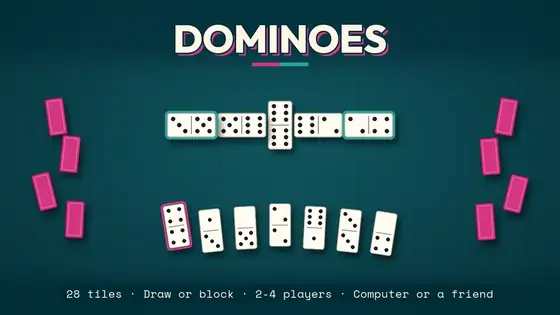
Dominoes is a tile game where you match numbers end to end, building a line across the table and trying to empty your hand before anyone else. Here you play dominoes free online with a double-six set, with no download and no sign-up. Your opponents can be the computer, or friends taking turns on the same device.
The domino set
The set is double-six: each half of a tile shows a number from 0 (blank) to 6, and each pair appears only once. That gives 28 tiles.
- 7 tiles are doubles: 0-0, 1-1, 2-2, 3-3, 4-4, 5-5, 6-6.
- 21 tiles have two different halves, such as 6-2 or 3-0.
- Each number appears on 7 tiles. The fours, for example: 4-0, 4-1, 4-2, 4-3, 4-4, 4-5, 4-6.
- The pips on all tiles add up to 168.
Setting up the table
There are three settings above the table:
- Players: 2, 3 or 4.
- Game: Draw or Block.
- Opponent: Computer or Friends.
With Computer, you sit at the bottom (South) and the computer takes the other seats. With Friends, everyone plays on the same device. When the turn changes, the screen says who to hand it to, and the tiles stay hidden until that player presses Show my tiles, so nobody sees anyone else’s hand.
Changing the number of players or the game type starts a new match, and New match resets the scores and deals again. A match in progress is saved after every move, so you can close the page and continue the same round later.
How to play dominoes
Who goes first?
In the first round of a match, the game checks every hand for the highest double. If the 6-6 was dealt, the player holding it must open with it. If no double was dealt, the heaviest tile opens. From the second round on, the winner of the previous round leads with any tile they like.
Adding a tile
Play goes clockwise. The first tile has two open ends, and the line grows from both. You can only place a tile where its number matches the open end: if an end shows 5, you can add the 5-2 with its 5 touching, and the new open end is 2.
On your turn the tiles you can play light up. Tap one. If it fits both ends, the game asks which one with a Left end and a Right end button, each showing the number on that end. Cancel takes you back.
When you can’t play
This is where the two games split. In the Draw game, press Draw to take a tile from the boneyard, and keep drawing one at a time until a tile fits; when one fits, you must play it. Pass only appears once the boneyard is empty. In the Block game there is no boneyard, so you press Pass right away. If you hold a tile that fits, you can’t draw or pass.
Draw game or Block game?
| Players | Draw: tiles each | Draw: boneyard | Block: tiles each | Block: out of play |
|---|---|---|---|---|
| 2 | 7 | 14 | 7 | 14 |
| 3 | 5 | 13 | 7 | 7 |
| 4 | 5 | 8 | 7 | 0 |
In the Draw game the number of tiles left in the boneyard is shown on the table. In a Block game with two or three players, the tiles not dealt stay face down and out of play for the round, and nobody sees them. In a four-player Block game all 28 tiles are dealt, so every number is in someone’s hand.
In practice, Draw rounds usually end when someone goes out, while Block rounds get stuck far more often, especially with two players: with 14 tiles unseen, the ends die quickly. We measured it with computer players in every seat:
| Players | Draw: blocked rounds | Block: blocked rounds |
|---|---|---|
| 2 | 7.0% | 54.8% |
| 3 | 4.7% | 34.1% |
| 4 | 6.0% | 14.3% |
In two-player Block dominoes, more than half the rounds end with nobody going out, and the round usually goes to whoever holds the fewest pips. In the Draw game, fewer than one round in ten gets blocked. We played 20,000 rounds for each player count and game type with this table’s rules code; repeating with a different seed moved the rates by half a point at most.
Dominoes scoring
A round ends in one of two ways:
- Going out. The first player to play their last tile wins the round and scores the total pips left in all the other hands.
- Blocked. If every player passes in a row, the round is blocked. Hands are shown, and the player with the fewest pips scores everyone else’s. If two or more players tie for the lowest total, nobody scores, and the same player leads the next round.
At the end of each round a table shows every player’s Pips left and total Points. Next round shuffles and deals again. The first player to reach 100 points wins the match.
Example: in a three-player Draw game you go out. West holds 6-4 and 2-0, East holds 5-5. You score 10 + 2 + 10 = 22 points.
Blocked example: in a four-player Block game nobody can move. You hold 2-1 (3 pips), West has 9, North 14 and East 11. You have the fewest, so you score 9 + 14 + 11 = 34. If West also had 3, nobody would score that round.
The computer player
There is one computer level. It always plays a tile when it can, preferring heavy tiles and doubles and tiles that keep its other tiles playable on the open ends. When it has nothing to play, it draws, and passes only when it has to. It follows the same rules you do and never sees your hand.
Dominoes strategy that works
Drop heavy tiles early. If 6-5 and 2-1 leave you equally flexible, play the 6-5. If someone else goes out, heavy tiles become their points; in a blocked round, fewer pips win.
Don’t sit on doubles. A double matches only one number. Play the 4-4 while a four is open; once the other fours are on the table, it becomes a tile nobody can use.
Count the numbers. Each number appears on 7 tiles. If five threes are on the table and you hold the sixth, only one three is left outside. Closing an end on three can block the player who needs it.
Watch draws and passes. A player who draws or passes has nothing matching either open end. Keeping those numbers open puts them under pressure.
Count pips in the Block game. With no boneyard to bail anyone out, blocks are likely. When you sense the line is about to close, play your heaviest fitting tile rather than the flexible one.
For a tile game with hidden hands and sets, try okey, the Turkish rummy tile game. For a family game with dice for up to four people on one device, try kizma birader, the Turkish ludo. More classics are on the Turkish games page.
Frequently asked questions
Can I play dominoes free against the computer?
Yes. Choose 2, 3 or 4 players and set Opponent to Computer. You sit at the bottom and the computer fills the other seats. It runs in your browser with no download and no account.
How many tiles are in a set of dominoes?
This table uses a double-six set of 28 tiles. Every pair of numbers from 0 to 6 appears exactly once, and the pips on all the tiles add up to 168.
What is the difference between the Draw game and the Block game?
In the Draw game the tiles not dealt form a boneyard, and if you can't play you draw from it. In the Block game there is no boneyard; if you can't play, you pass.
Who wins when the dominoes game is blocked?
When every player passes in a row, the round is blocked. The player with the fewest pips left scores everyone else's pips. If two or more players tie for the lowest total, nobody scores that round.
Can I play dominoes with friends on one device?
Yes. Set Opponent to Friends and pass the device around. When the turn changes, the screen says who should take it, and the tiles stay hidden until that player presses Show my tiles. There is no online play with people on other devices.
How do you win a game of dominoes?
You win a round by playing your last tile first, or by holding the fewest pips when the round is blocked. The winner scores the pips left in the other hands, and the first player to reach 100 points wins the match.
 Okey
 101 Okey
 Batak
 Pishti
 King Card Game
 Sixty-Six (66)