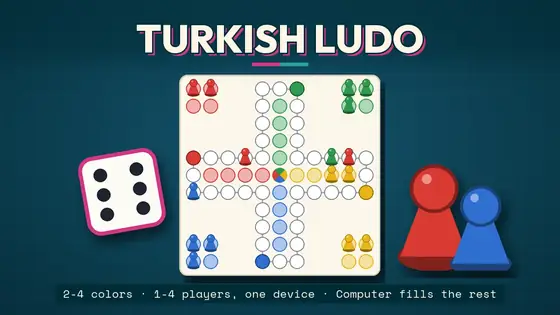
Kizma birader (written kızma birader in Turkish, “don’t get angry, brother”) is the Turkish ludo: each color races four pawns around a shared track and into its own home column, while landing on an opponent sends that pawn back to the start. Here you can play kizma birader online for free, against the computer or with friends taking turns on one device, with no download and no sign-up.
Kizma birader and ludo
The game is the Turkish name for Mensch ärgere Dich nicht, the German cousin of ludo, and the rules follow that line rather than the ludo board most English speakers grew up with. If you know ludo, these are the differences you will notice:
| Many ludo rule sets | Kizma birader here | |
|---|---|---|
| Track | 52 squares | 40 squares |
| Safe squares | Star or start squares can’t be captured on | None; even start squares are not safe |
| Two pawns of one color on a square | Allowed, often forms a block | Not allowed; you can’t land on your own pawn |
| Passing other pawns | Blocks may stop you | Always allowed, yours or anyone’s |
| Rolling three 6s in a row | Often loses the turn | No limit; every move made with a 6 earns another roll |
| No pawn on the track | One roll, or house rules | Up to three rolls to get a 6 |
| Home column | 5 squares before the center | 4 squares, exact roll needed |
Everything else will feel familiar: pawns enter on a 6, a 6 earns another roll, captures send pawns back, and the first color with all four pawns home wins.
Players and settings
Two settings sit above the board:
- Players: how many colors are on the board, 2, 3 or 4. With two, Red and Yellow sit opposite each other. With three, Red, Green and Yellow play. With four, Blue joins.
- Humans: how many of those colors are played by people. People take the colors in order, starting with Red, and the computer plays the rest.
Playing alone, leave Humans at 1: you are Red, labelled “Red (You)”, and the other colors are the computer’s. With friends, put the device where everyone can reach it. The message line names the color whose turn it is, and only that color’s pawns light up. New game starts a fresh board. The board is saved after every move, so you can close the page and continue later.
How to play kizma birader
The board. Each color has a base in its corner where its four pawns wait, a start square on the shared 40-square track, and a home column of four squares leading to the center. Every color goes once around the track and turns into its own home column.
Rolling. Tap the Die (it shows Roll while it is waiting). The pawns that can move with that number glow; tap one. If only one pawn can move, the game moves it for you.
Coming out. A pawn leaves the base only on a 6, onto its start square. This is compulsory: if you roll a 6, a pawn is in your base and your own start square is empty, you must bring a pawn out. And while pawns are still waiting in the base, the pawn on your start square has to move off it first whenever it can.
Rolling again. After a move made with a 6, you roll once more. A 6 that no pawn can use gives no extra roll.
Three tries. If you have no pawn on the track, you get up to three rolls in the turn to throw a 6. The message line shows how many tries are left.
Capturing. Land exactly on an opponent’s pawn and it is sent back to base. Capturing is never compulsory. Start squares give no protection: if you stop on an opponent’s start square and they roll a 6 with a pawn in base, your pawn goes home.
Your own pawns. You can’t land on a square where your own pawn stands. You can pass over any pawn on the track.
Getting home. The home column needs an exact roll. A pawn can’t overshoot the last square, and it can’t jump over or land on its own pawns inside the column. No other color can enter it, so pawns there are safe. The legend shows each color’s progress, such as “Red (You) 2/4”. The first color with all four pawns home wins, and the end box offers Play again or View board.
The computer player and game length
The computer scores every legal move: getting a pawn home, capturing (more for a pawn that has travelled far), bringing out a new pawn, and moving a pawn out of reach of opponents one to six squares behind it. Over 1,000 two-color games, it beat a player who picked pawns at random 892 times (89.2%). The die decides a lot, but the choice of pawn clearly matters.
We also ran 2,000 games with the computer playing every color, using the game’s own rules code:
| What we measured | 2 colors | 4 colors |
|---|---|---|
| Dice rolls per game (all players) | 162 | 531 |
| Captures per game | 6.7 | 48.4 |
| Red, who rolls first, won | 52.9% | 24.5% |
With four colors a game takes more than three times as many rolls, and captures are everywhere. Going first is a small edge in the two-color game and barely any in the four-color one.
Tips for winning
- Keep a pawn on the track. A 6 comes one roll in six. Even with three tries, the chance of bringing a pawn out in a turn is about 42%, so a turn with everything in base is often wasted.
- Spread the risk over two or three pawns. With several pawns out, almost every roll gives you a useful choice.
- Count the six squares behind you. An opponent one to six squares behind your pawn can capture it with one roll. Move out of that range when you can.
- Capture the pawn that has travelled furthest. Sending back a pawn near its home column costs the opponent most of a lap; one that just came out costs them only a 6.
- Fill the home column from the far end. Park your first pawn on the deepest square so later pawns don’t get stuck behind it.
If you like dice and race games, backgammon is the classic two-player one. For a game with no dice at all, try mangala or dominoes. More are on the Turkish games page.
Frequently asked questions
Is kizma birader the same as ludo?
It belongs to the same family: four pawns per color, a die, a shared track, a 6 to bring a pawn out and captures that send pawns back. Kizma birader is the Turkish name for the German game Mensch ärgere Dich nicht. It uses a 40-square track, has no safe squares and no blockades, and you can't land on your own pawn.
Can I play ludo against the computer here?
Yes. Choose 2, 3 or 4 colors with Players and leave Humans at 1. You play Red and the computer plays every other color. It runs in the browser with no download and no account.
Can I play kizma birader with friends?
Yes, on the same device. Set Humans to the number of people playing and pass the phone or tablet around, or put it in the middle of the table. Colors are taken in order, starting with Red, and the computer plays any color left over. There is no online play with people on other devices.
What happens when you roll a 6?
If you have a pawn in your base and your start square is free, you must bring a new pawn out. After any move made with a 6 you roll again. If you roll a 6 but no pawn can move, there is no extra roll.
Do you get three rolls when all pawns are at home?
Yes. If none of your pawns is on the 40-square track (they are all in the base or in the home column), you get up to three rolls per turn to throw a 6.
Do you need an exact roll to get home?
Yes. A roll that would take a pawn past the last square of its home column can't be used by that pawn, and inside the home column a pawn can't jump over or land on another pawn of the same color.
Is capturing compulsory?
No. A capture happens only if you choose the pawn that lands on the opponent. If another pawn has a legal move, you are free to play that one instead.
 Okey
 101 Okey
 Batak
 Pishti
 King Card Game
 Sixty-Six (66)