Card Counting in Blackjack: Does It Work?
Card counting is the one well-known way to turn blackjack in the player’s favor. You track the cards that leave the shoe, and when the cards still to come are rich in 10s and aces, you bet more. It isn’t magic and it isn’t illegal, but the edge it gives is tiny and the swings are huge. This guide explains the Hi-Lo count, then measures what it is worth on our free blackjack table, using the game’s own rules code for 40 million hands per test.
Why counting cards works
Blackjack, unlike roulette, has a memory. Cards dealt from a shoe don’t go back in until the reshuffle, so every hand changes what is left. Some of those changes help the player:
- 10s and aces help you. They make blackjacks, which pay 3:2 to you but only 1:1 to the dealer. They make your doubles on 10 and 11 stronger. And they bust the dealer, who must draw on 16 or less.
- Low cards help the dealer. A dealer holding 12 to 16 has to hit, and 2s to 6s are the cards that save that hand.
So a shoe that has already given out many low cards is good for you, and one that has given out many high cards is bad. Card counting is just bookkeeping for that.
The Hi-Lo count
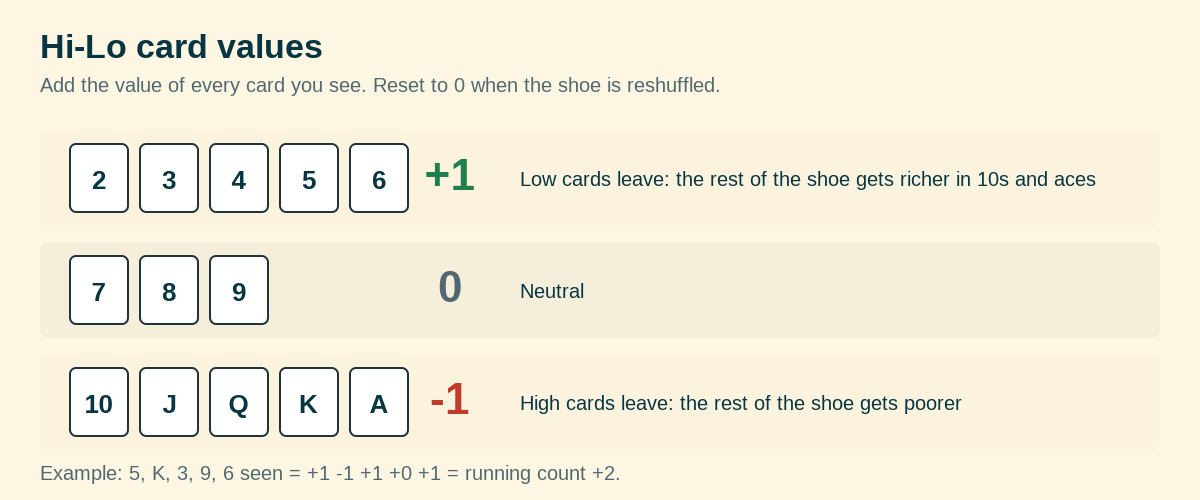
Hi-Lo is the most common system because it uses only three values. Every card you see adds +1, 0 or −1 to the running count. A deck holds 20 low cards and 20 high ones, so a full shoe counts to zero, and the count starts again at 0 after each shuffle.
The running count alone can mislead you. A count of +6 with five decks still to come is a small surplus spread thinly. The same +6 with one deck left is a big one. So you convert it into the true count:
| Running count | Decks left | True count |
|---|---|---|
| +6 | 6 | +1 |
| +6 | 3 | +2 |
| +6 | 1.5 | +4 |
| −4 | 2 | −2 |
True count = running count ÷ decks left. You estimate the decks left by eye at a real table. In our simulation we used the exact number of cards left and rounded the result down.
What the count is worth on our table
Our table deals from a 6-deck shoe of 312 cards. Its rules file reshuffles at the start of a hand when fewer than 78 cards are left, so about three quarters of the shoe is played before each shuffle. The shoe also stays in your browser between visits. That is the setup counting needs.
We played basic strategy with a flat bet and recorded the true count before each hand.
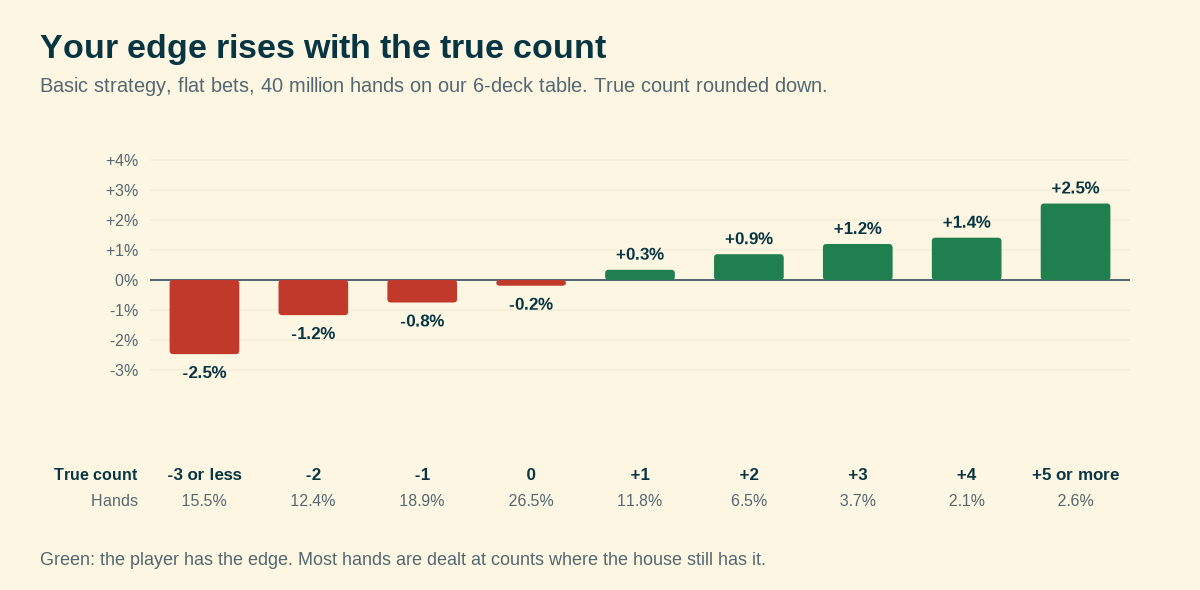
Two things stand out. The edge climbs steadily, by roughly half a percentage point per step of true count, and it turns in the player’s favor at a true count of +1. But good counts are rare: only 26.6% of hands were dealt at +1 or higher, and only 14.9% at +2 or higher. Most of the time the house still has the edge, and a counter has to play those hands too, at the smallest bet.
Betting with the count
Counting pays only if your bets follow the count. We tested two plans, both with basic strategy and Hi-Lo, through the same code:
- 1-8 spread: 10 credits at a true count of +1 or less, then 20, 40, 60 and 80 at +2, +3, +4 and +5 or more.
- 1-16 spread: the same start, rising to 160 credits at +6 or more.
Both also took insurance at a true count of +3 or higher, the one change to basic strategy that we tested. Counters use other count-based changes to the chart too; we left them out.
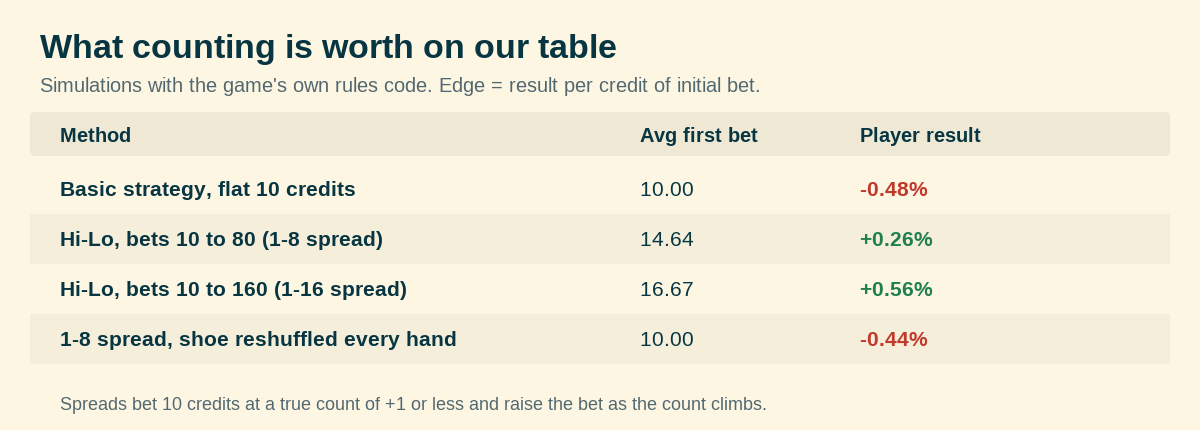
Basic strategy alone left a house edge of 0.48%, which matches the figure in our blackjack basic strategy guide. Counting with a 1-8 spread turned that into a player edge of +0.26%. A 1-16 spread raised it to +0.56%.
The last line is the control test. We kept the 1-8 plan but reshuffled the shoe before every hand. The true count was then always 0, the bet never left 10 credits, and the result was a loss of 0.44%, the same as plain basic strategy within the noise of the simulation. With no deck to track, counting does nothing.
The catch: swings bigger than the edge
A quarter-percent edge sounds like a win, so look at the size of the swings. With the 1-8 spread, the average result was +0.038 credits per hand, and the standard deviation of a single hand was about 22.8 credits.
| Hands played (1-8 spread) | Expected result | Typical swing (1 standard deviation) | Chance of being behind |
|---|---|---|---|
| 1,000 | +38 | ±722 | about 48% |
| 10,000 | +382 | ±2,284 | about 43% |
| 100,000 | +3,820 | ±7,223 | about 30% |
After 100,000 hands, which takes many hundreds of hours at a real table, about three counters in ten would still be losing. The 1-16 spread does better, about 18% behind after 100,000 hands, but it needs a bigger bankroll and much larger bets at high counts, the exact thing casinos look for.
And all of this assumes a perfect count, perfect basic strategy and no mistakes over hundreds of thousands of hands. Missing a few plays per hour easily costs more than the counter’s whole edge.
Does card counting work online or in a demo?
It depends on the shuffle, not on the screen.
- Shuffle before every hand: nothing to count. Many online blackjack games run by a random number generator work this way, and our control test shows the result: counting earns nothing.
- Shoe dealt down before a reshuffle: counting works in principle. That includes casino tables and our free table.
On our table there is one practical snag: the game doesn’t announce the reshuffle. It happens at the start of the first hand dealt with fewer than 78 cards left, so a counter here also has to keep track of how many cards have been dealt. That is good practice for keeping two numbers in your head at once.
Since the credits on this site are virtual, counting here can’t win you anything real. It is a free place to drill the count at your own pace, and to check with your own eyes that the high-count hands really do pay more.
How to practice the count
- Count a single deck first. Turn the cards over one at a time and keep the running count. If you count correctly, you finish at exactly 0. Aim to get through a deck in under half a minute without errors.
- Count in pairs. Low and high cards cancel out (a 5 and a king are 0 together), so learn to see two cards as one value.
- Play hands at our table. Count every card, including the dealer’s hole card when it is turned over at the end of the hand. Keep a rough tally of cards dealt so you know when the shoe is near the reshuffle.
- Convert and bet. Before each hand, divide by the decks left and set your bet from the true count. Only then add index plays such as insurance at +3.
Should you learn to count?
If you enjoy the challenge, Hi-Lo is easy to learn and our table is a fair place to practice it. If you are hoping for income, the numbers above are the honest answer: a fraction of a percent, swamped by swings for a very long time. And before counting is worth anything, you need basic strategy down cold, because that alone removes most of the house edge. Our house edge guide shows how blackjack’s 0.48% compares with every other game here, and the martingale guide shows why changing bet sizes without a count changes nothing.
Practice for free
Open our free blackjack table, start with 1,000 virtual credits, and count along. Credits can’t be bought, cashed out or exchanged for prizes. Blackjack is for adults (18+). With real money the house keeps an edge over almost every player, and gambling may be illegal where you live.
Frequently asked questions
Does card counting actually work?
Yes, in a game dealt from a shoe that isn't reshuffled every hand. On our 6-deck table, Hi-Lo with bets from 10 to 80 credits gave the player about a 0.26% edge over 40 million simulated hands. The edge is small and the swings are large, so it only shows up over a very long run.
Does card counting work online?
Rarely. Many online blackjack games that use a random number generator shuffle a fresh deck for every hand, and then there is nothing to count. Our free table is different: it deals down a 6-deck shoe and reshuffles only when fewer than 78 cards are left, so you can practice counting here.
What is a good card counting chart for beginners?
The Hi-Lo values: 2, 3, 4, 5 and 6 are +1; 7, 8 and 9 are 0; 10, jack, queen, king and ace are -1. Add them up as cards appear (the running count), then divide by the number of decks still in the shoe to get the true count.
What is the difference between running count and true count?
The running count is the sum of the Hi-Lo values of every card seen since the shuffle. The true count divides it by the decks still to be dealt. A running count of +6 means a lot with one deck left (true count +6) and little with six decks left (true count +1).
Is card counting illegal?
Keeping a count in your head is not cheating, since you only use cards everyone can see. Casinos are private businesses, though, and in many places they can ask a player they suspect of counting to stop playing blackjack or to leave. Using a device to count is a different matter and is illegal in some places.
How much can you make counting cards?
Less than most people think. In our simulation a 1-8 bet spread earned about 0.04 credits per hand on an average bet of 14.6 credits. After 10,000 hands the expected gain was 382 credits, while the normal swing was about 2,300 either way.