Poker Hand Rankings Chart, Best to Worst
Poker hand rankings, from best to worst: royal flush, straight flush, four of a kind, full house, flush, straight, three of a kind, two pair, one pair, high card. Every hand on that list beats every hand below it, in Texas Hold’em, five-card draw and video poker alike. This page gives you the chart, an example of each hand, the rules that settle ties, and how often each hand turns up. We counted every number with the hand evaluator of our Texas Hold’em table, the same code that decides who wins each pot there.
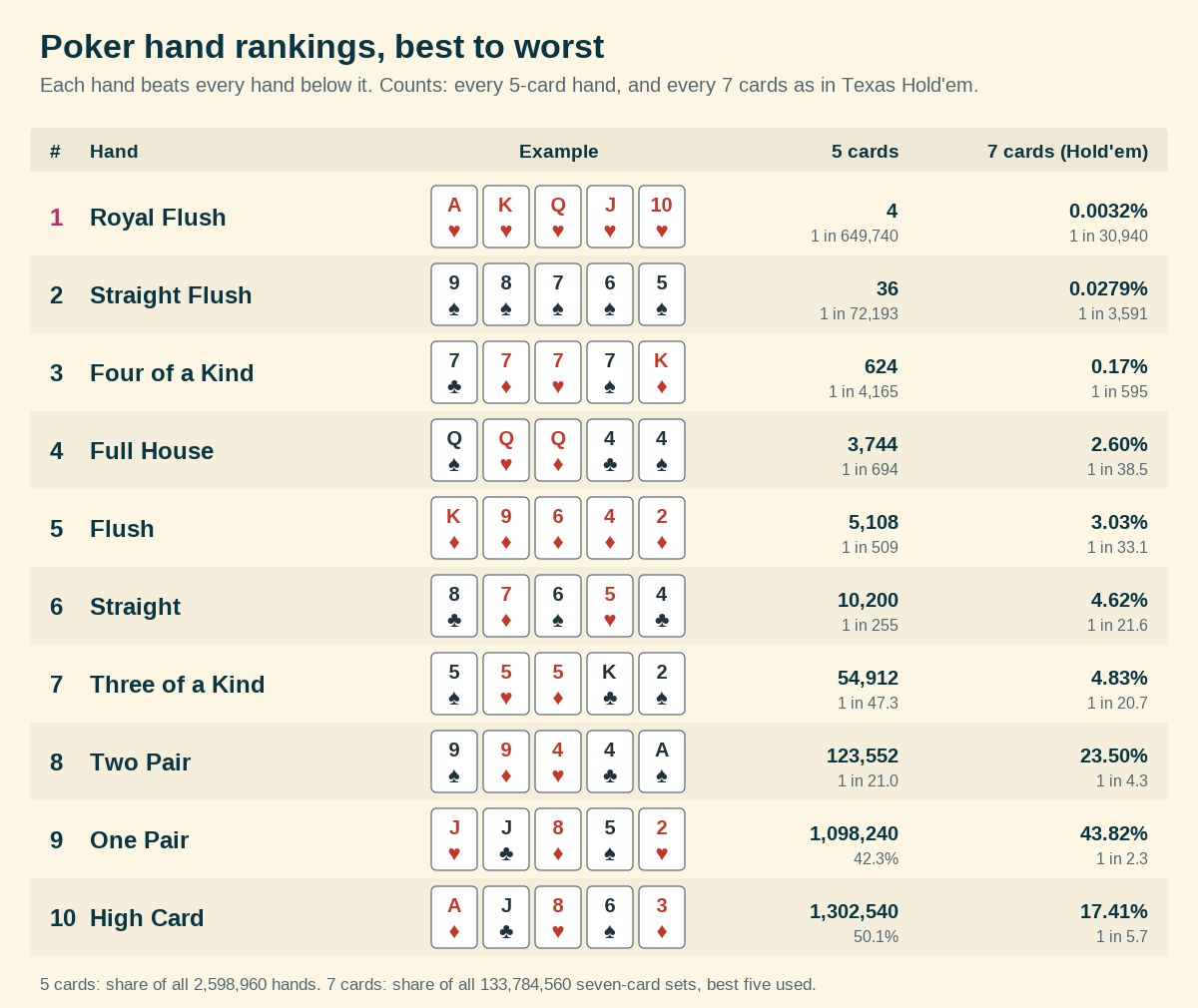
The 10 poker hands in order
- Royal flush. A-K-Q-J-10, all of one suit. It is the best straight flush and can’t be beaten.
- Straight flush. Five cards in sequence, all of one suit, such as 9-8-7-6-5 of spades.
- Four of a kind. Four cards of the same rank, plus any fifth card. Also called quads.
- Full house. Three of a kind together with a pair, such as Q-Q-Q-4-4.
- Flush. Any five cards of one suit, in any order.
- Straight. Five cards in sequence in mixed suits, such as 8-7-6-5-4.
- Three of a kind. Three cards of one rank and two unrelated cards. Also called trips, or a set when it is made with a pocket pair.
- Two pair. Two different pairs and a fifth card.
- One pair. Two cards of one rank and three unrelated cards.
- High card. None of the above. The hand is named after its highest card, so A-J-8-6-3 is “ace high”.
A poker hand is always exactly five cards. In Texas Hold’em you have seven to choose from, your two plus the five on the table, and only the best five count. A sixth or seventh card can never help a hand that already has five.
Poker hands cheat sheet
The chart above is the quick version. This table adds the two numbers behind the order: how many of the 2,598,960 possible five-card hands fall into each group, and the chance of finishing with that hand when you get seven cards, as in Hold’em when you stay to the river.
| Rank | Hand | Example | Five-card hands | Chance with 7 cards |
|---|---|---|---|---|
| 1 | Royal flush | A♥ K♥ Q♥ J♥ 10♥ | 4 | 0.0032% (1 in 30,940) |
| 2 | Straight flush | 9♠ 8♠ 7♠ 6♠ 5♠ | 36 | 0.028% (1 in 3,591) |
| 3 | Four of a kind | 7♣ 7♦ 7♥ 7♠ K♦ | 624 | 0.17% (1 in 595) |
| 4 | Full house | Q♠ Q♥ Q♦ 4♣ 4♠ | 3,744 | 2.60% |
| 5 | Flush | K♦ 9♦ 6♦ 4♦ 2♦ | 5,108 | 3.03% |
| 6 | Straight | 8♣ 7♦ 6♠ 5♥ 4♣ | 10,200 | 4.62% |
| 7 | Three of a kind | 5♠ 5♥ 5♦ K♣ 2♠ | 54,912 | 4.83% |
| 8 | Two pair | 9♠ 9♦ 4♥ 4♣ A♠ | 123,552 | 23.50% |
| 9 | One pair | J♥ J♣ 8♦ 5♠ 2♥ | 1,098,240 | 43.82% |
| 10 | High card | A♦ J♣ 8♥ 6♠ 3♦ | 1,302,540 | 17.41% |
The five-card counts come from running every possible hand through the game’s evaluator. The seven-card column comes from doing the same for all 133,784,560 seven-card combinations and keeping the best five each time. Both totals add up exactly, and they match the standard published figures for a 52-card deck.
How ties are broken
Two players often hold the same kind of hand, so the ranking has a second layer. In our game’s code each hand gets one comparable value: the hand type first, then up to five tie-breaking card values. Across all five-card hands there are only 7,462 different values, so many hands are exactly equal.
- Pairs, trips and quads compare the rank of the matched cards first. Kings beat queens. If those are equal, the remaining cards (the kickers) are compared from the highest down.
- Two pair compares the higher pair, then the lower pair, then the fifth card. K-K-4-4-A beats K-K-4-4-Q.
- Full house is decided by the three of a kind. 8-8-8-2-2 beats 7-7-7-A-A.
- Straights compare only the top card. A-2-3-4-5, the “wheel”, is the lowest straight, with 5 as its top card. 10-J-Q-K-A is the highest.
- Flushes compare card by card from the top: K-J-9-6-3 beats K-J-9-5-4.
- Suits never count. A heart flush and a club flush with identical values tie.
If the best five cards are equal, the pot is split. At our table, when chips don’t divide evenly, the odd chip goes to the first winner to the left of the dealer button.
Playing the board
In Hold’em your best five can use both of your cards, one, or none. If the five shared cards are 5-6-7-8-9 and nobody holds a 10, every player still in the hand has the same nine-high straight and the pot is split. Beginners often fold a winning hand here, or think they have won when the board has given everyone the same straight.
Why the order is what it is
The ranking follows rarity in a five-card hand. Fewer ways to make a hand means it ranks higher. There are 5,108 ways to make a flush and 10,200 ways to make a straight, so the flush wins. There are 54,912 ways to make three of a kind and 123,552 to make two pair, so trips win.
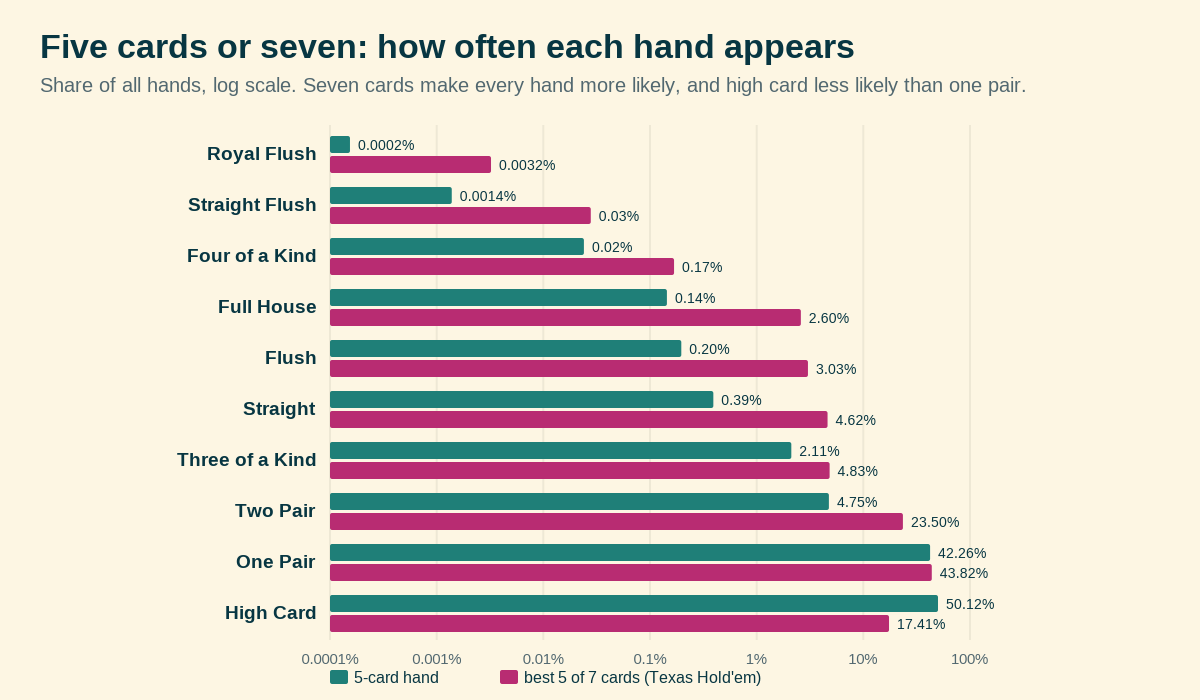
With seven cards the picture shifts. A full house goes from 1 in 694 to about 1 in 38.5, and two pair becomes more common than high card. In fact, high card is rarer than two pair once you see seven cards. The ranking still isn’t changed for Hold’em, and it doesn’t need to be: what matters at the table is which of two hands is better, and the five-card order answers that consistently.
What seven cards do change is your sense of a good hand. In five-card draw a pair of jacks beats most hands. In Hold’em, two pair or better appears in about 39% of seven-card sets, so one pair at a showdown is often second best, especially against several opponents.
Common mix-ups
“A straight beats a flush.” It doesn’t. The flush is rarer and ranks higher.
“Three pair.” With seven cards you can hold three pairs, such as K-K-8-8-3-3 plus a queen. Only five cards play, so it is two pair: kings and eights with a queen kicker. Our game’s evaluator does exactly that.
“Q-K-A-2-3 is a straight.” No. The ace can sit at the top (10-J-Q-K-A) or the bottom (A-2-3-4-5), but straights don’t wrap around the corner.
“A pair on the board is my pair.” When the board pairs, every player shares that pair. Your hand is only better if your own cards add something.
“Higher suit wins.” Some home games use a suit order, but standard poker rules and our table never do.
Rankings in video poker
Video poker uses the same ten hands in the same order. What changes is who you play against. There is no opponent, only a pay table, so a hand is worth what the machine pays for it. In Jacks or Better the lowest paying hand is a pair of jacks, and a royal flush pays far more than its place on the list suggests. Our Jacks or Better pay table guide shows that table and how often each hand is dealt, and you can drill the rankings on our free video poker machine.
Put the rankings to work
Knowing the order is step one. Step two is seeing how often your hand is likely to be best, which depends on your two cards, the board and how many opponents are left. Our Texas Hold’em rules for beginners covers the betting rounds, the rules for two players, and an odds chart for draws and starting hands.
You can then play hands at our Texas Hold’em table against three computer players. At the showdown the game names every hand shown, so you can check your reading against the evaluator. Chips and credits there are virtual: they can’t be bought, cashed out or exchanged for prizes, so it isn’t gambling. The game is for adults (18+). Real-money poker is gambling and may be illegal where you live.
Frequently asked questions
What are the poker hand rankings in order?
From highest to lowest: royal flush, straight flush, four of a kind, full house, flush, straight, three of a kind, two pair, one pair and high card. Any hand in the list beats every hand below it.
Does a flush beat a straight?
Yes. A flush (five cards of one suit) beats a straight (five cards in sequence). In five cards there are 5,108 flushes and 10,200 straights, so the flush is the rarer hand and ranks higher.
Which suit is highest in poker?
None. In Texas Hold'em and standard poker, suits have no rank. A flush in hearts and a flush in clubs with the same card values are equal, and the pot is split.
Is a royal flush the same as a straight flush?
A royal flush is the highest possible straight flush: ace, king, queen, jack and 10 of one suit. It has its own name because it can't be beaten. Only 4 of the 2,598,960 five-card hands are royal flushes.
What is a kicker in poker?
A kicker is a card that isn't part of your pair, trips or two pair but still counts when two players hold the same hand. A-A-K-7-3 beats A-A-Q-J-10, because the king outranks the queen.
Can two players have the same hand in Texas Hold'em?
Yes, often. If both players' best five cards have the same values, the pot is split. This happens a lot when the best hand is on the board itself, for example a straight made only from the five shared cards.