Texas Hold'em Rules for Beginners
Texas Hold’em rules in one line: each player gets two private cards, five shared cards are dealt face up in three stages, and the best five-card hand out of those seven wins the pot, unless everyone else folds first. Between the stages come four betting rounds, and that is where the game is really played. This guide walks through one hand step by step, covers the rules for two players, and ends with a Texas Hold’em odds chart we calculated with the game’s own code. You can try each step at our free Texas Hold’em table against three computer players.
The goal of the game
You win chips in one of two ways. Either you have the best hand when the cards are shown at the end, or you make a bet nobody else is willing to call. Plenty of hands end the second way, with no cards shown. So Texas Hold’em is part card ranking and part decision making: when to put chips in, and when to let a hand go.
The hands are ranked the standard way, from royal flush down to high card. If you aren’t sure whether a flush beats a straight (it does), keep our poker hand rankings chart open in another tab while you learn.
How a hand is played, step by step
1. The dealer button and the blinds
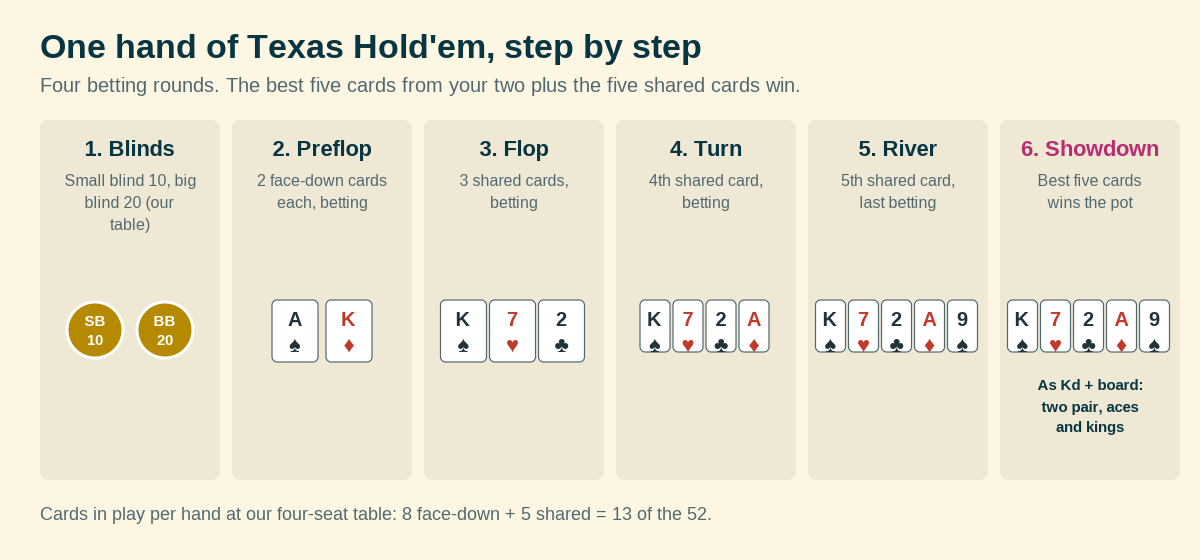
One seat has the dealer button. It moves one seat to the left after every hand. The player to its left posts the small blind and the next player the big blind. These forced bets put chips in the pot before anyone sees a card, so there is always something to play for. At our table the blinds are 10 and 20.
2. Preflop
Everyone gets two face-down cards, called hole cards. The first player to act is the one to the left of the big blind. Each player can fold, call (match the big blind) or raise. The betting goes around until everyone still in has put in the same amount. If nobody raised, the big blind gets a last chance to check or raise.
3. The flop
Three shared cards are dealt face up in the middle. A new betting round starts with the first active player to the left of the button. If nobody has bet yet, you can check (pass without betting) or bet.
4. The turn
A fourth shared card, then another betting round, same order.
5. The river
The fifth and last shared card, and the final betting round.
6. The showdown
If two or more players are still in, they show their cards. Each makes the best five-card hand from their two cards and the five on the board. The best hand takes the pot; equal hands split it. You can use both of your cards, one or none.
Betting rules beginners trip on
No-Limit means you can bet all your chips at any time. Our table plays No-Limit. The smallest opening bet after the flop is one big blind, and a raise must be at least as big as the last raise in that round.
All-in doesn’t let a bigger stack push you out. If you go all-in for less than the bet, you stay in the hand, but you can only win from each opponent what you put in yourself. Chips above that go into a side pot. The game page works through a side pot example with real amounts.
A short all-in doesn’t reopen the betting. If someone goes all-in for less than a full raise, players who already acted can only call or fold.
Folding is always allowed. Chips you already put in stay in the pot.
Texas Hold’em rules for 2 players
Heads-up play, with just two players, uses one special rule about position:
- The player on the dealer button posts the small blind, and the other player posts the big blind.
- Before the flop, the dealer acts first.
- On the flop, turn and river, the dealer acts last.
Everything else is the same: two hole cards each, five shared cards, four betting rounds, best five of seven. Our table always seats four (a computer player who runs out of chips is topped back up to 1,000), so you play heads-up there only when two players are left in a hand. From that point the usual order applies: the first active player left of the button acts first after the flop.
Texas Hold’em odds chart
Good decisions start with how often things happen. All the figures below were calculated exactly or simulated with our table’s hand evaluator; the simulations were checked a second way through the computer players’ own win-chance function and agreed within 0.3 points.
Starting hands
There are 1,326 different two-card hands you can be dealt, which group into 169 types (A-K suited, A-K offsuit, pair of 7s and so on).
| Starting hand | How often |
|---|---|
| Any pocket pair | 5.88% (78 of 1,326), about 1 in 17 |
| A specific pair, such as aces | 6 of 1,326, 1 in 221 |
| Two suited cards | 23.5% |
| Two unpaired, offsuit cards | 70.6% |
On the flop
| Situation | Chance |
|---|---|
| Pocket pair flops three of a kind or better | 11.8% |
| Pocket pair makes three of a kind or better by the river | 19.2% |
| Two unpaired cards: at least one pairs on the flop | 32.4% |
| Two suited cards flop a flush | 0.84% |
| Two suited cards flop a four-card flush draw | 10.9% |
| Two suited cards make a flush by the river | 6.4% |
Drawing odds: outs
An out is an unseen card that completes your hand. With a flush draw after the flop, 9 of the remaining cards of your suit are outs. The chart compares the exact chance with the popular rule of 4 and 2.
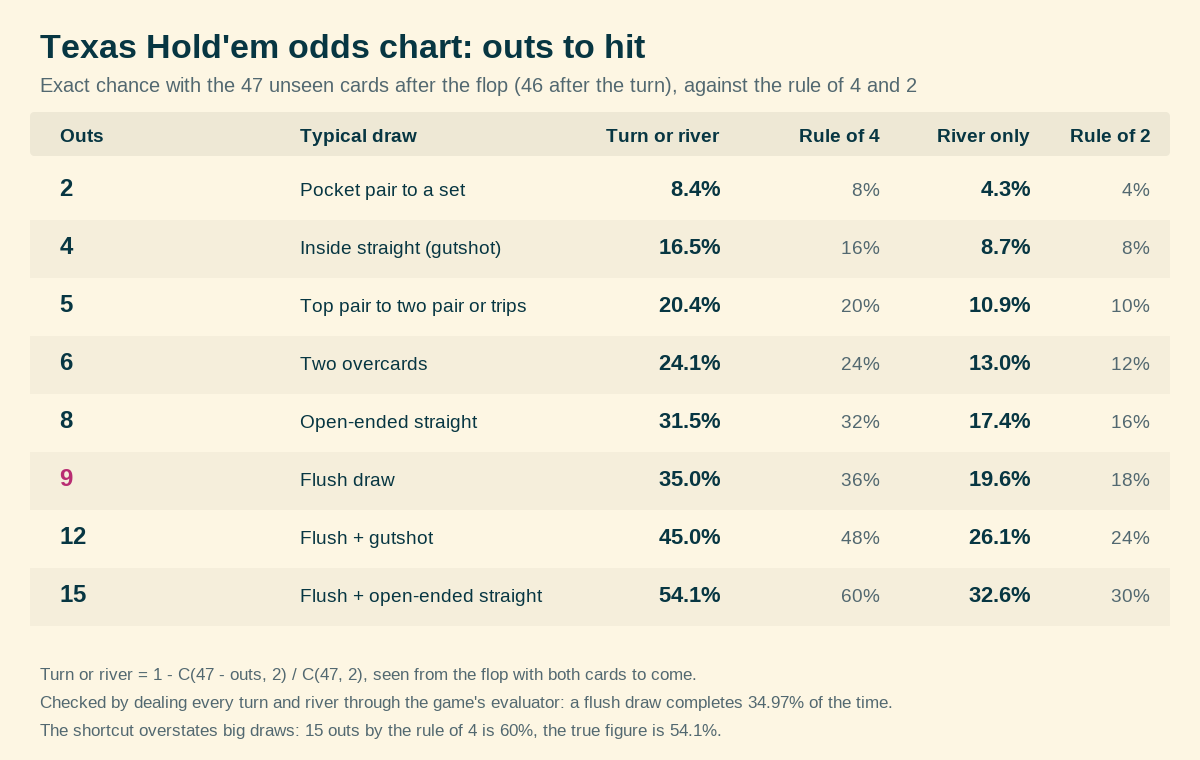
The rule of 4 is fine up to about 8 outs. Above that it runs high: a flush plus straight draw with 15 outs hits 54.1% of the time, not 60%. We also dealt every possible turn and river to a flush draw (A♥ K♥ on a 7♥ 2♥ 9♣ flop) through the evaluator: it completed in 34.97% of cases, matching the formula.
Starting hands against each other
These are exact results over all 1,712,304 possible boards for each matchup, with both players staying to the river.
| Matchup | Wins | Loses | Tie |
|---|---|---|---|
| A♠A♥ vs K♠K♥ | 82.4% | 17.1% | 0.5% |
| Q♠Q♥ vs J♠10♠ | 82.0% | 17.6% | 0.4% |
| K♠K♥ vs A♣Q♦ | 71.4% | 28.2% | 0.3% |
| A♠K♥ vs A♣Q♦ | 71.7% | 23.7% | 4.6% |
| A♠K♥ vs Q♠J♥ | 65.1% | 34.4% | 0.6% |
| 7♠7♥ vs A♣K♦ | 55.3% | 44.5% | 0.3% |
| A♠K♥ vs Q♠Q♥ | 43.4% | 56.1% | 0.5% |
| A♠K♥ vs 2♠2♥ | 47.4% | 51.9% | 0.7% |
Two lessons hide in there. A pair against two higher cards is close to a coin flip, slightly in the pair’s favor, even when the pair is 2s. And A-K against A-Q is a big favorite because the shared ace leaves the queen kicker needing help.
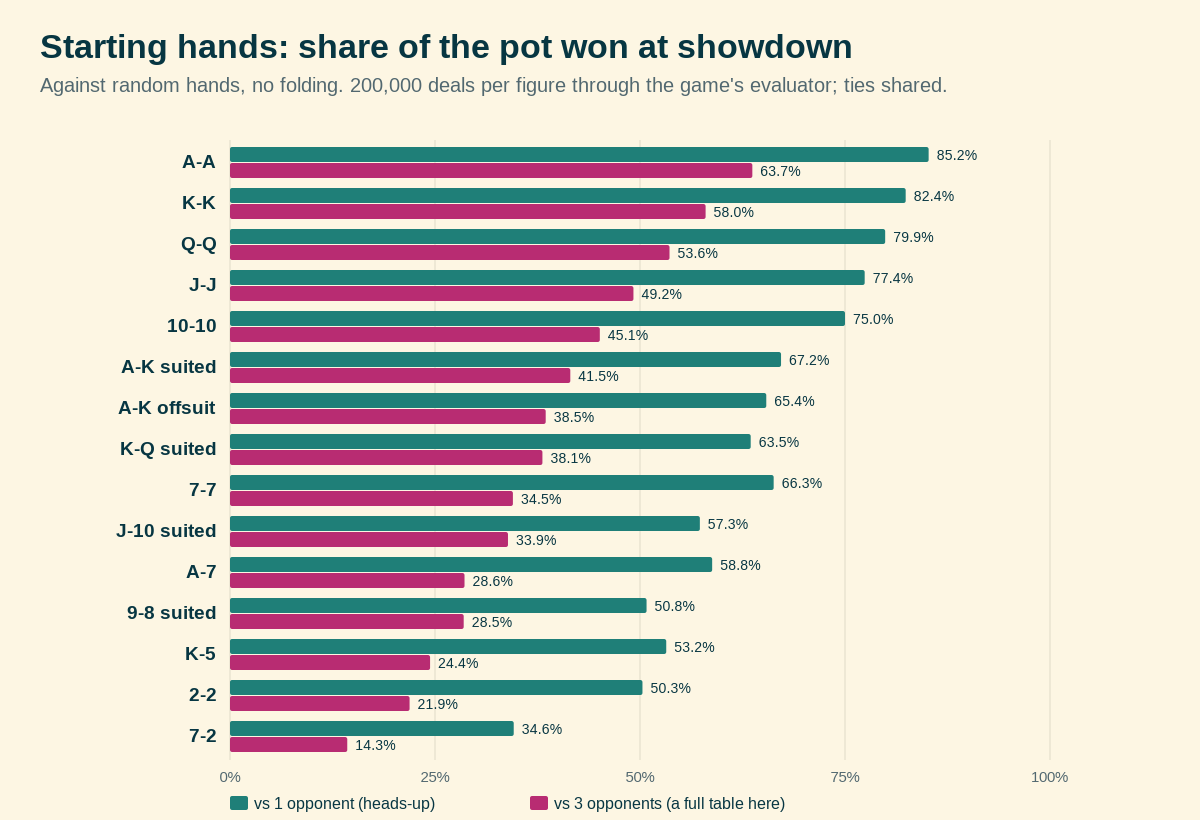
Pocket aces win about 85% of the time against one random hand, but about 64% against three. That drop is the reason to raise good hands before the flop: fewer opponents means your strong hand holds up more often.
Using the odds: pot odds
Odds only help when you compare them with the price. Say the pot holds 100 and your opponent bets 50. You must call 50 to win 150, so you need to win at least 50 / 200 = 25% of the time to break even. With a flush draw and only the river to come (19.6%), calling loses chips in the long run. On the flop, with two cards to come (35.0%), the same call is fine, as long as you don’t expect another big bet on the turn.
Five beginner tips
- Fold most hands before the flop. Hands like 7-2 or K-5 win little against several opponents.
- Raise your good hands to thin the field.
- Position matters. Acting last, on the button, lets you see what everyone did first.
- Count your outs and compare them with the pot odds before calling a bet.
- Watch the board. A paired board makes full houses possible; four cards of one suit put a flush in play for anyone holding one card of that suit.
Practice without risk
Our Texas Hold’em table puts these rules into play against three computer players who can’t see your cards. If you want to practice hand values first, video poker uses the same rankings without opponents. For how the house makes its money in the games where you play against the casino, see our house edge guide.
Chips and credits on this site are virtual. They can’t be bought, cashed out or exchanged for prizes, so playing here isn’t gambling. The games are for adults (18+). Real-money poker is gambling, and it may be illegal where you live.
Frequently asked questions
What are the basic rules of Texas Hold'em?
Each player gets two face-down cards. Five face-up shared cards are dealt in three stages: three on the flop, one on the turn, one on the river. There is a betting round before the flop and after each stage. At the end, the best five-card hand made from your two cards and the five on the table wins the pot, unless everyone else has folded first.
How do Texas Hold'em rules change with 2 players?
Heads-up, the player on the dealer button posts the small blind and the other player the big blind. Before the flop the dealer acts first; on the flop, turn and river the dealer acts last. Everything else, including hand rankings and the showdown, stays the same.
Do you have to use both of your cards in Texas Hold'em?
No. Your hand is the best five of the seven cards available, and it can use both of your cards, one of them or none. If the five shared cards are your best hand, you are playing the board, and so is everyone else who can't beat it.
What are the odds of hitting a flush in Texas Hold'em?
With four cards of one suit after the flop, 9 of the 47 unseen cards complete the flush. You hit by the river 34.97% of the time, or 19.57% with only the river to come. Starting with two suited cards, you finish with a flush by the river 6.4% of the time.
How often are you dealt pocket aces?
Once every 221 hands on average. There are 1,326 possible two-card starting hands and 6 of them are pairs of aces. Any pocket pair comes 5.9% of the time, about once in 17 hands.
What is the rule of 4 and 2 in poker?
A shortcut for your chance of hitting a draw: multiply your outs by 4 on the flop (two cards to come) or by 2 on the turn (one card). It is close for small draws but overstates big ones: 15 outs gives 60% by the rule and 54.1% exactly.