Slot Machine Myths Tested With Real Code
Slot players trade a lot of advice: machines run hot and cold, jackpots fall at night, a near miss means you’re close. Most of it can’t be checked in a casino, because the machine’s code is closed. Ours isn’t. We took nine common slot machine myths and tested each one against the code of our own Jackpot Slot, with 40 million spins drawn from the same random source the game uses. The short version: the machine has no memory, no clock and no plan.
If you want the mechanics first, how slot machines work explains the reels, the random draw and the exact jackpot odds this guide builds on.
Myth 1: “It’s due after a losing streak”
This is the gambler’s fallacy: the belief that a run of losses makes a win more likely. On a slot it would require the machine to remember its past spins. Ours draws three new random numbers each time and never looks back.
The numbers agree. Overall, 56.22% of spins paid something. Here is the rate on the spin right after a dry run:
| Before this spin | Spins measured | Next spin paid |
|---|---|---|
| Any history | 40,000,000 | 56.22% |
| 3+ losses in a row | 3,356,646 | 56.20% |
| 5+ losses in a row | 644,173 | 56.23% |
| 8+ losses in a row | 53,861 | 56.15% |
| A win of 20× the bet or more | 109,909 | 56.23% |
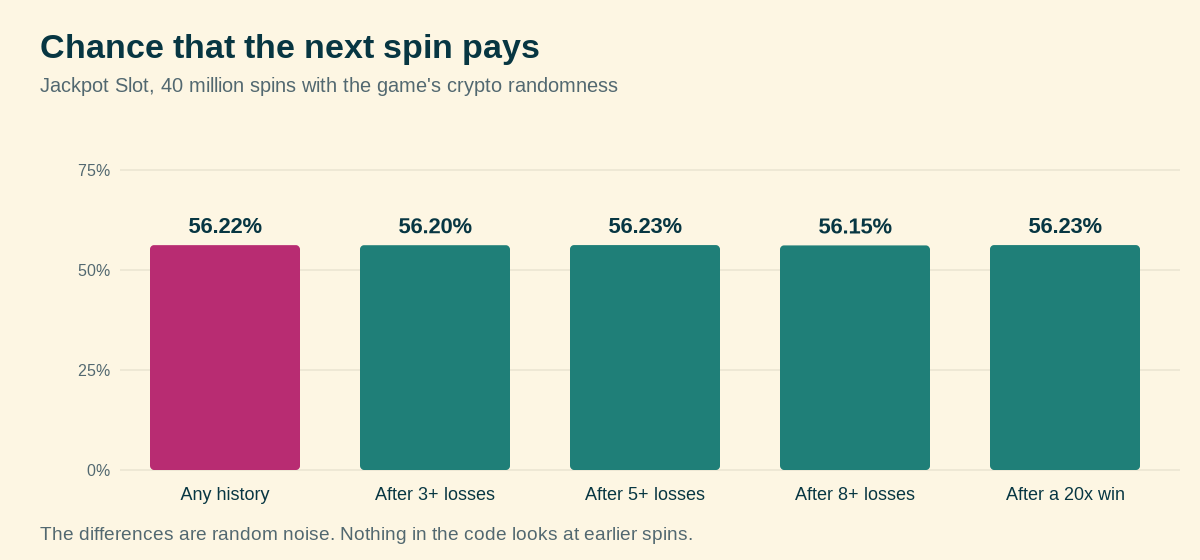
The last row covers the opposite myth, that a machine goes “cold” after paying out. It doesn’t. The longest losing streak in all 40 million spins was 21, because cherries land so often on this game; on a slot with a lower hit rate, dry spells run much longer and feel even more meaningful. They aren’t.
Myth 2: “The jackpot is about to drop”
A progressive meter that has climbed for hours looks ripe. But the chance of three Stars on a line is fixed by the reel strips at exactly 1 in 6,553.6, and the code never checks the size of the pool. We split the 40 million spins by how long it had been since the previous jackpot:
| Spins since the last jackpot | Jackpot rate |
|---|---|
| Under 2,000 | 1 in 6,530 |
| 2,000 to 9,999 | 1 in 6,474 |
| 10,000 or more | 1 in 6,898 |
All three sit within random noise of 1 in 6,554. The gaps between jackpots show how uneven a fixed chance looks: 14.1% of them were under 1,000 spins, 5.1% were over 20,000, and the longest was 71,585. A long wait is normal and says nothing about the next spin.
What a big pool does change is the prize. The odds stay the same while the payout grows, so a huge meter makes the max bet worth a little more, never a win more likely.
Myth 3: “Slots hit at certain times of day”
The idea that machines pay more at night, on weekends or at the start of the month has no hook in the code. Our spin function takes the current bet and a random number source, and that is all. It reads no clock, no date and no player count. A machine running a fixed program and a fair random draw can’t tell 3 a.m. from 9 p.m.
Myth 4: “A near miss means you’re close”
Two Stars on a line and the third just above or below the window feels like almost winning. It is a loss like any other, and a common one. Of the 32,768 stop combinations on the Jackpot Slot, 155 put Stars on the first two reels of a line without completing it: 31 near misses for every jackpot. Another 22 combinations show all three Stars on screen but not on a line, which looks even closer and pays nothing.
The machine isn’t teasing you, and it isn’t warming up. The near miss is simply what most of the Star results look like.
Myth 5: “Timing the button changes the result”
On our slot the stop positions are chosen the instant you press Spin, before the reels move. The animation runs for about a second and then lands on stops that already exist. Pressing faster, slower or twice can’t change them. Even “stopping” reels early, on machines that allow it, only ends the animation sooner.
Myth 6: “Betting max improves your odds”
Half true, and the true half is specific. The bet size doesn’t change how often any symbol lands: three Stars remain 1 in 6,553.6 at every stake. But on our slot only the max bet can win the progressive pool, so the long-run return is about 97.3% at the max bet against 95.32% at the others. That is a better rate on a bigger stake. You lose less per credit but more credits per spin, and you still lose over time.
Myth 7: “Find the slots that hit the most”
People asking “what slots hit the most” usually want the machine that pays best. These are different things. Hit frequency counts how often a spin pays anything, even a win smaller than the bet:
| Slot | Spins with a win | RTP |
|---|---|---|
| Gem Mine | 61.14% | 94.76% |
| Jackpot Slot | 56.23% | 95.32% |
| Turkish Delight Palace | 21.30% | 94.78% |
Gem Mine wins nearly three times as often as Turkish Delight Palace and returns 0.02 points less. A slot that hits often pays many small amounts; one that hits rarely saves its return for bigger wins. The price is the RTP. Our RTP and volatility guide shows how the two trade off.
Myth 8: “Play long enough and you’ll come out ahead”
The longer you play, the closer your result gets to the house edge. We ran sessions on the Jackpot Slot at a total bet of 5 credits:
| Session length | Sessions | Finished ahead | Median result |
|---|---|---|---|
| 100 spins | 20,000 | 33.5% | -54 credits |
| 1,000 spins | 20,000 | 27.8% | -280 credits |
| 10,000 spins | 4,000 | 6.7% | -2,330 credits |
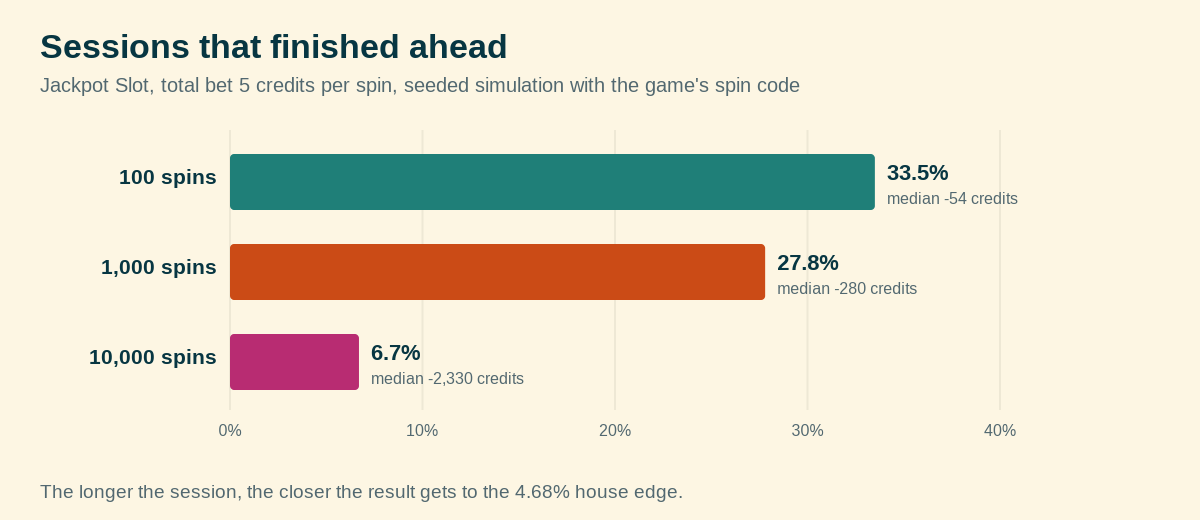
A short session is mostly luck, which is why a third of them end in profit. Over 10,000 spins the 4.68% edge has had time to work. No betting pattern changes that; we looked at the most famous one in the Martingale strategy.
Myth 9: “Demo slots pay more than real ones”
On this site there is no real-money version to compare: the demo is the whole game, and the RTP on each page is the one the code runs. Elsewhere the worry has a real basis. Commercial slots are often built with several RTP settings, and the operator picks one, so a free demo may not show you the setting used for real money. Whatever the setting, it stays under 100%.
What actually holds
A slot is a fixed price paid at a random pace. The price is the RTP, the pace is the volatility, and nothing you notice at the machine (streaks, meters, near misses, the time) tells you about the next spin. You can test all of this yourself on the Jackpot Slot with 1,000 virtual credits and free refills. Credits can’t be bought or cashed out, and the game is for adults (18+). Real-money gambling may be illegal where you live.
Frequently asked questions
Do slot machines hit at certain times?
No. A slot's result comes from a random number drawn when you press Spin. Our game's code never reads the clock, the date or how many people are playing, so a spin at 3 a.m. has exactly the same odds as one at 9 p.m.
Is a slot machine due to pay after a long losing streak?
No. That belief is the gambler's fallacy. In 40 million spins of our Jackpot Slot, the chance of a win right after 8 straight losses was 56.15%, the same as the 56.22% overall rate within measuring error.
What slots hit the most?
Hit frequency is printed on few machines, and it doesn't tell you the cost. On this site the 20-line Gem Mine pays something on 61% of spins and the cluster slot Turkish Delight Palace on 21%, yet both return about 94.8% over the long run. Check the RTP, not how often the screen lights up.
Does betting max increase your odds on slots?
It doesn't change how often symbols land. On some progressive slots, ours included, only the max bet can win the pool, so the long-run return is higher at the max bet: about 97.3% instead of 95.32% on our Jackpot Slot. You still lose more credits per spin.
Do near misses mean a slot is about to hit?
No. A near miss is just one of the losing results. On our Jackpot Slot, a line with Stars on the first two reels and something else on the third comes up 155 times in every 32,768 spins, 31 times as often as the jackpot itself.
Do demo slots pay differently from real money slots?
Ours have no real-money version: the demo is the whole game and the RTP on each page is what the code runs. For commercial slots you usually can't tell, because the same game is often built with several RTP settings and the operator picks one.