House Edge Explained: Casino Games Compared
The house edge is the share of every bet a casino game keeps on average over the long run. It is the price of playing, built into the payouts and rules. A game with a 2.70% edge keeps 2.70 credits of every 100 you bet, not every time, but on average across a huge number of rounds. This guide explains where the edge comes from, how to use it to compare games, and what it actually is on every casino game on this site, measured from the games’ own code.
What house edge means
Think of the edge as a fee taken from every bet in tiny pieces. You never see it on a single spin or hand. A bet wins or loses in full. But over thousands of rounds the wins and losses even out around a line that slopes slowly downward, and the slope of that line is the house edge.
House edge and RTP (return to player) are two sides of one number. A slot that pays back 95.32% has a house edge of 4.68%. Roulette’s 97.30% return is a 2.70% edge.
How the edge is built into a game
Every casino game creates its edge in one of a few ways:
- Payouts below fair odds. A single number on a European roulette wheel wins 1 time in 37. A fair payout would be 36 to 1; the table pays 35 to 1. Over 37 spins of 1 credit you stake 37 and get back 36. The missing credit is the edge: 1/37 = 2.70%. We checked all 157 bets on our roulette table against all 37 results, and every one returns exactly 36/37.
- A commission. In baccarat the Banker hand wins slightly more often than Player, so the game takes 5% of Banker wins. Counting every possible card order in our 8-deck shoe gives Banker a 1.06% edge and Player 1.24%.
- Rule asymmetry. In blackjack you act first. If you bust, you lose, even when the dealer busts afterwards. That single rule is the house’s main advantage.
- A pay table or formula. A slot sets the edge with its reel strips and pay table, and our Rocket crash game sets it with a formula: the chance of reaching multiplier m is 0.97 ÷ m, so every cash-out target returns exactly 97%.
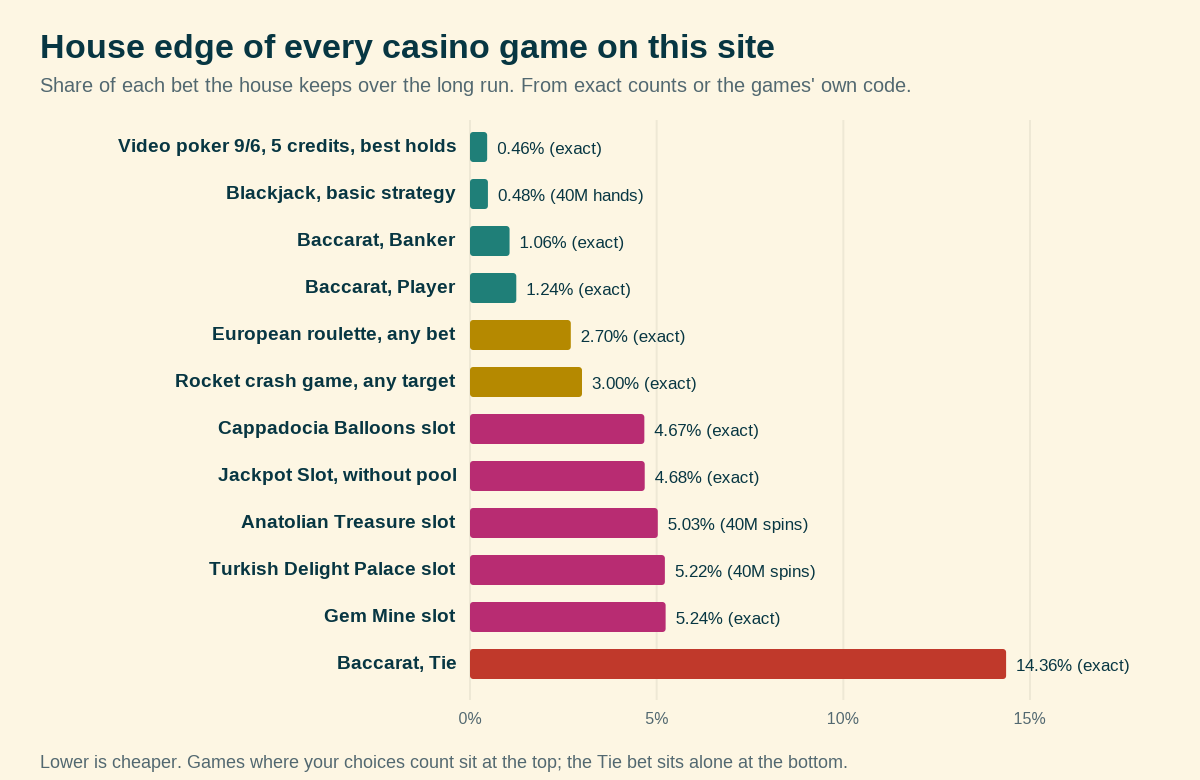
The house edge of every game here
We worked these figures out from each game’s rules file. Where the game allows it, the number is an exact count of every possible outcome. Where it doesn’t (blackjack, two of the slots), it comes from tens of millions of rounds played through the unchanged game code.
| Game and bet | House edge | How we got it |
|---|---|---|
| Video poker, 9/6 Jacks or Better, 5 credits, best holds | 0.46% | Exact calculation |
| Blackjack, basic strategy | 0.48% | 40 million hands |
| Baccarat, Banker | 1.06% | Every card order in an 8-deck shoe |
| Baccarat, Player | 1.24% | Same count |
| European roulette, any bet | 2.70% | All 37 results for all 157 bets |
| Rocket crash game, any target | 3.00% | Exact from the crash formula |
| Slots | 4.67% to 5.24% | Exact counts, or 40 million spins |
| Baccarat, Tie | 14.36% | Every card order in an 8-deck shoe |
We also played the no-decision games through their code as a second check. Two million baccarat hands came out within a tenth of a point of the exact figures, and two million Rocket rounds at a 2x target returned 96.98% against an exact 97%.
The blackjack figure is per credit of initial bet. Doubles and splits put extra credits on the table, and measured against everything wagered the same result is 0.43%. Either way, basic strategy is doing the work: our blackjack game page shows that copying the dealer’s hit-to-17 rule costs about 5.7% instead.
How much the edge costs you
Here is the part most players miss: the edge applies to the total amount you bet, not to the money you bring. If you sit down with 1,000 credits and play 1,000 rounds of 10 credits, you have wagered 10,000 credits, even if your balance never went above 1,100. Winnings you bet again count again.
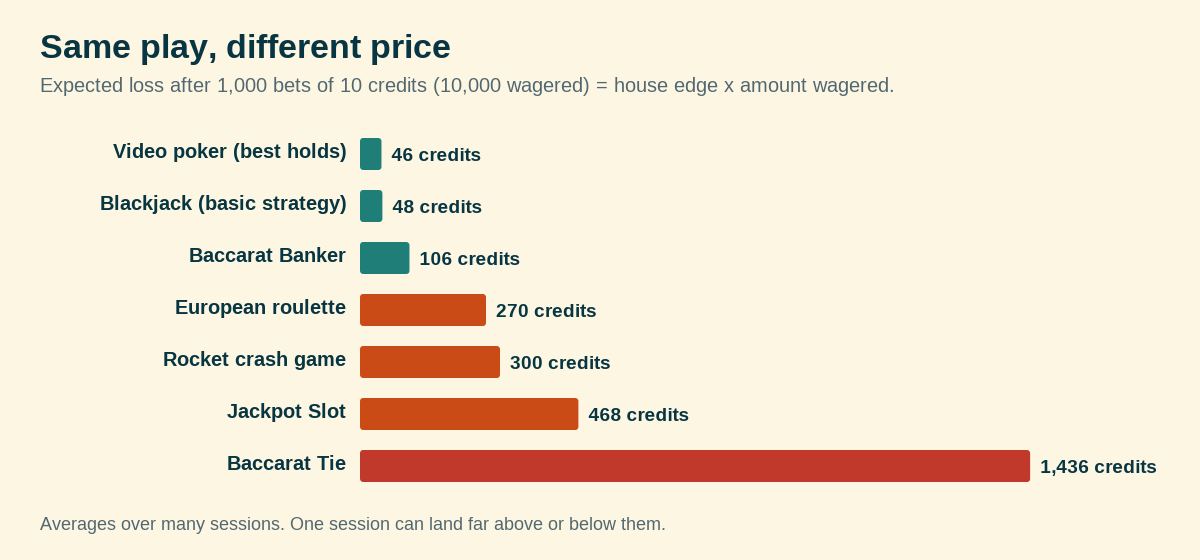
On 10,000 credits wagered, the expected loss runs from about 46 credits on video poker to 1,436 on the baccarat Tie. That gap matters more than any tip or system. Moving from the Tie bet to the Banker bet, on the same table, cuts the price of playing by more than 90%.
Speed matters too. A game you play twice as fast costs twice as much per hour at the same edge. Slots and crash games, with a round every few seconds, add up wagers faster than a blackjack table.
House edge vs. what happens tonight
The edge is a long-run average, and short sessions don’t follow it closely. On our Jackpot Slot, 28% of 1,000-spin sessions finished ahead in our slot RTP and volatility guide, even with a 4.68% edge. A winning night doesn’t mean a game is “loose”, and a losing night doesn’t mean it is rigged.
What the edge does tell you is where things end up over enough play. The more rounds you play, the closer your total result gets to the edge times the amount wagered.
Three common mix-ups
“A 2.70% edge means I lose 2.70% of my money.” Only if you bet your balance once. Bet the same 100 credits ten times over and the expected loss is 2.70% of 1,000, or 27 credits.
“A game that wins often has a low edge.” Red on roulette wins 48.65% of spins and a straight up bet wins 2.70%, yet both carry the same 2.70% edge. How often a bet wins tells you about the swings, not the price.
“The house edge is the chance of losing.” It isn’t a probability at all. In blackjack you lose about 48% of hands, but the edge is under half a percent, because pushes, 3:2 blackjacks and doubled wins make up the difference.
Does skill change the house edge?
Only in games where you make decisions that change the outcome.
- Blackjack: basic strategy, explained in our basic strategy chart guide, brings the edge down to under half a percent. Bad play multiplies it.
- Video poker: the cards you hold set the return. Our Jacks or Better guide shows the holds behind the 99.54% return.
- Roulette, baccarat, crash games, slots: your choices change how results are spread out, never the average. On roulette every bet costs 2.70%. In baccarat, our third-card rules guide explains why the draw is fixed and only the bet you pick matters.
- Poker against other players: our Texas Hold’em table takes no cut; you play against three computer opponents. In a real-money card room, the house usually takes a fee from each pot or charges for the seat instead of holding an edge on the cards.
Can you beat the house edge?
Betting systems can’t. Each bet in a sequence carries the same edge, so the whole sequence does. Our martingale strategy guide ran five systems through 200,000 roulette sessions each, and every one returned about 97.3% of the money bet.
Card counting in blackjack is the one real exception, because a shoe changes as it is dealt. On our table it turned the 0.48% house edge into a player edge of 0.26% to 0.56%, depending on how much the bets varied. Our card counting guide shows how slowly that edge appears through the swings, and why it disappears when the cards are reshuffled every hand.
Play the games without the cost
Every game here runs on virtual credits: you start with 1,000, refills are free, and credits can’t be bought, cashed out or turned into prizes. That makes this a place to see the edge at work without paying it. The games are for adults (18+). With real money, every casino game carries a house edge, and gambling may be illegal where you live.
Frequently asked questions
What does house edge mean?
It is the average share of each bet that the game keeps over a very long run. A 2.70% house edge means that for every 100 credits bet, about 2.70 stay with the house on average. It doesn't predict a single session, only the long-run price of playing.
What is the house edge in blackjack?
It depends on the rules and on how you play. On our 6-deck table, where the dealer stands on soft 17 and blackjack pays 3:2, basic strategy leaves a house edge of about 0.48%, measured over 40 million hands. Playing by feel or copying the dealer raises it to around 5 to 6%.
What is the house edge on roulette?
2.70% on a single-zero European wheel, for every bet on the table: each one returns 36/37 of the stake. On an American wheel with a double zero it rises to 5.26%.
Which casino game has the lowest house edge?
Among our games, 9/6 Jacks or Better video poker played with the best holds at 5 credits (0.46%) and blackjack with basic strategy (0.48%). Both need correct decisions. Of the games with no decisions, the baccarat Banker bet is cheapest at 1.06%.
What is the difference between house edge and RTP?
They describe the same thing from two sides. RTP (return to player) is the share paid back, house edge is the share kept. A slot with a 95.32% RTP has a 4.68% house edge.
Can you beat the house edge?
Not with a betting system: every bet carries the edge, so any mix of bets does too. Counting cards in a blackjack shoe that isn't reshuffled every hand can give a small player edge, about 0.26% to 0.56% in our tests, with swings far larger than the gain.