Martingale Roulette Strategy: Does It Work?

The martingale strategy is the oldest betting system in roulette: bet on red, double the bet after every loss, and go back to the first bet after a win. The first win always recovers what you lost plus one base bet. That sounds like a sure thing, and most of the time it feels like one. This guide shows what actually happens when you run it, using the rules code of our free European Roulette table to play 200,000 sessions per test.
How the martingale works
Say your base bet is 10 credits on red. Red pays 1:1 and comes up in 18 of the 37 pockets.
- Spin 1: bet 10 on red. It loses. You are down 10.
- Spin 2: bet 20. It loses. Down 30.
- Spin 3: bet 40. Red wins and pays 40. You are now up 10.
However long the streak, the winning bet is always one base bet larger than everything lost before it, because 10 + 20 + 40 + … + 10 × 2ⁿ⁻¹ adds up to 10 × 2ⁿ − 10. Each finished cycle earns exactly 10 credits. The catch is in the size of the bets you need to get there.
Where the ladder breaks
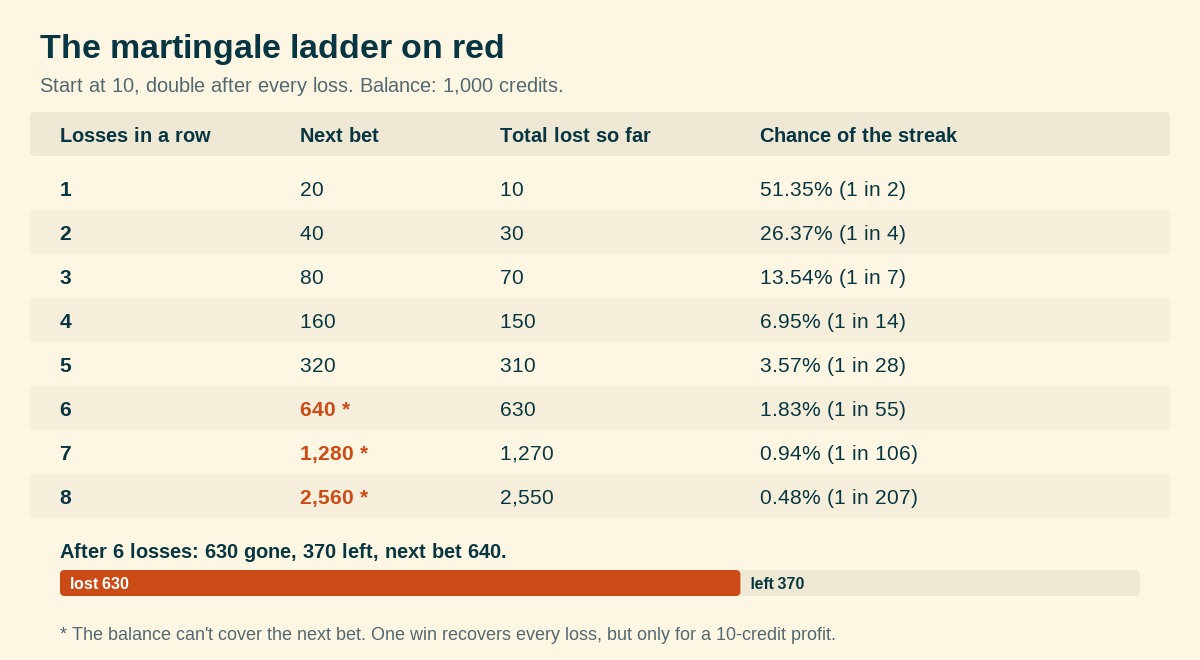
With 1,000 credits and a 10-credit base, you can afford six bets in a row: 10, 20, 40, 80, 160 and 320. If all six lose, 630 credits are gone and the seventh bet would be 640. You have 370. The system is over, and the loss is 630 credits, the profit of 63 successful cycles.
How likely is that? A bet on red loses on 19 of 37 pockets (18 black plus the zero), so six losses in a row come up with a chance of (19/37)^6 = 1.83%, about 1 in 55. Each cycle wins 10 credits 98.17% of the time and loses 630 the other 1.83%. Multiply it out and an average cycle costs about 1.7 credits. The big rare loss more than pays for the small frequent wins.
200,000 sessions on our table
We connected the table’s rules file to a test script and played sessions exactly as a player would: 1,000 credits, 10 on red, double after a loss, back to 10 after a win. Each session stopped at its profit target, or when the next bet was more than the balance.
| Target profit | Sessions that reached it | Average session result |
|---|---|---|
| +50 | 91.0% | -9.3 |
| +100 | 83.0% | -16.7 |
| +200 | 69.2% | -28.3 |
| +500 | 48.8% | -62.9 |
| +1,000 | 30.4% | -103.8 |
The +100 row matches the math: ten successful cycles in a row have a chance of (1 − 0.0183)^10 = 83.1%. A small target makes the system look brilliant. A target of +500 succeeds less than half the time, and the middle session ends at −380, because the longer you play, the more likely you are to meet the streak.
Without any target, playing up to 200 spins, 69.0% of martingale players hit the wall, and the average session lost 103 credits.
What about table limits?
In a casino the table maximum usually stops the ladder before your balance does. Our free table has no maximum bet, so the only limit is your credits. To see what a limit does, we gave the script a 500-credit table maximum and a 5,000-credit balance. The result, 83.2% of sessions reaching +100, was the same as with 1,000 credits: the 640 bet is over the limit either way.
Without the limit, the 5,000-credit player reached +100 in 95.3% of sessions. But the streak that ends that ladder is eight losses in a row, and it costs 2,550 credits. A bigger balance doesn’t remove the wall. It moves it further away and makes it more expensive to hit.
Other roulette systems, same result
Doubling is the most aggressive system, but players have plenty of gentler ones. We ran four of them through the same code under the same rules: start with 1,000, stop at +100, after 200 spins or when the next bet can’t be paid.
- Flat betting: 10 on red every spin, as a baseline.
- d’Alembert: add 10 after a loss, take 10 off after a win.
- Fibonacci: move one step up the sequence 1, 1, 2, 3, 5, 8… after a loss, two steps back after a win.
- Paroli (reverse martingale): double after a win, up to three wins in a row, then back to 10. Back to 10 after any loss.
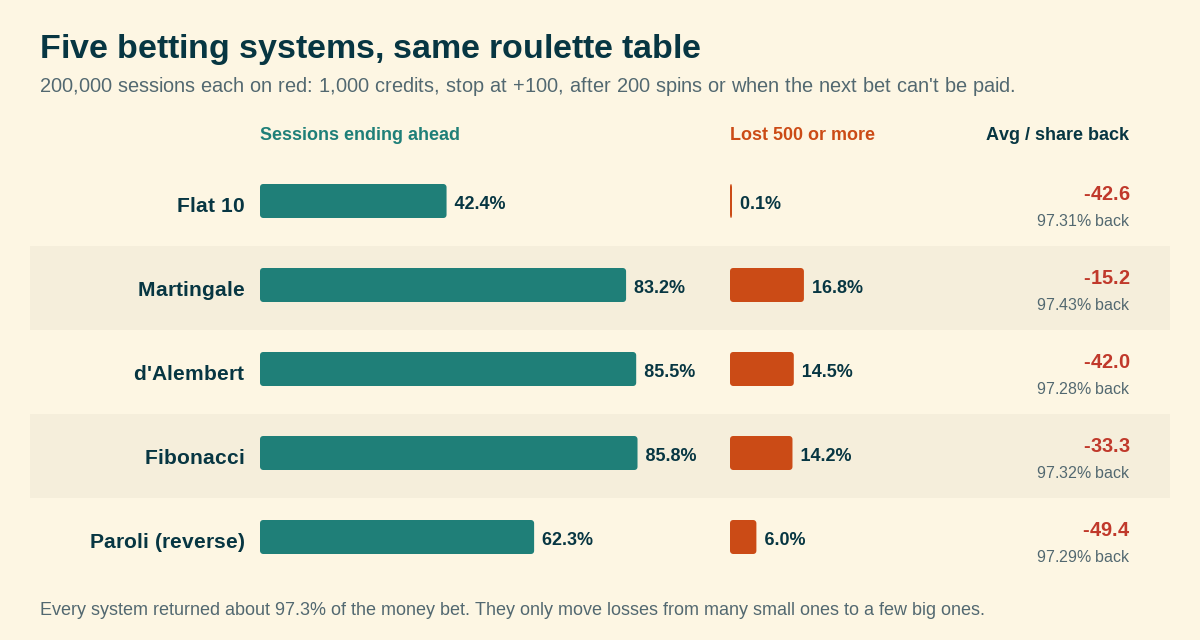
The systems that raise the bet after losses (martingale, d’Alembert, Fibonacci) all end ahead in roughly 83 to 86% of sessions, and all lose 500 or more in roughly 14 to 17%. Paroli flips the pattern: small losses, the odd big run, fewer sessions ending ahead. Flat betting ends ahead least often, in 42.4% of sessions, but almost never loses big.
Look at the last column, though. Every system got back between 97.28% and 97.43% of the money bet. That is the single-zero return of 36/37, explained in our European roulette rules and odds guide, give or take the noise of a simulation. Flat betting lost more per session on average (−42.6) than the martingale (−15.2) only because flat sessions lasted longer and put more credits on the table. Per credit bet, the price was identical.
Martingale in blackjack and other games
The same arithmetic applies to any game. We ran the martingale on our free blackjack table with basic strategy: 1,000 credits, 10-credit base, double after a lost hand, stop at +100 or at the wall. Over 465,180 sessions, 84.1% reached +100 and 15.9% hit the wall. The worst session lost 1,830 credits, because doubles and splits on a 320-credit hand add even more to the bet. (We let those extra bets through even when the balance was short, which flatters the system a little.)
Sessions lost only about 2 credits on average, against 15 on roulette. That isn’t the martingale working. It is blackjack’s smaller house edge, about half a percent instead of 2.70%, showing through. Our house edge guide puts every game side by side.
Crash games invite the same idea with a 2x cash-out, and our crash game guide shows the ladder hitting that game’s 500-credit maximum after six losses.
Is there a roulette strategy that always wins?
No. The reason is short: every spin is independent, and every bet on the table returns 36/37 of what you stake. A betting system is just a rule for choosing the next bet size. Each of those bets returns 97.30% on average, so the whole sequence does too, whatever order the sizes come in.
What a system can do is reshape your results. The martingale gives you a high chance of a small win and a small chance of a large loss. Paroli gives you the opposite. Neither touches the average.
Two beliefs keep systems alive:
- “Red is due.” After six blacks, red still has 18 chances in 37 on the next spin. The wheel has no memory, and our game draws each result independently from the browser’s random number generator.
- “I’ve won with it many times.” You probably have. With a +100 target the martingale wins 83% of sessions, so most players who try it a few times see nothing but wins. The loss that pays for all those wins comes later.
Try it with virtual credits
Our European Roulette table starts you with 1,000 virtual credits and free refills, so you can play a martingale until it breaks and see the 640 bet you can’t place. Credits can’t be bought, cashed out or exchanged for prizes. The games here are for adults (18+). With real money, no betting system changes the house edge, and gambling may be illegal where you live.
Frequently asked questions
What is the martingale strategy in roulette?
A betting system for even-money bets like red or black. You start with a base bet and double it after every loss. When you finally win, that one win pays back all the losses in the streak plus one base bet, and you go back to the start.
Does the martingale strategy work?
It works most of the time and fails badly the rest. In our test it reached a 100-credit profit in 83.2% of sessions, but every failed session lost about 630 credits. On average the sessions lost 15 credits, and about 97.3% of all money bet came back, exactly the roulette return.
Why do casinos have table limits?
A maximum bet caps how far a doubling system can go, and it protects the casino from very large single bets. For the martingale player the effect is the same as a small balance: the ladder stops after a few doublings. Our free table has no maximum bet; your balance is the limit.
Is there a roulette strategy that always wins?
No. Every bet on a single-zero wheel returns 36/37 of the stake on average, so any mix of bets returns the same. A system can change how often you win and how big the losses are. It cannot change the 2.70% the house keeps.
Does the martingale work in blackjack?
Not better than in roulette. We ran it through our blackjack game's code with basic strategy: 84.1% of sessions reached +100 and 15.9% hit the wall. It loses less per session than on roulette only because blackjack's edge is smaller, about 0.5% instead of 2.70%.
What is the reverse martingale?
A system that doubles after a win instead of a loss, usually for a fixed number of wins (the Paroli). Losses stay small, and a lucky run makes a big win. In our test it ended ahead in 62.3% of sessions and still returned only 97.3% of what was bet.