Baccarat Strategy: Odds, Systems, Patterns
Baccarat strategy is shorter than most people expect: you choose Banker, Player or Tie, and that choice is the only thing that changes the odds. The cards are dealt by fixed rules, so there are no decisions to get right after the bet. That hasn’t stopped players from inventing betting systems and scoreboard patterns. We took nine of them and ran each through the dealing code of our free baccarat table, 100,000 sessions at a time, to see what they actually do.
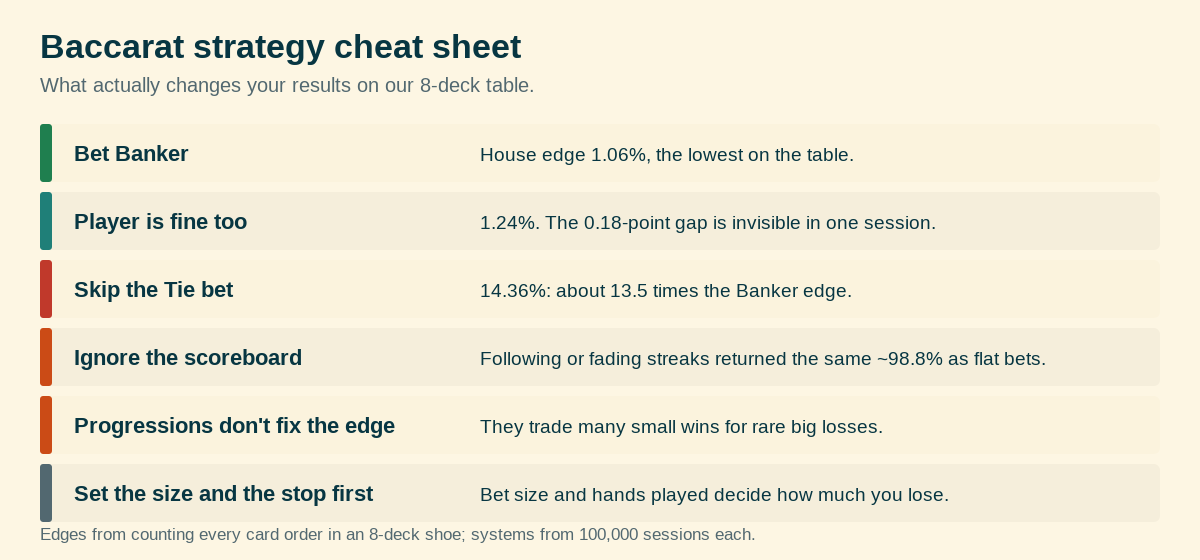
Baccarat odds: Banker vs Player
The drawing rules give Banker a small advantage. Banker acts second, and its third-card chart reacts to the card Player just drew. Our third-card rules guide explains the chart and counts every possible card order in an 8-deck shoe. The results that matter for strategy:
| Bet | Wins | Pays | House edge |
|---|---|---|---|
| Banker | 45.86% of hands | 0.95:1 (5% commission) | 1.06% |
| Player | 44.62% of hands | 1:1 | 1.24% |
| Tie | 9.52% of hands | 8:1 | 14.36% |
On a tie, Banker and Player bets come back to you. So in practice, a Banker bet loses about 49.3 times for every 50.7 times it wins, if you leave the ties out.
The gap between Banker and Player is 0.18 points: 18 credits over 10,000 credits bet. Over a session of a hundred hands, the normal swing is several hundred times larger. Banker is the better bet, but Player isn’t a mistake. The Tie bet is, at about 13.5 times the Banker edge.
How baccarat compares with blackjack and roulette
“Does baccarat have the best odds?” depends on what you compare it with, and on whether you play the other game well.
| Game and bet | House edge on our tables |
|---|---|
| Blackjack, basic strategy | 0.48% |
| Baccarat, Banker | 1.06% |
| Baccarat, Player | 1.24% |
| European roulette, any bet | 2.70% |
| Slots | 4.67% to 5.24% |
| Blackjack, copying the dealer | 5.7% |
| Baccarat, Tie | 14.36% |
Blackjack played by the basic strategy chart is the cheapest game here, but only if every hit, stand, double and split is right. Baccarat needs no skill at all, and its Banker bet costs less than half of roulette’s 2.70%. That is a big part of its appeal: it is the cheapest bet you can make without studying anything. Our house edge guide puts every game on the site side by side.
We tested nine baccarat systems
Every session started with 1,000 credits and a base bet of 10. It stopped when the player was 100 credits ahead, after 200 hands, or when the next bet in the system couldn’t be paid. The shoe carried on from one session to the next, as it does at our table, and every hand went through the game’s own dealing function.
The systems:
- Flat bets: 10 credits on Banker every hand, the same on Player, and the same on Tie.
- Martingale: double the Banker bet after each loss, back to 10 after a win.
- Fibonacci: Banker bets follow 1, 1, 2, 3, 5, 8… units, one step up after a loss, two steps back after a win.
- 1-3-2-6: 10, 30, 20 and 60 on Banker while you keep winning, back to 10 after any loss or after the fourth win.
- Three pattern systems, flat 10 credits: follow the last winner, bet against the last winner (the “chop”), and back whichever side won more of the last ten hands.
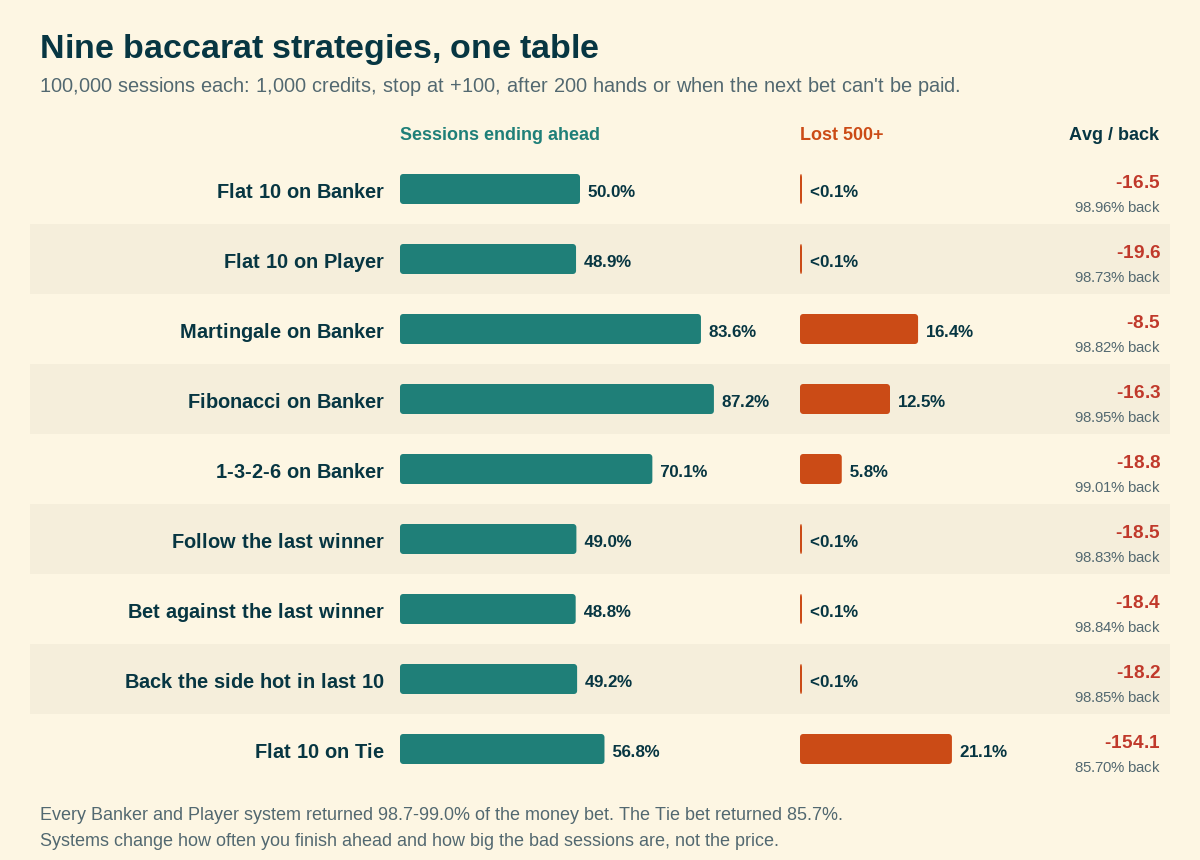
Read the last column first. Every system that bets Banker or Player returned between 98.7% and 99.0% of the money put on the table. That is the house edge showing through: about one credit in a hundred stays behind, however the bets are arranged. No system broke out of that range.
The other columns are where systems differ, and only in how the same loss is packaged.
Martingale and Fibonacci: many small wins, a few big losses
Doubling after a loss feels safe because one win pays everything back. On our table, Martingale on Banker reached its 100-credit target in 83.6% of sessions. In the other 16.4%, six losing hands in a row (ties don’t count) pushed the next bet to 640 credits with only 370 left, and the session ended at least 500 credits down (630 lost on the run itself). Fibonacci was similar: 87.2% of sessions ahead, 12.5% ended by a bet it couldn’t pay.
Baccarat adds a twist that roulette doesn’t have. Banker wins pay 0.95 to 1, so each win comes back 5% short, and the shortfall grows with the bet.
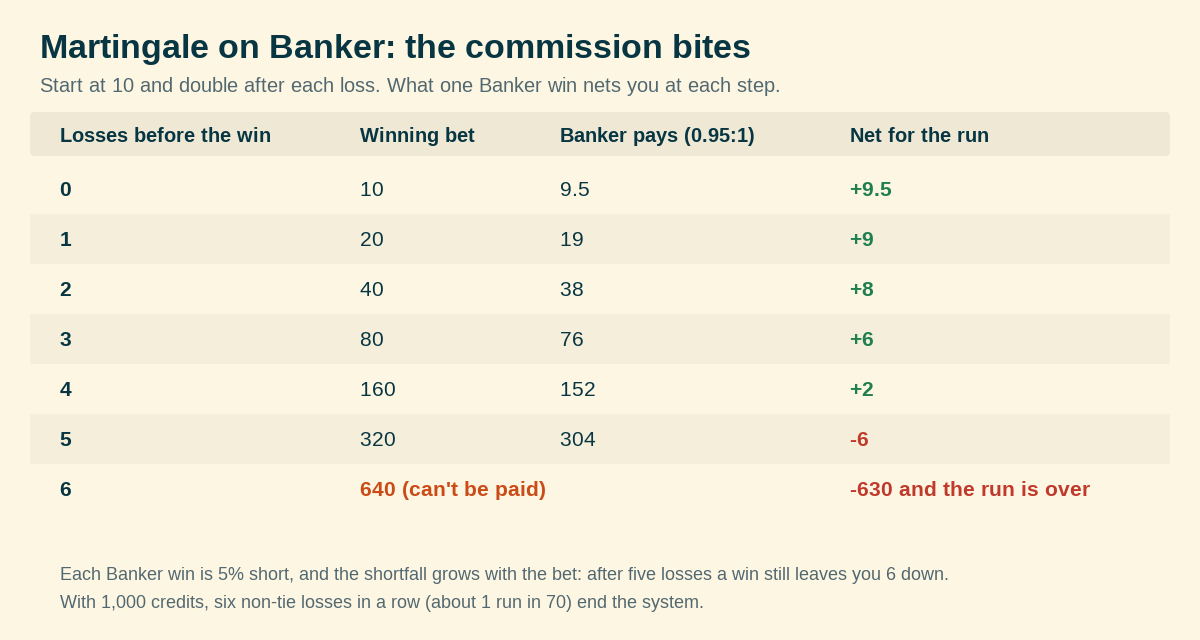
After five losses, the 320-credit win pays 304 against 310 already lost. The system “wins” and you are still 6 down. The 1-3-2-6 system goes the other way: it raises bets after wins, so it reached the target in 68.8% of sessions with smaller losses, but it still returned 99.0%.
The average result per session looks better for Martingale (−8.5 credits) than for flat Banker (−16.5), but only because Martingale sessions were short: 24 hands on average against 159. Per credit bet, the two cost the same. Our martingale guide shows the same pattern on the roulette wheel.
Reading the scoreboard: streaks and patterns
Live baccarat tables show “roads”, grids of past results that players scan for streaks and zigzags. Our table shows a simpler strip with the last 40 results. Both record the past and nothing else.
We tested the three most common ways of reading them:
| Pattern system | Sessions ahead | Share of bets returned |
|---|---|---|
| Follow the last winner | 49.0% | 98.83% |
| Bet against the last winner | 48.8% | 98.84% |
| Back the side hot in the last 10 hands | 49.2% | 98.85% |
| Flat Banker, for comparison | 50.0% | 98.96% |
All three land between the Banker and Player figures, exactly where a mix of Banker and Player bets has to land. Picking a side by the scoreboard just decides how often you pay the Player edge instead of the Banker edge. Our baccarat game page has the matching streak count from a million dealt hands: after three Banker wins in a row, Banker won the next hand 50.68% of the time, the same as at any other point.
Card counting doesn’t rescue baccarat either. The drawing rules use almost every kind of card in a similar way, so removing a few cards from an 8-deck shoe barely moves the Banker and Player odds.
The Tie bet: wins often enough to be dangerous
The flat Tie bet is the odd result in the chart. It finished ahead in 56.8% of sessions, more than Banker. Two tie wins pay 160 credits, and that is often enough to reach the target before the losses pile up. But it returned only 85.7% of the money bet, the average session lost 154 credits, and 21% of sessions lost 500 or more. A bet can win often and still be the most expensive one on the table.
A baccarat strategy that holds up
- Bet Banker, or Player if you prefer. Leave the Tie alone.
- Pick a flat bet that fits your balance. Your expected loss is about 1% of the total you bet. 200 hands at 10 credits means 2,000 bet and about 21 credits of expected loss on Banker.
- Decide in advance when you’ll stop, after a number of hands or a loss you are comfortable with. It sounds dull, but bet size and time played are the only levers left. Our bankroll management guide covers how long a balance lasts.
- Skip progressions unless you like their shape. They don’t lower the cost; they move it into rare, larger losses.
Practice for free
Our free baccarat table runs the same rules and dealing code used in these tests. You start with 1,000 virtual credits and can refill for free; credits can’t be bought, cashed out or exchanged for prizes. Baccarat is for adults (18+). With real money, every bet on the table carries a house edge, and gambling may be illegal where you live. If you’d rather play a card game where your decisions matter, our split, double and insurance guide shows how much each blackjack move is worth.
Frequently asked questions
What is the best baccarat strategy?
Bet on Banker, skip the Tie, and decide your bet size and session length before you start. Banker carries a 1.06% house edge after the 5% commission, Player 1.24% and Tie 14.36%. No betting pattern or progression lowers these numbers; in our tests every Banker or Player system returned about 99% of the money bet.
Is it better to bet on Banker or Player?
Banker, by a small margin. It wins 45.86% of hands against Player's 44.62%, and even after the 5% commission its house edge (1.06%) is lower than Player's (1.24%). The difference is 0.18 credits per 100 bet, too small to notice in a single session.
Does the Martingale work in baccarat?
It wins small amounts often and loses big amounts sometimes. In 100,000 sessions on our table, Martingale on Banker reached a 100-credit profit 83.6% of the time and hit the wall in the other 16.4%, losing 500 credits or more each time. It returned 98.8% of the money bet, no better than flat betting. The 5% commission also means that after five losses a Banker win leaves you 6 credits down.
Can you predict baccarat patterns or streaks?
No. Each hand is dealt from the shoe by fixed rules, and the scoreboard only records the past. In our tests, following the last winner, betting against it and backing the side that won more of the last ten hands all returned about 98.8% of the money bet, the same as betting at random between Banker and Player.
Does baccarat have the best odds in the casino?
Among games where you make no decisions, the Banker bet is the cheapest on our site at 1.06%, against 2.70% for European roulette and 4.67% or more for the slots. Blackjack is cheaper still at about 0.48%, but only if you play basic strategy; played by feel it costs around 5 to 6%.
Is baccarat better odds than blackjack?
Baccarat Banker is better than blackjack played by feel, and worse than blackjack played by the book. On our tables: blackjack with basic strategy 0.48%, baccarat Banker 1.06%, blackjack copying the dealer 5.7%.