Bankroll Management: How Long Money Lasts
Bankroll management is the most honest advice in gambling, as long as it is described honestly. No way of managing money changes the house edge. What it does control is how fast you spend, how big the swings are, and when you walk away. This guide measures all three with the code of the games on this site: our Jackpot Slot, two higher-volatility video slots, European Roulette and blackjack played with basic strategy. Every session below starts with a bankroll of 100 bets.
What bankroll management can and can’t do
Every bet in a casino game carries the house edge. If the Jackpot Slot keeps 4.68% of every credit bet, a session of 1,000 spins at 5 credits costs about 234 credits on average whatever you do between spins. You can’t spread, split or time your bets around that, because each bet pays the price on its own. Our house edge guide shows the edge for every game here.
That leaves three things a bankroll plan really controls:
- Speed: smaller bets mean fewer credits bet per hour, so the same money lasts longer.
- Swings: choosing a lower-volatility game or bet makes the balance move more gently.
- Stopping: a budget, a loss limit or a time limit decides when the session ends.
Anything sold as a bankroll “strategy to win” is one of these three dressed up. The martingale guide tests the best-known betting systems; all of them returned about 97.3% of the money bet on roulette, the same as flat betting.
How long will my money last?
A useful rule of thumb: average rounds until broke ≈ bankroll in bets ÷ house edge. With 100 bets on the Jackpot Slot that is 100 ÷ 0.0468 ≈ 2,137 spins. We played thousands of sessions to zero through each game’s code and the averages land close to the rule. The spread around them is the real story.
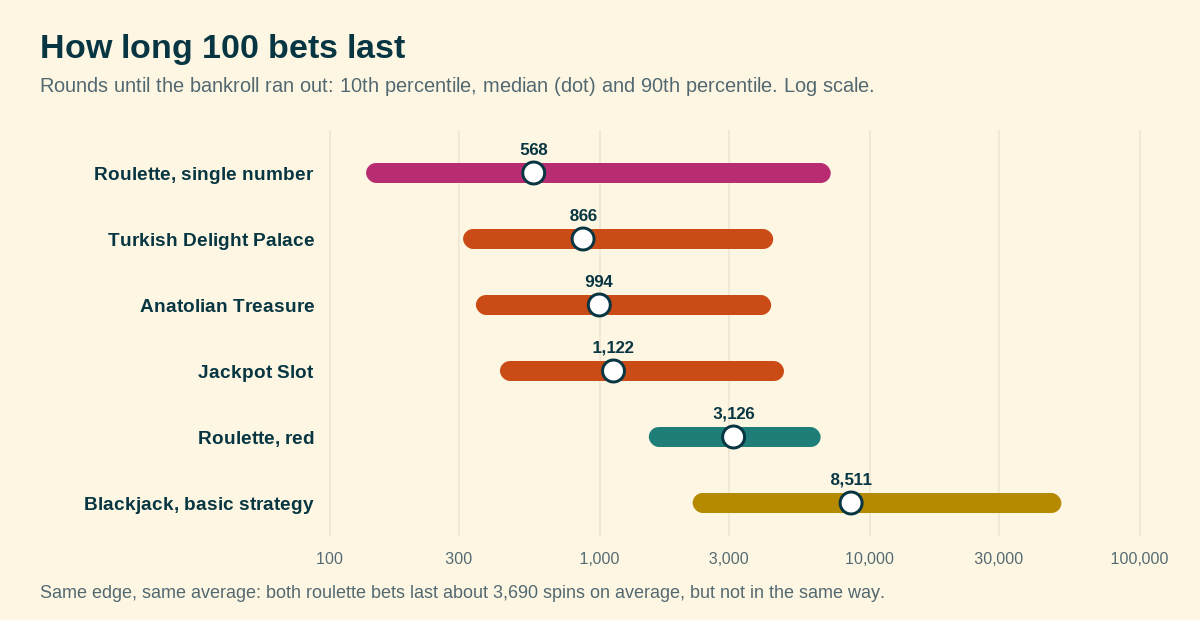
| 100 bets, played until broke | Median rounds | 1 in 10 broke by | 1 in 10 lasted past | Average |
|---|---|---|---|---|
| Jackpot Slot (RTP 95.32%) | 1,122 | 426 | 4,803 | 2,119 |
| Anatolian Treasure (about 95.0%) | 994 | 347 | 4,306 | 1,892 |
| Turkish Delight Palace (about 94.8%) | 866 | 311 | 4,382 | 1,857 |
| Roulette, 1 unit on a single number | 568 | 136 | 7,156 | 3,687 |
| Roulette, 1 unit on red | 3,126 | 1,516 | 6,566 | 3,691 |
| Blackjack, basic strategy | 8,511 | 2,203 | 51,163 | about 19,700 |
Two things stand out. The averages follow the edge: the two roulette bets have the same 2.70% edge and the same average of about 3,690 spins. But the median does not. A single-number bet pays 35 to 1 and wins 1 spin in 37, so the balance falls steadily and jumps now and then. Half of those sessions were over by spin 568, while a few lucky ones ran for many thousands. Red wins almost every second spin and drifts down slowly, so its sessions bunch around the average.
The slots behave like the single-number bet. On the Jackpot Slot, 45% of sessions were broke within 1,000 spins, even though the average session lasted over 2,100. On Turkish Delight Palace, where much of the return sits in free spins, it was 55%. How those features pack the return into rare rounds is explained in our guide to cascading reels and hold and spin.
Blackjack lasts by far the longest, because basic strategy brings the edge down to about half a percent. Over two million hands our player lost 0.51 bets per 100, in line with the 0.48% measured on 40 million hands in our basic strategy guide. The rule of thumb gives 100 ÷ 0.0048 ≈ 20,800 hands. In our 2,000 sessions the average was about 19,700, a little low because 0.8% of them were still going when we stopped them at 200,000 hands.
Risk of ruin: the chance of going broke first
Risk of ruin is the chance of losing the whole bankroll. Asked plainly, it has a plain answer: in any game with a house edge, if you keep playing with the same money, it is 100%. The more useful version asks what happens first: do you hit a goal, or zero?
| 100 bets | Doubled at some point before going broke | Down to 50 bets before ever reaching 200 |
|---|---|---|
| Jackpot Slot | 23.0% | 84.9% |
| Turkish Delight Palace | 25.9% | 82.8% |
| Anatolian Treasure | 24.5% | 83.3% |
| Roulette, single number | 43.4% | 71.7% |
| Roulette, red | 0.41% | 99.6% |
| Blackjack, basic strategy | 31.2% | 79.4% |
The red-bet figure can be checked with a formula. For flat 1-unit bets that win 18 times in 37, the chance of reaching 200 units before 0 from 100 is 0.45% (the classic gambler’s ruin formula), and our simulation gave 0.41%. Doubling with small even-money bets almost never happens, because the edge has thousands of spins to work. The volatile bets double far more often for the same reason that they go broke sooner: the money moves in big jumps. Blackjack is the odd one out. Its swings are small, but its edge is so small that almost a third of the sessions doubled before the long slide to zero.
Bet size: longer sessions, same cost per credit
Bet size is the lever bankroll advice talks about most. We gave the Jackpot Slot the same 1,000 credits at three total bets and played to zero:
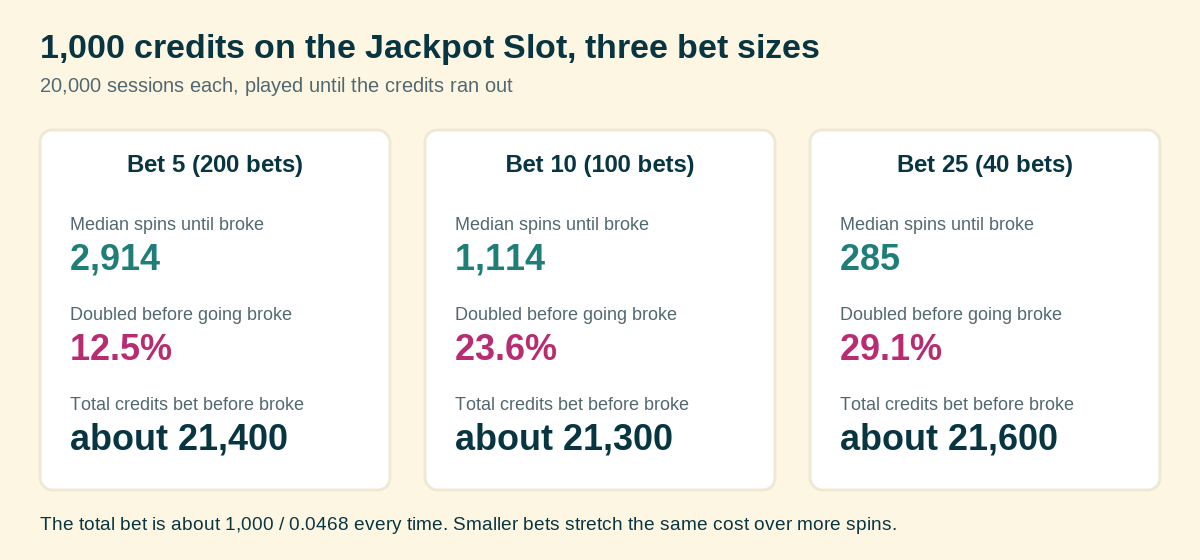
| 1,000 credits on the Jackpot Slot | Bet 5 (200 bets) | Bet 10 (100 bets) | Bet 25 (40 bets) |
|---|---|---|---|
| Median spins until broke | 2,914 | 1,114 | 285 |
| Average spins until broke | 4,280 | 2,129 | 865 |
| Doubled before going broke | 12.5% | 23.6% | 29.1% |
| Total credits bet before going broke | about 21,400 | about 21,300 | about 21,600 |
The last row is the key. Played all the way down, 1,000 credits bought about 21,400 credits of bets at every bet size, which is 1,000 ÷ 0.0468. Smaller bets didn’t lower the price; they spread it over more spins. The cost per spin was smaller, the number of spins larger, and the product the same.
The doubling row runs the other way. The fewer spins you need, the less time the edge has to work, so bigger bets give a better chance of a lucky double. On roulette red the formula shows it clearly: with 100 units, 0.45%; with 20 units, 25.3%; with 10 units, 36.8%; and with the whole bankroll on one spin, 48.6%. That is a fact about the math, not a recommendation. Betting big ends most sessions quickly, and the money lost is the same money.
So pick a bet size by how long you want to play. Bring 100 bets or more if you want a long session. Small bets make a budget last; they don’t make it profitable.
Stop-loss and win goals
A stop-loss ends the session when you are down a set amount; a win goal ends it when you are up a set amount. We ran 40,000 Jackpot Slot sessions of up to 1,000 spins for each plan, all starting with 100 bets:
| Plan (in bets) | Hit the win goal | Hit the loss limit | Average spins | Average result | Lost per credit bet |
|---|---|---|---|---|---|
| No limits, 1,000 spins | - | 44.5% broke | 827 | -38.9 bets | 4.70% |
| Stop at +50 or -50 | 28.2% | 68.9% | 336 | -15.5 bets | 4.61% |
| Stop at +20 or -50 | 47.1% | 52.8% | 208 | -9.9 bets | 4.77% |
| Stop at +100 or -30 | 9.6% | 85.7% | 286 | -13.4 bets | 4.68% |
Look at the last column. Every plan lost about 4.7% of what was bet, the slot’s edge. The limits made sessions shorter, so they lost less in total, and a small win goal turned nearly half of the sessions into small wins. But each small win was paid for by bigger losses elsewhere. A limit is a good tool for spending what you planned and no more. It is not a way to win.
Rules that actually help
These are the parts of bankroll management that hold up in the numbers:
- Decide the budget before you play, as money you are fine losing. Treat it as the price of the entertainment. The expected cost is the edge times the total you bet.
- Choose the game by its edge. 10,000 credits bet costs about 48 credits on blackjack with basic strategy, 270 on roulette and 468 on the Jackpot Slot.
- Size the bet for the time you want. About 100 bets gives a session of hundreds to thousands of rounds, depending on the game.
- Set a loss limit and a time limit, and keep them. They protect the budget. Chasing losses with bigger bets only spends it faster.
- Don’t count winnings as house money. Credits you won and bet again pay the edge again.
- Ignore streaks. Nothing in our games looks at earlier results, as our slot machine myths test shows.
Practice with virtual credits
Every game here runs on virtual credits: you start with 1,000, refills are free, and credits can’t be bought, cashed out or turned into prizes. That makes this a good place to watch a bankroll rise and fall without paying for it. The games are for adults (18+). If gambling with real money stops being fun or starts costing more than you planned, stop and talk to someone; real-money gambling may also be illegal where you live.
Frequently asked questions
What is bankroll management in gambling?
It is a set of rules for the money you set aside to play: how much to bring, how much to bet per round, and when to stop. Good rules keep a session within a budget and make it last. They don't change the odds of any bet.
How long will my money last at a casino?
As a rough average, divide your bankroll in bets by the house edge. 100 bets on a slot with a 4.68% edge last about 2,100 spins on average; on roulette, with 2.70%, about 3,700 spins. Many sessions end much sooner, because the swings are bigger than the edge over a few hundred rounds.
What is risk of ruin?
The chance of losing your whole bankroll before reaching a goal, or at all. In a game with a house edge, the risk of eventually losing everything you keep playing with is 100%. The useful question is how likely you are to hit a goal first, which depends on the edge, the volatility and your bet size.
What is a good bankroll for blackjack?
There is no amount that makes blackjack safe, but 100 bets gives a long session. In our test with basic strategy, half of 100-bet sessions lasted more than 8,511 hands and 31.2% doubled the bankroll at some point before going broke. Doubles and splits mean you need some spare money on the table.
Do stop-loss limits work in gambling?
They work as a spending limit, which is what they are for. They don't make you win: in our slot test, sessions with a 50-bet stop-loss and a 50-bet win goal lost 4.6% of what they bet, the same as playing on without limits.
Is it better to bet small or big to make money last?
Small bets make the same money last longer, and the cost per credit bet stays the same. Big bets end the session sooner and give a better chance of a short lucky run. Neither turns the game in your favor.