Blackjack Split, Double Down and Insurance
Splitting, doubling down and insurance are the three moves that turn blackjack from “hit or stand” into a real game. Splits and doubles let you put more money on the table when the odds favor you, and they are a big part of why basic strategy keeps the house edge under half a percent. Insurance looks like protection but is a side bet the house wins. This guide explains the rules for each move, then measures what every decision is worth on our free blackjack table, using the table’s own rules code for millions of hands per decision.
The rules on our table
House rules for these three moves vary from casino to casino, so the right play depends on the table. These are the rules in our game’s code:
| Move | Our table |
|---|---|
| Split | Any two cards of the same value (a jack and a king count as a pair). Once per hand, no re-splitting |
| Split aces | One card each, then the hands stand |
| 21 after a split | Counts as 21, paid 1:1, not as a blackjack |
| Double down | On any first two cards, including after a split |
| Insurance | Offered when the dealer shows an ace; costs half your bet, pays 2:1 |
| Dealer blackjack | Checked before you act when the dealer shows an ace or a 10 |
| Surrender | Not offered |
The dealer check matters. If the dealer has a blackjack, the hand ends before you can split or double, so you never lose the extra bet to a dealer blackjack.
Other tables differ. Many casinos let you re-split up to three or four hands, some allow only one card on split aces and no re-split of aces, and some restrict doubling to totals of 9, 10 and 11 or don’t allow doubling after a split. Those are general rules elsewhere; none of them changes the advice below by much, but our numbers apply to our table only.
Blackjack split rules: when to split
Splitting turns one hand into two, each with the original bet. The question is always the same: are two hands starting from one card each better than the one hand you hold?
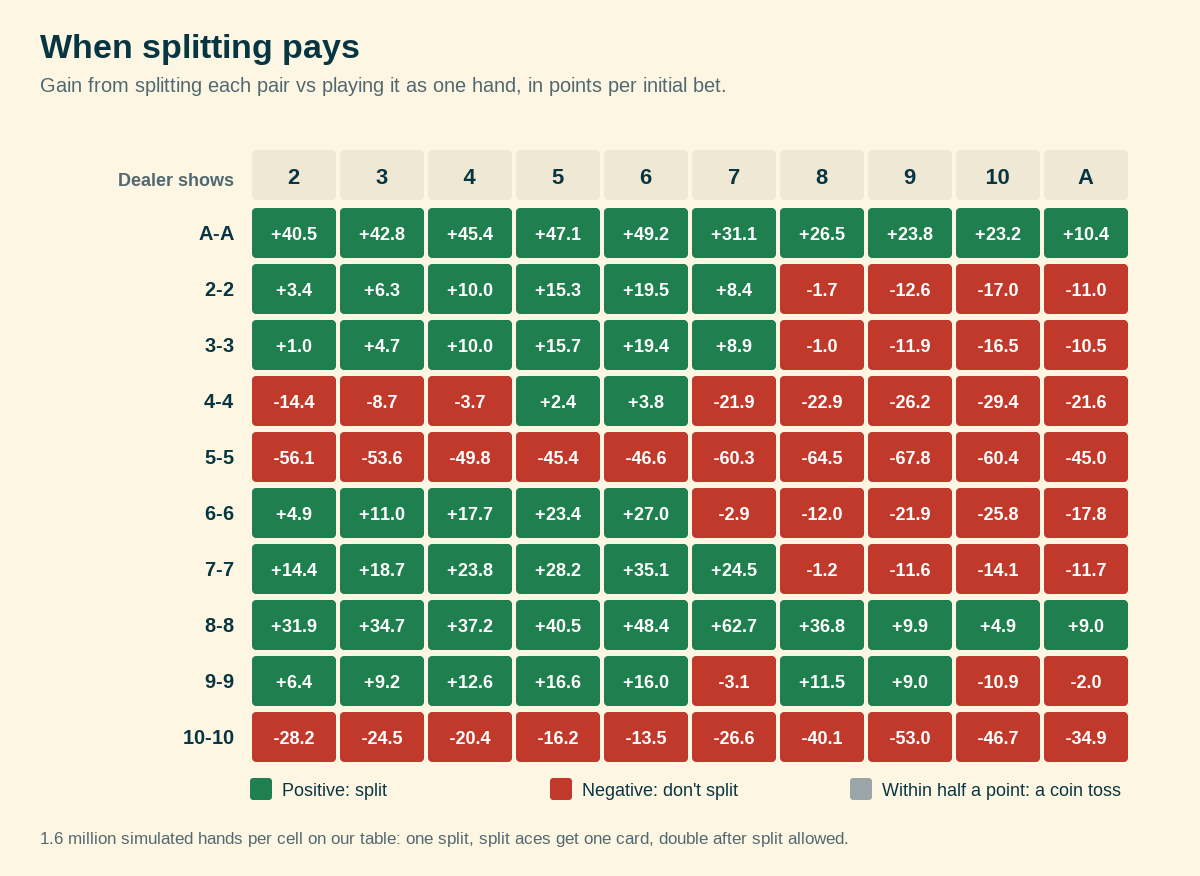
The pattern behind the chart:
- Always split aces. Two aces are a soft 12. Split, each ace is a fresh start where any 10-value card makes 21. Against a dealer 6 the split was worth +68.1% of the bet, against +18.8% for hitting the 12. Even against a dealer ace, splitting lost 22.4% instead of 32.6%.
- Always split 8s. Sixteen is the worst total you can hold. Against a dealer 6, splitting turned a hand worth −15.8% (standing) into one worth +32.9%. Against a 10 or an ace you still lose on average, but less: −52.3% against −57.1% for hitting 16 versus a 10.
- Never split 10s. A 20 wins most of the time. Against a dealer 6, standing was worth +70.3% and splitting +56.7%; against a 10, standing +43.8% and splitting −3.1%.
- Never split 5s. Two 5s are a hard 10, a doubling hand. Against a dealer 6, doubling was worth +60.0% and splitting only +13.7%.
- Split 9s against 2-6, 8 and 9, but stand against 7, 10 and ace. Against a 7, your 18 already beats the dealer’s most likely 17: standing +39.9%, splitting +36.8%.
- The small pairs (2s, 3s, 6s, 7s, 4s) split against weak dealer cards. These splits lean on doubling after the split: a split 4 that catches a 7 becomes an 11 you can double.
Our table allows one split, so if a split hand draws another pair, play it as a normal total. Splitting happened in about 2.5% of hands when we played basic strategy, and aces in 0.54%. Each split ace made 21 about 31% of the time, paid 1:1.
Double down: rules and when to do it
Doubling down means doubling your bet after the first two cards, taking exactly one more card, and standing. You give up the right to hit again in exchange for twice the money on a hand that is likely to win.
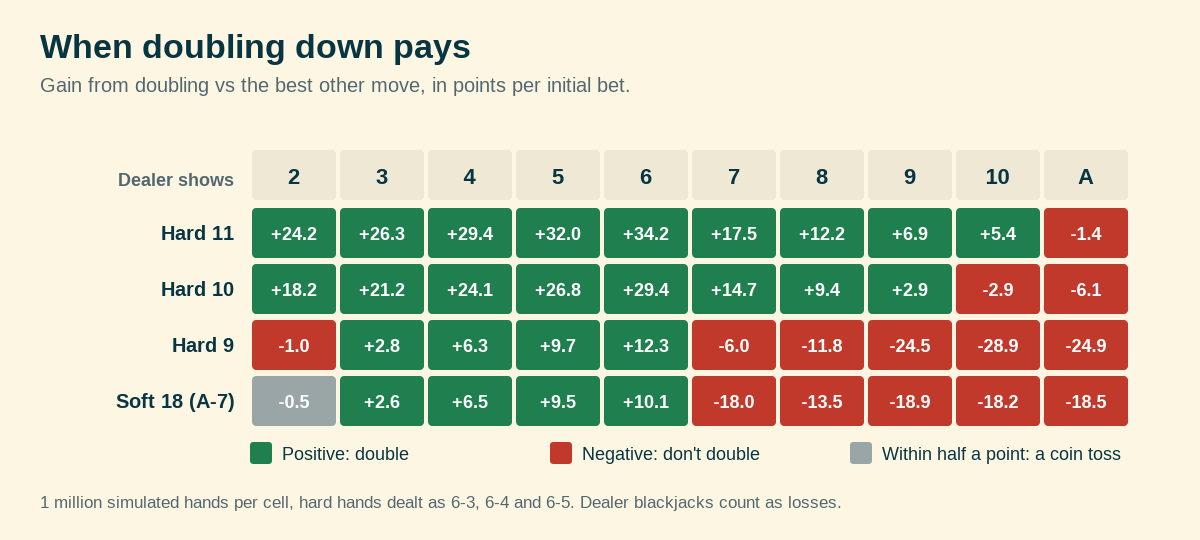
- Hard 11: double against 2 through 10. Against a dealer 6, doubling 11 was worth +68.2% of the original bet, twice the +34.0% from just hitting. Against a 10 the gain shrinks but stays positive (+8.5% against +3.1%). Against an ace, hitting is slightly better.
- Hard 10: double against 2 through 9. Against a 10 or an ace, the dealer is too strong; just hit.
- Hard 9: double against 3 through 6. Against a 2 it was close, and hitting came out 1 point ahead.
- Soft hands double against the weakest dealer cards. Soft 18 (ace-7) doubles against 3-6, stands against 2, 7 and 8, and hits against 9, 10 and ace. Our basic strategy chart lists the full soft-hand rows.
Playing basic strategy, about 10.2% of hands ended up doubled, and 55.1% of those were won. Doubles don’t win much more often than other hands. They win more money because the bet is twice as large exactly when the odds are best.
Split vs double down
The two moves compete only when you hold a pair. Two 5s are the clearest case: as one hand they are a 10 to double; split, they are two weak starts on 5. Two 4s are a hard 8, which you hit, except against a dealer 5 or 6 where splitting wins. For any pair the order is the same: check the pair rule first, and if it says don’t split, play the total from the hard chart, doubling included.
Blackjack insurance: is it worth it?
When the dealer shows an ace, you are offered insurance before anything else happens. It is a side bet of half your stake that the dealer’s face-down card is a 10. If it is, the dealer has blackjack, insurance pays 2 to 1, and that covers the main bet you just lost. If not, you lose the insurance and the hand goes on.
Paying 2:1, the bet needs the hole card to be a 10 more than one time in three. A 6-deck shoe holds 96 ten-value cards in 312, and with the dealer’s ace and your two cards out, the chance is about 31%:
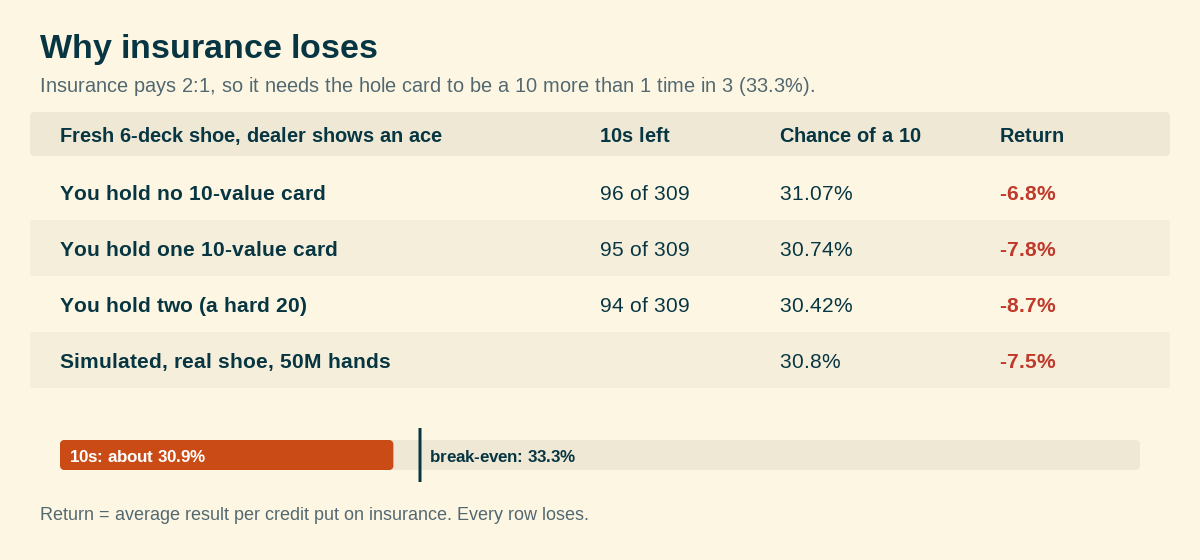
So insurance loses 6.8% to 8.7% of whatever you put on it, more when you hold 10s yourself. In our simulations the hole card was a 10 in 30.8% of insurance offers, a loss of 7.5% per credit insured. Insurance came up in 7.7% of hands (one in 13, the share of aces), and always taking it raised the house edge by about 0.29 points.
Even money is the same bet in disguise. With a blackjack against a dealer ace, insuring it guarantees a 1:1 win whatever the hole card. Declining pays 3:2 when the dealer has no blackjack (69.3% of the time) and pushes otherwise. That averages 1.039 bets against exactly 1, so declining is worth almost 4% more of your bet. Our table offers insurance on your blackjack too; basic strategy turns it down.
The exception is card counting. When the shoe is rich enough in 10s, insurance becomes a good bet, and our card counting guide uses it at a Hi-Lo true count of +3 or higher. Without a count, skip it.
What each move is worth
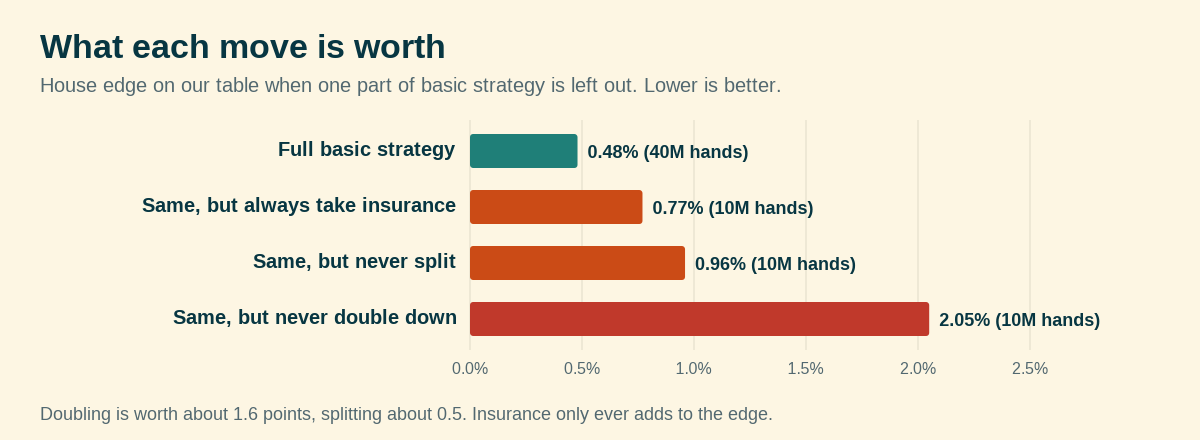
We played the whole game through the same rules code with the real shoe, leaving out one part of basic strategy at a time.
| How you play | House edge |
|---|---|
| Full basic strategy | about 0.48% |
| Basic strategy, but always insure | 0.77% |
| Basic strategy, but never split | 0.96% |
| Basic strategy, but never double down | 2.05% |
Doubling is worth about 1.6 points, more than any other single part of the chart. Splitting is worth about half a point, because pairs come up less often (13.8% of hands) and only some should be split. Insurance only ever adds to the edge. Together with the 3:2 blackjack, splits and doubles are what pull the game down from the 5.7% you’d pay by copying the dealer to under half a percent; our house edge guide compares that with every other game on the site.
The hardest hand: 16 against a 10
Hard 16 against a dealer 10 is the hand where many players freeze. Our simulation shows why: it loses whatever you do. Hitting lost 57.1% of the bet and standing 57.7%, over 4 million hands each. The chart says hit, and it is right, but by less than one point. If your 16 is a pair of 8s, split them: at −52.3% it is the least bad of the three.
Practice for free
Our free blackjack table runs exactly the rules above, with 1,000 virtual credits to start and free refills. Credits can’t be bought, cashed out or exchanged for prizes. Blackjack is for adults (18+). With real money, even perfect splits and doubles leave the house a small edge, and gambling may be illegal where you live. For a casino card game with no decisions at all, see our baccarat strategy guide.
Frequently asked questions
What are the split rules in blackjack?
When your first two cards have the same value, you can split them into two hands and put a second bet, equal to the first, on the new hand. Each hand then gets a second card and is played on its own. On our table you can split once, any two 10-value cards count as a pair, split aces get one card each, and a 21 made after a split pays 1:1, not 3:2.
Should you always split aces and 8s?
Yes. In our simulation, splitting aces against a dealer 6 was worth +68% of the bet against +19% for hitting the soft 12. Splitting 8s against a 10 still loses, but 52% of the bet instead of 57% for hitting or standing on 16.
Should you split 10s in blackjack?
No. Twenty wins most of the time. Against a dealer 6, standing on 20 was worth +70.3% of the bet and splitting +56.7%. Against a 10 the gap was much larger: +43.8% for standing, -3.1% for splitting.
What does double down mean in blackjack?
You double your bet after seeing your first two cards, take exactly one more card, and stand. It pays when you are likely to end with a strong total and the dealer is weak, mainly on hard 10 and 11. On our table you can double any first two cards, also after a split.
Is blackjack insurance worth it?
No, unless you are counting cards. Insurance pays 2:1, so it breaks even only if more than a third of the remaining cards are 10s. In a 6-deck shoe it's about 31%, so insurance loses roughly 7 to 9% of the amount you insure. Always taking it raised our table's house edge from about 0.48% to 0.77%.
Should you take even money with a blackjack?
No. Even money is insurance taken on a blackjack: you get a sure 1:1 instead of 3:2. Declining earns 1.5 times the bet about 69% of the time, worth 1.039 bets on average, against exactly 1 for even money.