Poker Pot Odds and Outs: Formula and Chart
Pot odds tell you how often a call has to win to pay for itself. Divide the amount you must call by the pot you will have after calling: facing a 50 bet into a 100 pot, you call 50 to make the pot 200, so you need to win 25% of the time. Then you count your outs, turn them into a percentage, and compare the two numbers. This guide gives the formula, a cheat sheet by bet size, a full outs to percentage chart, and the cases where counting outs goes wrong. Every figure was calculated exactly or dealt out card by card with the hand evaluator of our free Texas Hold’em table.
If you are new to the game, read our Texas Hold’em rules for beginners first. It has a shorter odds chart for the common draws; this page goes further into using those odds.
The pot odds formula
Pot odds can be written two ways. Both say the same thing.
- As a ratio: what you can win to what you must put in. With 100 in the pot and a bet of 50, there are 150 to win for a call of 50: 3 to 1.
- As a percentage: your call divided by the pot after your call. 50 ÷ (100 + 50 + 50) = 25%.
To turn a ratio into the break-even percentage, add the two sides and divide: 3 to 1 means 1 ÷ (3 + 1) = 25%. The percentage is the more useful form, because your chance of winning is usually a percentage too.
One common mistake is to leave out your own call or the opponent’s bet. The pot you are playing for includes both.
Pot odds cheat sheet
You rarely need to do the sum at the table, because bets come in a few standard sizes. If the bet is b and the pot before it is P, you need b ÷ (P + 2b) equity:
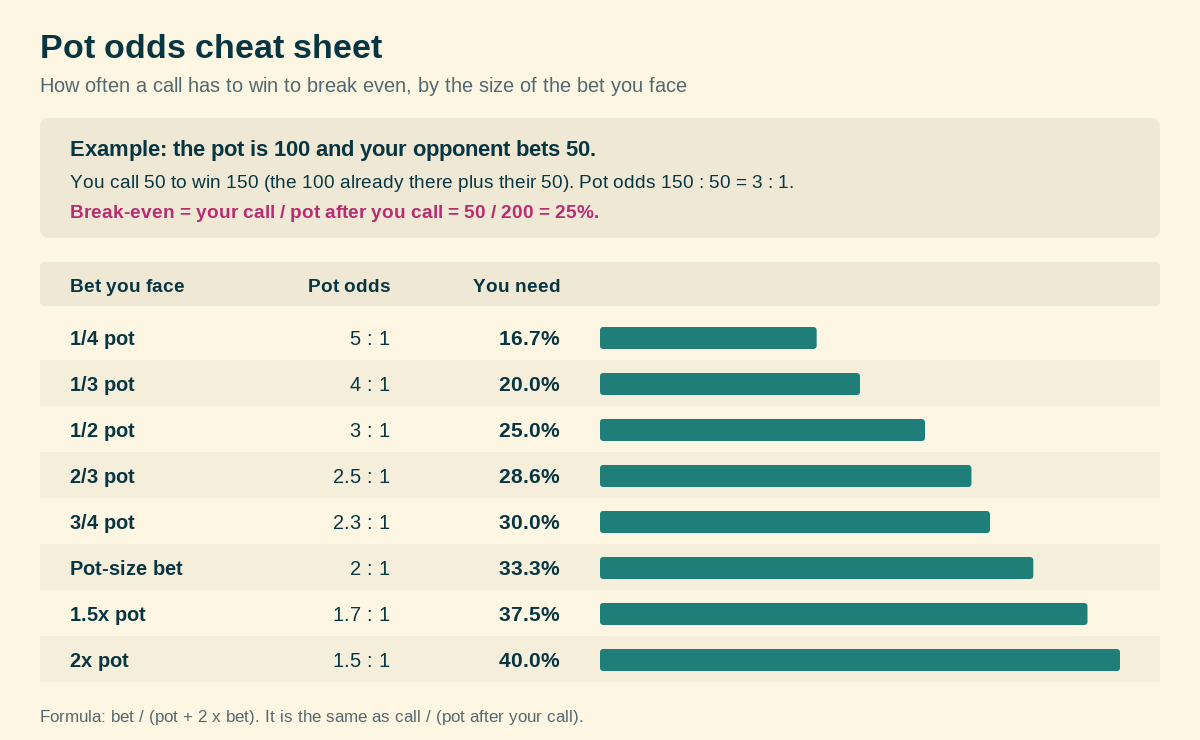
Two sizes are worth knowing by heart: half pot needs 25% and pot-size needs 33.3%. Notice that the requirement rises slowly. Doubling a bet from half pot to full pot doesn’t double what you need; it moves it from 25% to 33%. Even an overbet of twice the pot asks for only 40%.
Outs: from cards to a percentage
An out is an unseen card that makes your hand the best one. After the flop you can see five cards (your two plus three on the board), so 47 are unseen. After the turn, 46.
Common counts: a flush draw has 9 outs, an open-ended straight draw 8, an inside straight draw (gutshot) 4, two overcards to a pair 6, and a pocket pair hoping for a set 2.
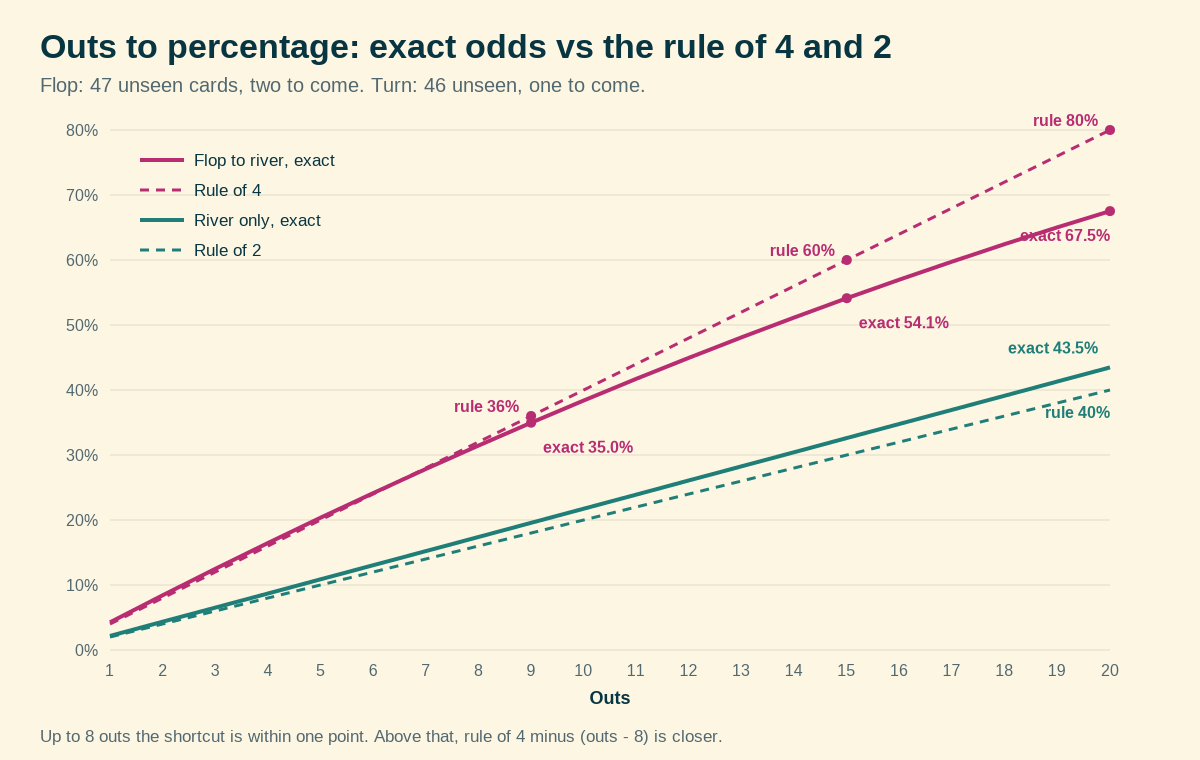
The exact chance of hitting from the flop is 1 − C(47 − outs, 2) ÷ C(47, 2), which is just the chance that neither the turn nor the river is an out, taken away from 1. From the turn it is simply outs ÷ 46. The rule of 4 and 2 approximates both: outs × 4 on the flop, outs × 2 on the turn.
| Outs | Flop to river (exact) | Rule of 4 | Turn to river (exact) | Rule of 2 |
|---|---|---|---|---|
| 2 | 8.4% | 8% | 4.3% | 4% |
| 4 | 16.5% | 16% | 8.7% | 8% |
| 6 | 24.1% | 24% | 13.0% | 12% |
| 8 | 31.5% | 32% | 17.4% | 16% |
| 9 | 35.0% | 36% | 19.6% | 18% |
| 12 | 45.0% | 48% | 26.1% | 24% |
| 15 | 54.1% | 60% | 32.6% | 30% |
| 20 | 67.5% | 80% | 43.5% | 40% |
The rule of 4 counts a card that hits on both the turn and the river twice, and the double counting grows with the number of outs. A simple fix: above 8 outs, take away (outs − 8). For 15 outs that gives 60 − 7 = 53%, one point from the exact 54.1%; for 20 outs, 68% against 67.5%.
There is a second catch. The flop-to-river figure assumes you see both cards for one price, which is only true when you or your opponent is all-in. If you call a bet on the flop and expect another bet on the turn, compare the flop price with the one-card figure instead: 9 outs hit on the turn only 19.1% of the time.
Pot odds vs equity
Equity is your share of the pot if all the cards are dealt and nobody folds. Pot odds are the price. The decision is a comparison:
- Equity higher than the pot odds require: calling wins chips in the long run.
- Equity lower: calling loses chips in the long run, unless you expect to win more later (implied odds, below).
A worked example. On the turn, the pot is 100 and your opponent bets 50. You hold a flush draw, which wins 19.6% on the river. A half-pot bet needs 25%, so the call loses on its own: you win 150 about 19.6% of the time and lose 50 about 80.4% of the time, an average of −10.9 chips a call. Against a bet of 25, which needs 16.7%, the same draw is a profitable call.
Clean outs and dirty outs
Counting outs assumes each out wins and every other card loses. Real hands are messier. We took six draws, gave the opponent a known hand, and dealt all 990 possible turn and river pairs through the game’s evaluator:
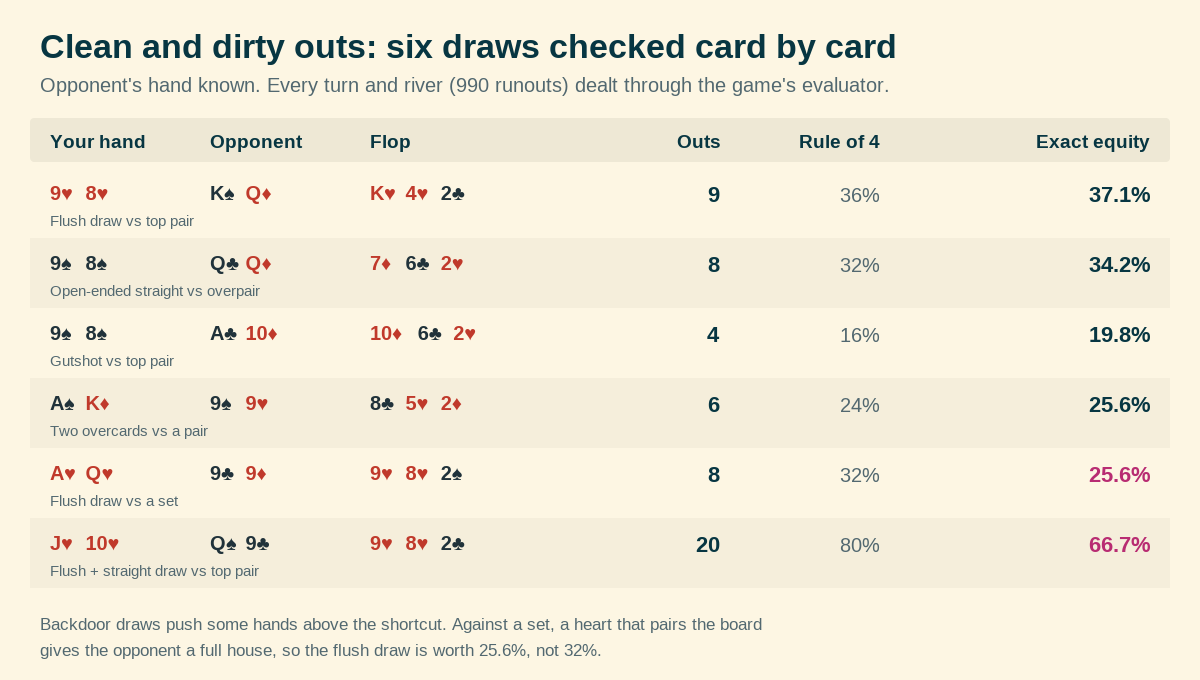
Three lessons come out of the table:
- Backdoor draws add a little. The 9♥ 8♥ flush draw against top pair wins 37.1%, above both the rule of 4 (36%) and the clean formula (35.0%). Running pairs, two pair and runner-runner straights win some extra pots. The gutshot gains even more, 19.8% against a formula figure of 16.5%.
- Some outs are dirty. A♥ Q♥ against a set of nines on 9♥ 8♥ 2♠ looks like a flush draw with 9 outs. But the 2♥ pairs the board and gives the set a full house, so only 8 hearts are outs. Even after a heart on the turn, any river that pairs the board still gives the set a full house. The real figure is 25.6%, not 32%.
- Big combo draws are favorites. J♥ 10♥ on 9♥ 8♥ 2♣ has 20 cards that put it ahead on the turn. It wins 66.7% against top pair, which makes it a hand to bet, not just call with.
When you suspect your opponent holds a set or a bigger draw, discount your outs. A common habit is to count only the cards you are confident about.
Implied odds
Pot odds use the chips in the pot now. Implied odds add the chips you expect to win later when you hit. They matter most for draws that are well hidden, such as a gutshot, and least for obvious ones, such as a fourth card of one suit on the board.
The question to ask: how much more would I need to win on the river to make this call break even? On the turn, with a pot of 100 and a bet you must call:
| Outs | Facing 50 (need 25%) | Facing 100 (need 33.3%) |
|---|---|---|
| 4 (gutshot) | 375 more | 850 more |
| 6 | 183 more | 467 more |
| 8 (open-ended) | 88 more | 275 more |
| 9 (flush draw) | 56 more | 211 more |
| 12 | none needed | 83 more |
| 15 | none needed | 7 more |
A flush draw facing a half-pot bet needs to win about 56 more on average once it hits, which is realistic against an opponent with a strong hand. A gutshot facing a pot-size bet needs 850 more, more than eight times the current pot. That rarely happens.
The opposite effect is called reverse implied odds: when you hit and still lose a big pot, for example making a small flush against a bigger one. It is the reason weak draws are worth less than their out count suggests.
How our computer players use pot odds
The three bots at our table follow this logic, and the game’s code shows exactly how. After the flop each bot estimates its chance of winning by dealing out the unknown cards a few hundred times, assuming every opponent holds a random hand. When facing a bet, it compares that estimate with the pot odds and calls only if it clears them by 4 points (against small bets a fairly good hand is also enough). It also lowers its estimate when the bet is large, by up to 18 points, because a big bet usually means a strong hand.
We gave the balanced bot (the Center seat) three draws on the flop and let it decide 2,000 times at each bet size into a pot of 100:
| Bet faced | Pot odds need | Flush draw (7♥ 6♥) calls | Open-ended (9♠ 8♠) calls | Gutshot (9♠ 8♠) calls |
|---|---|---|---|---|
| 30 | 18.8% | 100% | 100% | 100% |
| 50 | 25.0% | 100% | 100% | 97% |
| 75 | 30.0% | 99.8% | 99% | 16% |
| 100 | 33.3% | 67% | 52.5% | 0.1% |
| 150 | 37.5% | 0.1% | 0% | 0% |
The bot’s estimate against a random hand was 50.6% for the flush draw, 49.4% for the straight draw and 40.0% for the gutshot. Those are higher than the equity against a hand that is actually betting, which is why the code adds the margins. The pattern is clear in practice: small bets keep the bots in the hand with their draws, and bets of more than the pot push draws out. Bots also raise now and then, so expect the odd surprise.
Practice on our table
Pot odds become automatic with repetition. At our Texas Hold’em table, try a simple drill: before every call, say the pot odds and your outs out loud, then check how often your draws come in over a few dozen hands. For when to get involved in the first place, see our Texas Hold’em strategy tips, which ranks all 169 starting hands, and keep the poker hand rankings handy if you are still learning which hand beats which.
Chips and credits on this site are virtual. They can’t be bought, cashed out or exchanged for prizes, so playing here isn’t gambling. The game is for adults (18+). Real-money poker is gambling and may be illegal where you live.
Frequently asked questions
What is the pot odds formula?
Divide the amount you have to call by the total pot after your call. If the pot is 100 and you face a bet of 50, you call 50 into a final pot of 200: 50 ÷ 200 = 25%. Your hand has to win at least 25% of the time for the call to break even. As a ratio, the same spot is 150 to 50, or 3 to 1.
How do you convert outs to a percentage?
Exactly: on the flop, the chance of hitting by the river is 1 − C(47 − outs, 2) ÷ C(47, 2); on the turn it is outs ÷ 46. As a shortcut, multiply your outs by 4 on the flop and by 2 on the turn. Above 8 outs, take away (outs − 8) from the rule-of-4 answer to stay close to the exact figure.
Is the rule of 2 and 4 accurate?
Close enough for small draws. For 4 outs it gives 16% against an exact 16.5%; for 9 outs 36% against 35.0%. It overstates big draws: 15 outs gives 60% against 54.1%, and 20 outs 80% against 67.5%. The rule of 2 slightly understates: 9 outs on the river is 19.6%, not 18%.
What is the difference between pot odds and equity?
Pot odds are the price: the share of the final pot you are putting in. Equity is your hand's share of the pot if all the cards are dealt out. You compare them. A call is profitable in the long run when your equity is higher than the pot odds require.
What are implied odds in poker?
Implied odds count the chips you expect to win on later streets when you hit, not only what is in the pot now. If the direct pot odds are slightly too short for a draw, a call can still pay off when the opponent is likely to put more chips in after you make your hand. They are an estimate, not a fixed number.
How many outs does a flush draw have?
Nine: 13 cards of the suit minus the 4 you can see. It completes 35.0% of the time from the flop and 19.6% with one card to come. Some of those 9 can be worthless if they also pair the board against a set, or give an opponent a bigger flush.