Texas Hold'em Strategy Tips for Beginners
The best Texas Hold’em strategy for beginners fits in one sentence: play fewer hands, play them aggressively, and play more of them when you act last. The rest is detail. This guide backs each tip with numbers from our free Texas Hold’em table: all 169 starting hands dealt out 100,000 times each through the game’s hand evaluator, at one, two and three opponents, and 240,000 hands of the game’s computer players against each other to measure what position is worth.
It assumes you know the rules. If not, start with our Texas Hold’em rules for beginners, and keep the poker hand rankings chart nearby.
Tip 1: Choose your starting hands
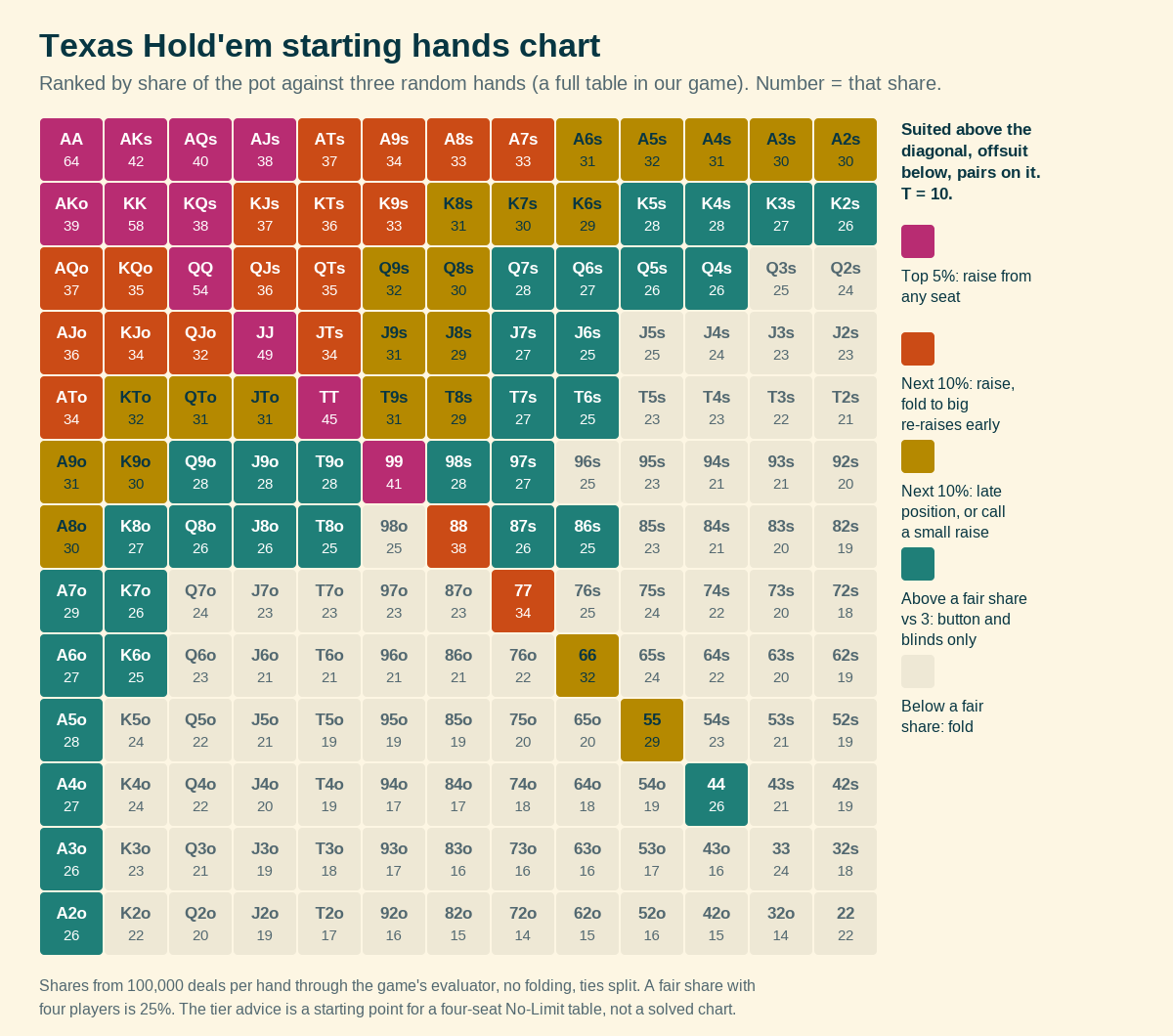
Most chips are lost before the flop, by playing hands that can’t win often enough. There are 1,326 ways to be dealt two cards, which group into 169 types: 13 pairs, 78 suited hands and 78 offsuit hands. We dealt each type against random hands, with nobody folding, and recorded the share of the pot it won (ties split).
With four players at the table, a fair share is 25%. A hand that wins less than that at showdown loses money in the long run unless folds, bluffs or position make up the difference. Against three opponents, only 83 of the 169 types win more than 25%, and they cover 43.6% of all deals. That alone says you should fold more than half your hands.
Preflop hands ranked: the top 20
| Rank | Hand | vs 1 opponent | vs 2 | vs 3 |
|---|---|---|---|---|
| 1 | A-A | 85.3% | 73.3% | 64.0% |
| 2 | K-K | 82.4% | 68.8% | 58.4% |
| 3 | Q-Q | 79.9% | 64.9% | 53.7% |
| 4 | J-J | 77.6% | 61.4% | 48.9% |
| 5 | 10-10 | 75.2% | 57.5% | 45.3% |
| 6 | A-K suited | 67.0% | 50.8% | 41.5% |
| 7 | 9-9 | 72.1% | 53.6% | 41.2% |
| 8 | A-Q suited | 66.2% | 49.3% | 40.1% |
| 9 | A-K offsuit | 65.4% | 48.1% | 38.6% |
| 10 | K-Q suited | 63.4% | 47.5% | 38.3% |
| 11 | A-J suited | 65.4% | 48.1% | 38.2% |
| 12 | 8-8 | 69.0% | 50.1% | 37.7% |
| 13 | A-10 suited | 64.5% | 47.2% | 37.0% |
| 14 | A-Q offsuit | 64.6% | 46.8% | 36.7% |
| 15 | K-J suited | 62.6% | 45.9% | 36.6% |
| 16 | K-10 suited | 61.6% | 45.0% | 35.8% |
| 17 | Q-J suited | 60.3% | 44.0% | 35.8% |
| 18 | A-J offsuit | 63.5% | 45.3% | 35.5% |
| 19 | K-Q offsuit | 61.4% | 44.4% | 35.1% |
| 20 | Q-10 suited | 59.7% | 43.3% | 34.6% |
The ranking is by the three-opponent column, since that is a full table in our game. The worst hand of all is 3-2 offsuit: 32.4% heads-up and 13.9% against three. To check the simulation a second way, we ran a dozen hands through the computer players’ own win-chance function as well; the two methods agreed within 0.5 points.
More opponents, different hands
The order changes as more players stay in. Against several opponents you usually need a strong hand to win, and one pair often isn’t enough.
- Small pairs fall. 4-4 ranks 47th heads-up and 73rd against three; 2-2 drops from 87th to 113th. They win showdowns against one player and lose them against several.
- Weak offsuit aces and kings fall. K-3 offsuit slides 31 places, from 77th to 108th.
- Suited connectors climb. 6-5 suited rises from 127th to 93rd, 7-6 suited from 117th to 84th, 8-7 suited from 100th to 69th. They rarely win a small pot, but they make straights and flushes that win big multiway pots.
Being suited is worth about 2.7 points of equity heads-up and 3.8 points against three opponents. That is enough to make K-Q suited a better hand than A-J offsuit at a full table, but not enough to save rags: 8-3 suited still wins only 19.7% against three.
Small pairs deserve a note. Their showdown share is low, but a pocket pair flops three of a kind 11.8% of the time, and a set often wins a big pot. That is why they are worth a cheap call and not worth a big one. Our pot odds and outs guide shows how to work out whether a call is cheap enough.
Tip 2: Play more hands in late position
Position is where you sit relative to the dealer button. After the flop the button acts last, and acting last is an advantage: you see whether everyone checked or bet before you decide. You can take a free card with a draw, bet when others show weakness, and keep the pot small with a medium hand. That is why the standard advice is to play your widest range on the button and your tightest in early position and in the blinds.
At our four-seat table the seats are the button, the small blind, the big blind and the player to the left of the big blind, who acts first before the flop. We let the game’s three bot personalities plus a fourth bot play 240,000 hands against each other, resetting every stack to 1,000 chips (50 big blinds) before each hand, and recorded the result by seat:
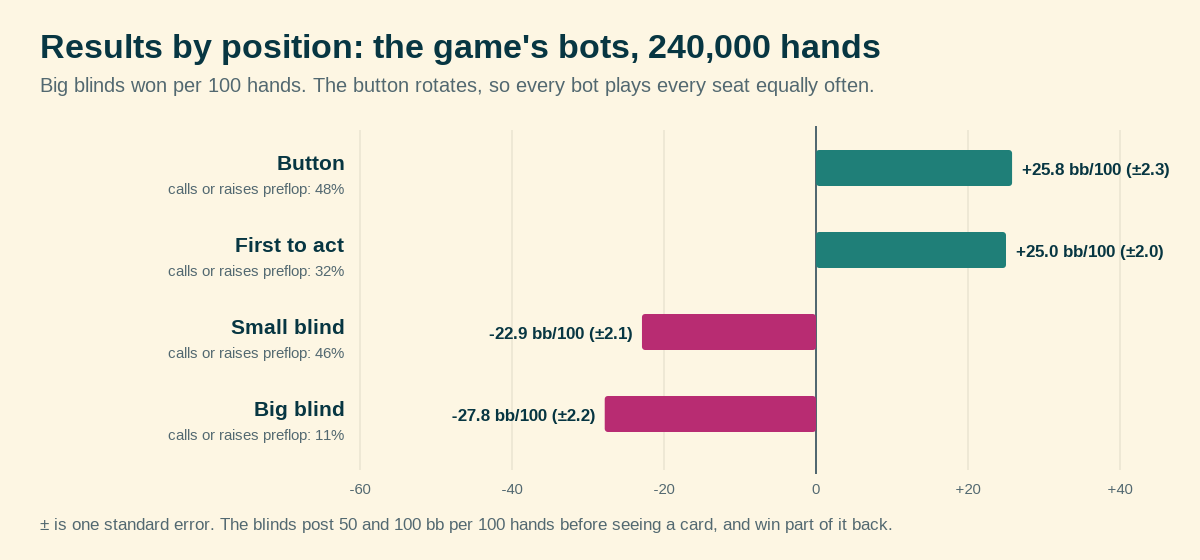
The button and the first seat won about 25 big blinds per 100 hands each, and the blinds lost 23 and 28. Part of that is simple bookkeeping: the small blind posts 50 big blinds per 100 hands and the big blind 100, before seeing a card, so both blinds actually won back a good share of their forced bets. Losing chips in the blinds is normal; the aim is to lose as few as possible there. From the blinds you act first after the flop, so call raises with hands that play well, not with any two cards just because some of your chips are already in the pot.
One honest caveat. Our bots use position only before the flop, where the button plays slightly looser. After the flop their code ignores it. So we also measured position directly: in 80,245 hands where exactly two bots saw the flop, the one acting last won 51.8% of the chips that were in the pot on the flop, give or take 1.4 points. That is a small edge, because these bots don’t use the extra information they get by acting last. A human who does use it, checking behind for free cards and betting when the bot checks, gets more out of the button than the bots do.
Tip 3: Raise or fold, don’t just call
When you play a hand before the flop, raise with it instead of calling the big blind. A raise does two jobs. It can win the blinds right away when everyone folds, and it thins the field, which our numbers show helps strong hands: aces win 85.3% against one opponent but 64.0% against three. Calling with a medium hand invites everyone in and leaves you guessing after the flop.
The usual opening size is two and a half to three big blinds, 50 to 60 at our 10/20 table, plus one big blind for each player who already called.
Tip 4: Let the price decide your calls
After the flop, count your outs and compare them with the pot odds before calling. Facing a half-pot bet you need to win 25% of the time; facing a pot-size bet, 33.3%. A flush draw hits 35.0% of the time from the flop to the river but only 19.6% on the river alone, so the same draw can be a good call on the flop and a bad one on the turn. Our pot odds and outs guide has the full chart.
Tip 5: Don’t fall in love with one pair
With seven cards, one pair is the most common final hand, and two pair or better shows up about 39% of the time. Against two or three opponents, a hand like top pair with a weak kicker is often second best by the river. Bet it for value when the board is dry, but slow down when the board pairs, shows three or four cards of one suit, or fills in a straight.
Playing against our computer players
The bots at our table follow fixed rules in their code, and knowing them helps:
- Before the flop they score their hand with a simple formula and play a little looser on the button. The Left seat plays tight, the Right seat loose, and the Center seat in between.
- After the flop they estimate their chances against random hands and compare them with the pot odds, with a margin that grows with the bet. In our tests a bot holding a flush draw called a half-pot bet every time and folded to a bet of one and a half times the pot 99.9% of the time.
- They bluff a little, from 3% to 10% of the time depending on the seat, and they don’t remember how you played earlier hands.
So value bets get paid by draws when they are small, and big bets push draws out. The bots don’t play like strong human players, so treat the table as practice for the fundamentals, not for reading people.
Keep your bankroll and your head
Even good decisions lose often in the short run. A hand that wins 80% of the time still loses one time in five. Set a limit before you sit down, and stop when you notice yourself calling because you are annoyed rather than because the price is right. Our bankroll management guide explains how bet size affects how long a stack lasts.
Practice for free
Open our Texas Hold’em table and try one change at a time: first fold everything outside the top tiers of the chart, then add hands on the button. Chips and credits on this site are virtual. They can’t be bought, cashed out or exchanged for prizes, so playing here isn’t gambling. The game is for adults (18+). Real-money poker is gambling and may be illegal where you live.
Frequently asked questions
What is the best Texas Hold'em strategy for beginners?
Play fewer hands, and play them aggressively. Fold most hands before the flop, raise with the ones you keep instead of just calling, play more hands on the button than in early position, and compare the pot odds with your chance of winning before you call a bet.
What are the best starting hands in Texas Hold'em?
Against three random hands, the top ten in our simulation were A-A, K-K, Q-Q, J-J, 10-10, A-K suited, 9-9, A-Q suited, A-K offsuit and K-Q suited. Heads-up the order shifts a little toward pairs: 9-9, 8-8 and 7-7 all rank above A-K offsuit.
What is the worst starting hand in Texas Hold'em?
3-2 offsuit. It wins 32.4% against one random hand and 13.9% against three in our simulation. 7-2 offsuit has the worst reputation, since its two cards can never work together in a straight or a flush, but at 34.5% against one opponent it does a little better than 3-2, 4-2 and 6-2 offsuit.
Why does position matter in poker?
Acting last lets you see what everyone else did before you decide. You can bet when others show weakness, check behind to see a free card, and fold cheaply when someone shows strength. At our table, over 240,000 hands of the bots playing each other, the button won about 26 big blinds per 100 hands and the big blind lost about 28.
Should I play suited cards?
Suited cards are slightly better than the same cards offsuit, about 2.7 points of equity against one opponent and 3.8 against three. That makes K-Q or J-10 suited clearly playable. It doesn't rescue hands like 8-3 or 9-2: suited, they still win less than a fair share against three opponents.
Is it worth playing small pocket pairs?
Often, but for a specific reason. If everyone goes to showdown, a pair of 2s or 3s wins less than a fair share against three opponents, and 4s and 5s only a little more. Its value comes from flopping a set, which happens 11.8% of the time, and then winning a big pot. Play them cheaply, and fold them if you face a big raise.